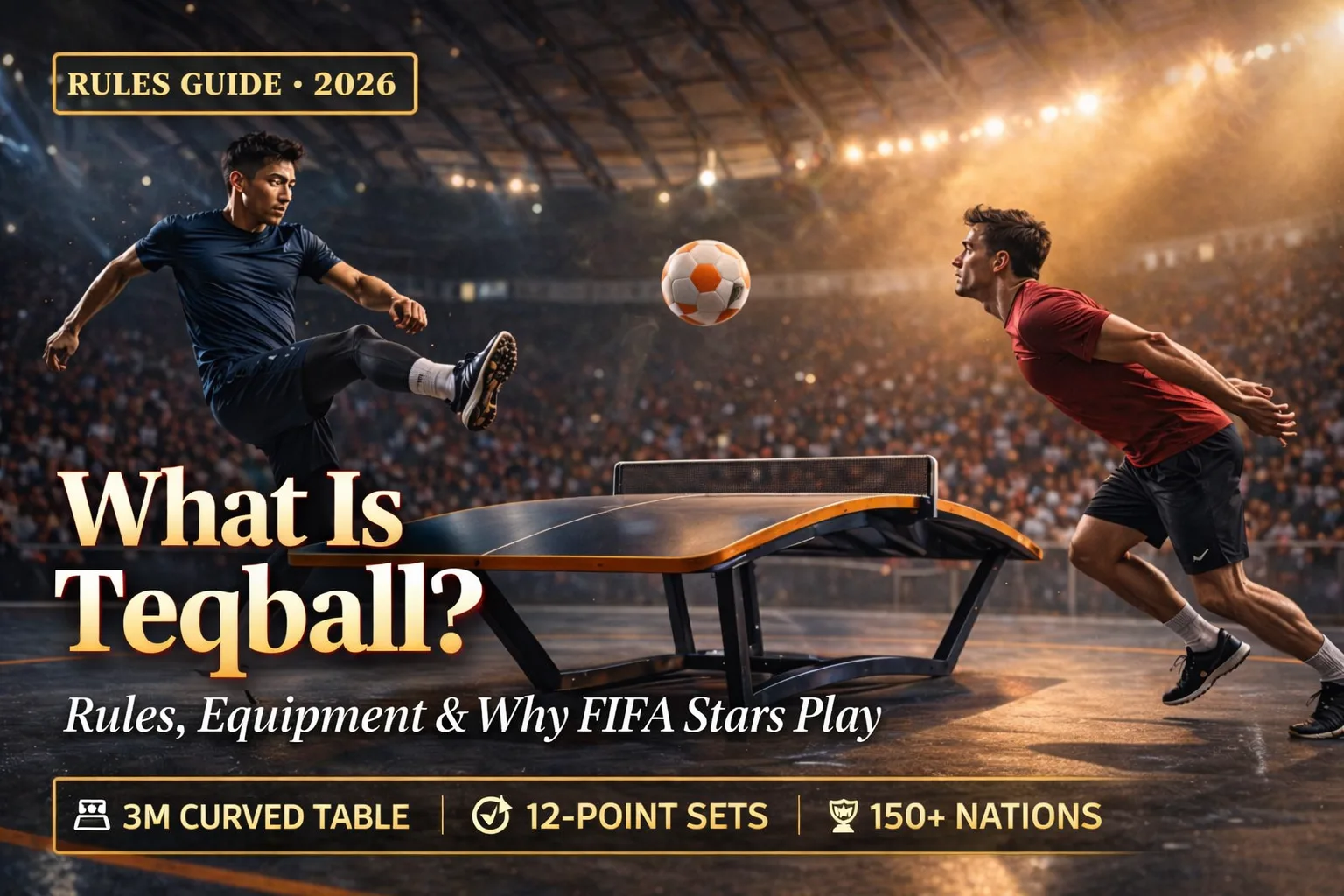
1.7 meters wide, 3 meters long, curved like a skate ramp in the middle. That's the teqball table — and what is teqball rules, exactly? The short answer: football-meets-table-tennis on a patented curved surface, where the ball can never touch hands, the same body part can't touch twice in a row, and players can't touch each other. In 2014, three Hungarians built this sport in a Budapest garage. A decade later, Ronaldinho, Neymar, David Beckham, and Marcelo have all been photographed playing it, FITEQ has 150+ member nations, and the IOC is reviewing Olympic inclusion for Brisbane 2032.
This guide covers everything a beginner needs. Table dimensions and cost tiers. The scoring math — 12 points per set, best of three. The three-touch rule that humbles football stars. And FITEQ's May 2026 rule changes that rewrite serve rotation. By the end, you'll know what is teqball rules well enough to set up your own table, referee a casual match, or explain to your friend why Beckham keeps posting teqball clips.
Key Takeaways
- The Zero-Contact Code: Teqball forbids opponent contact AND consecutive same-body-part touches — two rules that force constant rotation and reward technique over physicality.
- Scoring: 12 points wins a set. Best of three sets wins a match. Service rotates every 2 points under FITEQ's 2026 rules (was every 4 pre-May 2026).
- The Three-Touch Rule: Each player gets max 3 touches per possession — and can't use the same body part twice in a row. Doubles teams get 3 total touches with mandatory teammate pass.
- Table standard: 3m long × 1.7m wide × 0.76m curve height × 14cm net. Prices range from $1,200 (TEQ LITE) to $3,999 (TEQ ONE competitive).
- Global scale: 2025 World Championships in Romania featured 41 nations + 165 athletes. Thailand's Jutatip Kanthong took double gold for a second straight year.
What Are Teqball Rules? The Zero-Contact Code in 60 Seconds
Teqball is a 2v2 or 1v1 sport played on a curved table. Players use any body part except hands and arms to volley a size-5 football back and forth. The rules are simple enough to grasp in a minute but deep enough to reward years of practice.
Here's the absolute minimum you need. The ball can touch the table only during a legal serve, a successful return, or between teammate passes in doubles. Hit the opponent, touch them, or even lean into their side of the table, and you lose the rally. Use the same body part twice in a row and you lose the rally. Take more than three touches before returning the ball, and you lose the rally.
That's the Zero-Contact Code at the heart of what is teqball rules. Two layers of no-contact: between players, and between consecutive same-body-part touches. Physical dominance means nothing. A 5-foot-6 technical player can beat a 6-foot-4 athlete every time, because brute force has nowhere to land. FITEQ Chairman Dr. Viktor Huszár has called this the sport's "equalizer principle," and it's exactly why elite football players take to it so naturally.
The Teqball Table: 3 Meters of Patented Geometry
You can't play teqball on a ping-pong table. The curve is the entire point. Gábor Borsányi, the Hungarian ex-footballer who co-invented the sport in 2014, started by playing football across a flat table tennis surface. The ball died on every bounce. A curved surface, Borsányi realized, would force the ball to roll back toward the striking player's feet — creating the physics that make rallies possible.
FITEQ certifies three official table tiers. The TEQ LITE is fiberglass-reinforced polyester and foldable. It sells for $1,200-$1,500 on Amazon and specialty soccer retailers. It's built for recreational play and school PE programs. The TEQ SMART adds gas-spring wheels, weatherproofing, and competition-grade laminate at $2,500. The TEQ ONE is the fixed-structure pro-tour table, same laminate quality as the SMART but bolted to a steel base for tournament play; it runs $3,999.
TEQ™ X is FITEQ's newest offering — same iconic curve and structure as the TEQ ONE but at a lower price point, designed to bring competition-grade geometry to non-pro clubs. Whatever table you buy, the ball standard is the same: a regulation size-5 football, inflated to FIFA match pressure.
"The teqball table's curve is the single most important innovation. It's what turns a flat volley into a skill-based rally where every touch has to land inside a 3-meter geometry."
— Dr. Viktor Huszár, FITEQ Chairman (via FITEQ official)Scoring, Serves, and the 12-Point Set
The scoring system is compact and fast. Each set runs to 12 points. Matches are best-of-three sets. A full singles match typically lasts 15-25 minutes, which makes the sport ideal for tournament-stage TV coverage.
FITEQ's most important 2026 rule change lands May 16, 2026: opponents now swap serve every 2 points instead of every 4. Testing showed this creates a more balanced serve distribution. The new rhythm closes the gap between strong servers and weak returners. Each player gets two serve attempts per rotation. A serve that clips the net on a legal delivery (an "edgeball") results in the rally being replayed, not a fault.
| Rule Element | Pre-May 2026 | May 2026 onward | Applies To |
|---|---|---|---|
| Points per set | 12 | 12 (unchanged) | All formats |
| Sets per match | Best of 3 | Best of 3 (unchanged) | All formats |
| Service rotation | Every 4 points | Every 2 points | Singles + doubles |
| Serve attempts | 2 per rotation | 2 per rotation | All formats |
| Max touches per player | 3 | 3 (unchanged) | Per possession |
| Max touches per team | 3 total | 3 total (unchanged) | Doubles only |
| Consecutive same-part rule | Illegal | Illegal (unchanged) | All formats |
The 2026 serve change is the biggest rule update since teqball went global. The Adriatic Teqball League in Herceg Novi will be the first official tournament to apply the new 2-point rotation, making it the inaugural test case every pro-tour coach is watching. Expect higher-octane matches where a single bad serving streak can't run a player out of a set.
The Three-Touch Rule and Why It Humbles Football Stars
The single rule that defines teqball physics is simple: you get three touches. Each player, singles or doubles, may touch the ball up to three times before the ball must cross the net. In doubles, those three touches can be split between teammates — but the ball MUST pass between teammates at least once for a legal return.
Then comes the cruel twist that separates teqball from casual keepy-uppy. You can't use the same body part twice in a row. Head, then head again? Illegal. Right foot, right foot? Illegal. You must alternate — chest to foot, foot to knee, thigh to head. This is what professional football players spend decades drilling in rondo exercises, and it's why they love the sport. Every teqball rally is an elite football warmup condensed into 8 seconds.
David Beckham, Neymar, and Marcelo have all trained on teqball tables. Neymar posted a slow-motion teqball clip that drew 8 million views in a week. The pattern is consistent: high-skill players love the sport because it rewards the muscle memory they've built over two decades of football. Weak-foot control. Chest-cushion touch. Head-to-foot sequencing.
"You don't need to have high-end equipment to be fast. My advice to someone just getting into teqball is to buy used and buy cheap. Get a feel for what the sport is about."
— Jutatip Kanthong, 2x Women's Singles World Champion (via FITEQ Odorheiu 2025)The Zero-Contact Code: Why No Physical Contact Changes Everything
The Zero-Contact Code
The core teqball principle combining two no-contact rules: players can't physically interfere with opponents (no reaching over the table, no body contact), AND can't use the same body part on consecutive touches of their own possession. The result is a football-derived sport where technical skill, not physical aggression, decides every point.
I first noticed this watching Neymar's first teqball clip land on YouTube — the entire point is won through touch geometry, not muscle. No defender to beat. No tackle to fear. Just the geometry of your own body against the table's curve.
What makes the Zero-Contact Code unique in global sport is how it inverts expectations. Football rewards aggressive 50-50 duels. Rugby rewards collisions. Basketball rewards athletic verticality. Teqball strips all of that away and asks: can your non-dominant foot control a ball at 40 km/h on a 1.7-meter-wide surface? If yes, you can win. If no, size and speed won't save you.
This framing also explains why FITEQ's member-nation map has grown to over 150 countries in just 10 years. The sport scales. It needs one table, one ball, and two willing players. School PE programs in Hungary, France, and Brazil have adopted it. Injury rates are near-zero. And because the Zero-Contact Code maps directly onto football training drills, the sport has piggybacked on football's existing coaching infrastructure.
From Budapest 2014 to Brisbane 2032: The Olympic Push
Teqball became GAISF's fastest-recognized sport in 2018. FITEQ secured Olympic Council of Asia recognition in August 2018, African recognition in June 2019, and full GAISF membership in November 2020. Teqball appeared at the 2023 European Games in Kraków, the first continental-level multi-sport event on the pathway to Olympic inclusion.
The sport missed the cut for LA 2028 — which added flag football, lacrosse sixes, squash, cricket T20, and baseball/softball but not teqball. FITEQ's target is now Brisbane 2032. The timeline is tight but credible. The 2025 World Championships in Odorheiu Secuiesc, Romania, drew 41 nations and 165 athletes — a participation floor the IOC typically wants to see before considering inclusion.
My specific prediction: teqball clears the IOC's 2028 program review window in late 2027. Brisbane 2032 gets provisional inclusion. Expect FITEQ to lobby for singles + mixed doubles as the two Olympic medal events, keeping athlete count manageable at roughly 48-64 qualified competitors total. The 2026 serve-rotation rule change, paired with the Zero-Contact Code's broadcast-friendly pace, makes the sport a better TV product than padel or pickleball — both of which are also competing for Brisbane slots.
Sources and Reporting
- FITEQ — International Federation of Teqball — official governing body, leadership, events
- Wikipedia — Teqball — historical timeline, table specs, founders
- FITEQ — 2026 Rule Changes — official May 2026 serve rotation update
- Wikipedia — Teqball World Championships — tournament history
- FITEQ — World Teqball Championships 2025 — Odorheiu Secuiesc results
- TEQERS — Official Table Pricing — TEQ ONE, SMART, LITE, X tier data
- Inside The Games — The Teq Tables — table construction analysis
- BME — Ronaldinho Ambassador Announcement — October 2016 ambassador launch
The Verdict: The Zero-Contact Code Is Teqball's Competitive Edge
What is teqball rules, in the end? A patented curved-surface sport with a 3m × 1.7m table, 12-point sets best of three, three-touch possession limit, and a hard ban on consecutive same-body-part touches. Under the Zero-Contact Code, physical dominance disappears and technical skill becomes the only currency. That's why Ronaldinho, Neymar, Beckham, and Marcelo have all publicly embraced it — the sport rewards the exact muscle memory they've spent careers building. Brisbane 2032 is the next milestone. The 2026 serve-rotation rule change is the first hint that FITEQ is tuning the product specifically for that audience.
Frequently Asked Questions
What is teqball rules in the simplest possible explanation?
Teqball is played on a curved 3-meter table between 2 or 4 players. You touch the ball up to 3 times per possession. Any body part works except hands and arms. You can't use the same body part twice in a row. You can't touch your opponent or the table with your body. First to 12 points wins a set; best of 3 sets wins the match. Service rotates every 2 points under the May 2026 updated rules.
How much does a teqball table cost in 2026?
Four official table tiers exist under FITEQ certification. TEQ LITE (foldable, recreational): around $1,200-$1,500. TEQ X (newest entry-level competition-grade): approximately $1,900. TEQ SMART (weatherproof, gas-spring wheels, competition-grade): $2,500. TEQ ONE (pro-tour fixed structure): $3,999. Unofficial look-alike tables exist but aren't FITEQ-approved and void tournament eligibility.
Which famous football players actually play teqball?
Ronaldinho has been FITEQ's global ambassador since October 2016 and regularly appears in official promotional content. David Beckham, Neymar, and Marcelo have been photographed training on teqball tables. Neymar's social-media teqball clips routinely clear 5+ million views. The sport's footprint inside professional football dressing rooms has grown substantially since 2020, though FITEQ has not published a definitive list of pro-player ambassadors.
Is teqball an Olympic sport?
Not yet. Teqball was GAISF's fastest-recognized sport in 2018 and holds full GAISF membership since November 2020. It appeared at the 2023 European Games in Kraków and the 2019 African Beach Games. FITEQ missed the LA 2028 program cut but is actively lobbying for Brisbane 2032 inclusion. The IOC's next program review window closes in late 2027.
Can you play teqball on a regular table tennis table?
No, and FITEQ treats it as a rules violation for official play. Teqball requires a patented curved surface designed so a landing ball rolls back toward the striker's feet. Flat tables kill the ball on every bounce, breaking rallies after one or two touches. The curve also protects the sport's trademark — FITEQ owns the teqball mark and has enforced it against knockoff table manufacturers.
What are teqball's 2026 rule changes?
Effective May 16, 2026, FITEQ changed the service rotation from every 4 points to every 2 points. The Adriatic Teqball League in Herceg Novi is the first tournament to apply the new rule. All other scoring elements — 12 points per set, best-of-three matches, three-touch limit, no consecutive same-body-part touches — remain unchanged. The change aims to balance serve distribution and speed up rally rhythm for broadcast audiences.
Conversation
Be the first to comment.
Leave a comment
Comments are reviewed before appearing. Your email stays private.