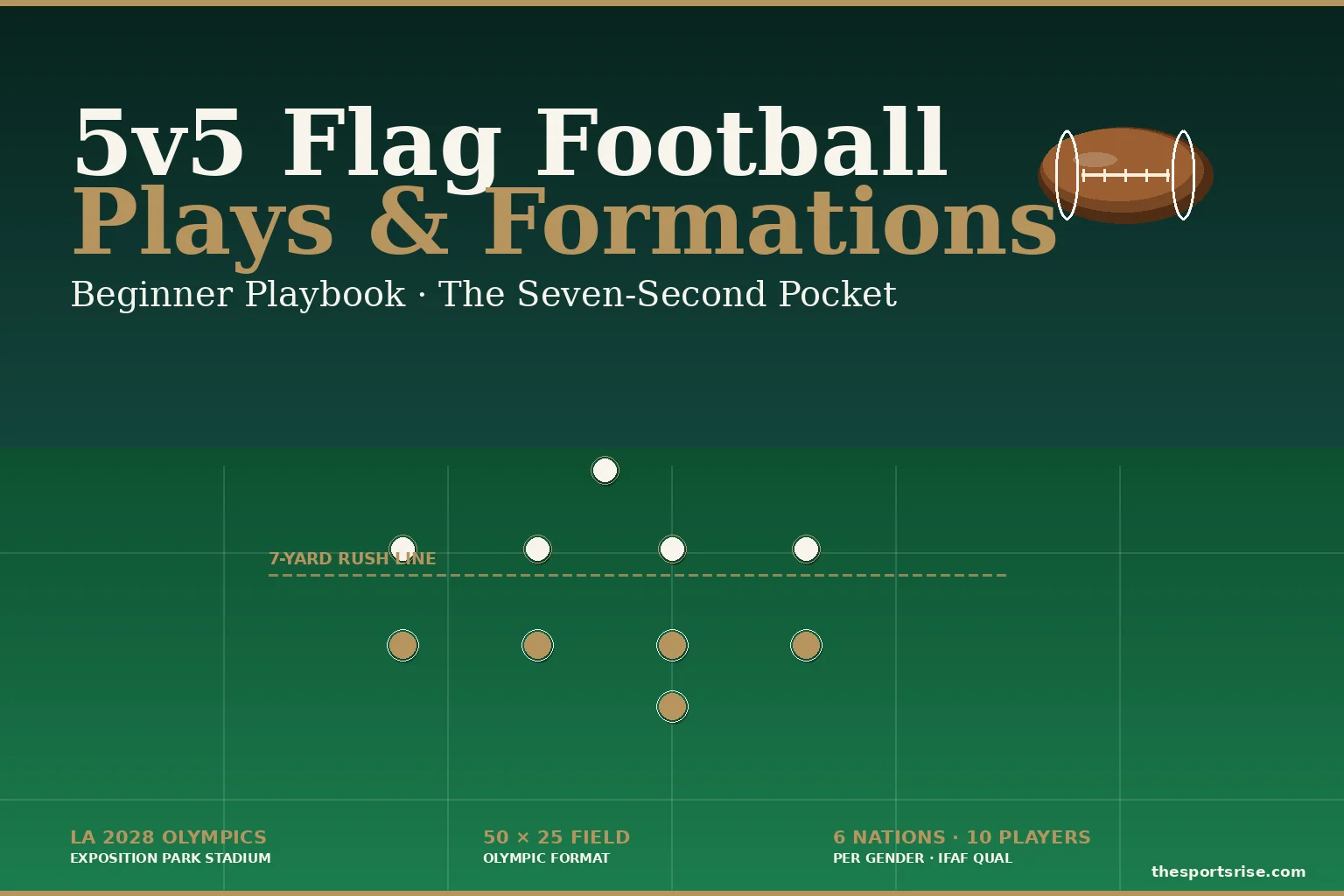
You get exactly 7 seconds from snap to release. That single rule — written into every NFL FLAG, IFAF, and LA28 Olympic rulebook — explains why most beginner 5v5 flag football plays formations playbooks fail before the first whistle. Coaches inherit 30-page binders of NFL-style concepts, then watch their quarterback hold the ball, panic, and absorb a sack-equivalent dead-ball penalty on the third snap of the game.
This guide rebuilds the playbook from the constraint forward. Six core formations, twelve route concepts, two coverage reads, and a defensive blueprint that wins more youth leagues than any "trick" play ever will. Everything ties back to the Seven-Second Pocket, the unforgiving offensive window that turns 5v5 flag from "small football" into its own discipline. By the time you finish, you'll know why 4.1 million American kids now play this sport. You'll know why Mexico has emerged as a co-leader of the world game. And you'll know why the same six plays your 8-year-old runs at NFL FLAG will also win Olympic medals at Exposition Park Stadium in July 2028.
Key Takeaways
- The Seven-Second Pocket: 5v5 quarterbacks must release the ball within 7 seconds; every formation, route, and read works backward from that single rule.
- 6 plays, not 20: Championship 5v5 teams run 6-8 well-drilled plays; FlagSketch's coaching database confirms execution beats variety every time.
- Center is eligible: The center becomes a live receiver the instant the ball leaves their hands — most beginner playbooks waste this five-man math advantage.
- Rushers stage 7 yards back: Per IFAF rules, blitzers must start 7 yards behind the line, which redefines what "pressure" even means at this level.
- The Olympic standard: LA28 will use a 50×25-yard field with two 15-minute halves — the same format your beginner team should train toward today.
Why 5v5 Flag Football Is Its Own Sport, Not Mini Football
Most coaches treat 5v5 flag like a shrunken NFL. That mental model breaks down within the first drive. The field measures 70 yards by 25 yards in the standard NFL FLAG format, and just 50 by 25 yards under the Olympic rulebook. The QB can't run unless the play starts in a no-run zone. The center must hike, then explode into a route. Every player on offense counts as an eligible receiver, including the snapper who just delivered the ball.
And the clock — that brutal 7-second clock — turns scrambling into a lose condition rather than a creative bailout. When I watch youth coaches install 12 formations on day one, I see a quarterback who hesitates because the read tree runs too deep. The Seven-Second Pocket punishes hesitation with brutal consistency. A half-second delay on read recognition equals a dead ball.
The growth numbers tell the same story. According to NFL Football Operations, more than 620,000 youth ages 4-17 compete in 1,800 NFL FLAG leagues across all 50 states. Around 4.1 million American children play in some organized format — a 50% jump since 2020. High school girls' participation alone rose nearly 60% from 2024 to 2025. The sport no longer plays out only at recess. It now feeds a development pipeline that ends in Los Angeles in three summers.
"I just got goosebumps. It's a dream that I get to be a part of, and I can dream for this."
— Vanita Krouch, U.S. Women's National Team quarterback (via Olympics.com)Krouch isn't chasing nostalgia. She owns a 33-1 international record with three world titles. For her, LA28 is the moment when the sport she's carried for a decade finally meets its audience.
The Six Formations Every Beginner Team Needs
You don't need 12 formations. You need six, each with a clear job. Here's the inventory I would install for any beginner youth or rec-league team starting from zero.
| Formation | Personnel | Best vs. | Key Concepts |
|---|---|---|---|
| Spread | 2 WR wide, 1 RB, 1 C, QB shotgun | Zone, beginner D | Slant-Flat, Four Verts, Center Drag |
| Trips (3x1) | 3 WR strong side, 1 RB weak | Man, mismatched athletes | Flood, Y-Sail, Trips Cross |
| Twins (2x1) | 2 WR strong, 1 WR weak, 1 RB | Single-high safety | High-Low, Quick Cross, Slant-Flat |
| Single Back | 1 WR each side, 1 RB, 1 C | Balanced fronts | Play-Action Post, HB Dive Fake |
| Stack | 2 WR stacked one side | Press man | Mesh, Pick-Rub, Quick Out |
| Bunch | 3 WR clustered tight | Zone with rush lane | Corner-Flat-Seam, Spacing |
One unifying principle ties them together. Every formation gives the quarterback exactly four route options and a checkdown to the center. Any more and the read tree exceeds the Seven-Second Pocket. Any fewer and the defense rolls coverage to your single read. Sketch these formations on a whiteboard or use a play-drawing tool like FlagSketch to print them on your team's wristband sheets.
The Seven-Second Pocket: A Timing-First Route Tree
The Seven-Second Pocket
The unforgiving offensive window in 5v5 flag football where the quarterback gets exactly seven seconds from snap to release, with no scramble bailout. Every formation, route concept, and protection scheme builds backward from that single constraint.
I first noticed this pattern coaching my nephew's 8U team in 2024 — the kids who threw on time beat the kids with better arms but slower reads, every single Saturday.
The pocket math works in three beats. The snap leaves the QB's hands at zero. By 2.5 seconds, the primary read should settle and the throw should trigger. By 4 seconds, the secondary read goes live if Read 1 stays covered. By 5.5 seconds, the checkdown to the center (who released into the flat) becomes the only legal option left. After 7 seconds, the play dies.
That math forces every route in a clean 5v5 playbook into one of three timing windows. Quick game covers 5-7 yards and breaks at 2 seconds — slants, quick outs, hitches. Intermediate covers 8-12 yards and breaks at 3.5 seconds — drags, digs, curls, sail routes. Deep covers 15+ yards and breaks at 4-5 seconds — posts, corners, four verticals.
Drag the timing past those windows and the Seven-Second Pocket eats the play. The defense doesn't need to "win." It just needs to not lose for seven Mississippi.
Six Plays That Win Beginner Leagues
Run these six. Master these six. Then add a seventh only when you can call all six from memory at full speed. Each play below comes with a route map you can sketch directly onto a wristband sheet.
1. Spread Slant-Flat: Outside WRs run 3-step slants. RB releases to the flat opposite the slant. Center drags underneath. The QB reads the playside flag-defender — slant if he widens, flat if he sits. Two-second window.
| Player | Route | Depth / Timing |
|---|---|---|
| WR1 (outside left) | 3-step slant, breaks inside | 5 yds at 1.5 sec |
| WR2 (outside right) | 3-step slant, breaks inside | 5 yds at 1.5 sec |
| RB | Flat — opposite the playside slant | 3 yds at 1 sec |
| Center (checkdown) | Drag — underneath, across formation | 5 yds at 2 sec |
2. Trips Flood: Three receivers attack one half-field at three depths — flat at 5 yards, intermediate at 10, corner at 15. The defender can't cover all three. Three-second window, throw to the open horizontal lane.
| Player | Route | Depth / Timing |
|---|---|---|
| WR1 (#1 strong, outside) | Corner — break out at top of stem | 15 yds at 3 sec |
| WR2 (#2 strong, slot) | Sail / out — intermediate | 10 yds at 2.5 sec |
| WR3 (#3 strong, inside slot) | Flat — quick release | 5 yds at 1.5 sec |
| Center (checkdown) | Drag weak — backside relief | 5 yds at 2 sec |
3. Twins High-Low: Outside WR runs a deep post (15 yards). Inside slot WR runs a shallow drag (5 yards). The deep safety chooses; whichever route he ignores, you throw. Three-and-a-half-second window.
| Player | Route | Depth / Timing |
|---|---|---|
| WR1 (outside, twins side) | Deep post — break inside at stem | 15 yds at 3.5 sec |
| WR2 (slot, twins side) | Shallow drag — across midline | 5 yds at 1.5 sec |
| WR3 (single weak side) | Comeback — backside clear | 10 yds at 2.5 sec |
| Center (checkdown) | Sit / settle in zone | 5 yds at 2 sec |
4. Single-Back Play-Action HB Dive: Fake the handoff to the RB. He fakes a dive and slips out for the swing pass. Outside receivers run 12-yard comebacks to drag the corners deep. Four-second window. This becomes your second-down hammer.
| Player | Route | Depth / Timing |
|---|---|---|
| WR1 (outside left) | Comeback — sell deep, snap back | 12 yds at 4 sec |
| WR2 (outside right) | Comeback — sell deep, snap back | 12 yds at 4 sec |
| RB | Fake dive, swing wide playside | 5 yds at 2 sec |
| Center (checkdown) | Drag underneath | 5 yds at 2.5 sec |
5. Stack Mesh: Two receivers in a stack run crossing routes that pass within a yard of each other — a legal pick that wrecks man coverage. The trailing crosser sits down at 8 yards. Three-second window.
| Player | Route | Depth / Timing |
|---|---|---|
| WR1 (front of stack) | Shallow cross — release outside | 5 yds at 1.5 sec |
| WR2 (back of stack) | Deeper cross — sit at 8 yds | 8 yds at 3 sec |
| WR3 / RB (single side) | Quick out — sideline | 5 yds at 1.5 sec |
| Center (checkdown) | Sit underneath | 3 yds at 1 sec |
6. Bunch Spacing: Three bunched receivers spread to corner, flat, and seam at 5/8/12 yards. Read the middle linebacker — throw to whichever route he ignores. Four-second window.
| Player | Route | Depth / Timing |
|---|---|---|
| WR1 (point of bunch) | Corner — break outside at top of stem | 12 yds at 3.5 sec |
| WR2 (interior bunch) | Seam — straight up the field | 8 yds at 2.5 sec |
| WR3 (outside bunch) | Flat — release outside | 5 yds at 1.5 sec |
| Center (checkdown) | Drag opposite | 5 yds at 2 sec |
Notice what's missing: trick plays. Reverses. Halfback passes. Quarterback designed runs. None of those survive the Seven-Second Pocket against a competent zone. The recommended playbook size from FlagSketch's coaching database lands at 6-8 plays total — a number I agree with, but for a different reason. Their logic focuses on execution quality over variety. The Seven-Second Pocket adds a constraint-first justification: with only 7 seconds per snap and a maximum of three reads per timing window, any playbook deeper than 8 plays forces your quarterback to think rather than react.
The single biggest read-progression error I see in 8U and 10U coaching is the eyes locking on Read 1 past the 2.5-second deadline. The fix is a practice drill I borrowed from college 7-on-7: have the QB call out "ONE … TWO … THREE" out loud during every rep, throwing on the count that matches the window. After two weeks, the verbal cue becomes internal and the throws come out on time without thought.
Defense for 5v5 Flag Football: The 1-3-1 Zone
Beginner defense has one job — give up no big plays. The Seven-Second Pocket already does most of your work. You just have to not collapse.
The 1-3-1 zone runs as the cleanest base. One designated rusher stages 7 yards off the line per IFAF rules. Three flat-zone defenders split the field horizontally at 5-7 yards depth, each responsible for any receiver entering their lane. One free safety plays 12-15 yards back, eyes on the deepest threat, never out-flanked.
The 1-3-1 works for kids and rec adults alike because the rusher rules stay explicit. Per iFlag's official rulebook, designated rushers must identify themselves with a raised hand pre-snap and stage 7 yards behind the line. Officials announce LANE or NO LANE based on whether the offensive bunch leaves a clear path. Once you understand the lane call, you can dictate when pressure arrives — and the Seven-Second Pocket finishes the job.
"Flag football is showing us that there are no limits."
— Diana Flores, captain of Mexico's women's national team (via Olympics.com)Flores's Mexico squad runs the 1-3-1 against most opponents and shifts to a 2-2 box only when facing bunch formations. That base structure carried them to a 26-21 win over the U.S. in Chengdu in August 2025 — a win that strengthened Mexico's case as a co-leader of the world game alongside the United States.
The Olympic Standard: Field, Clock, and the Pros' Preview at Exposition Park
The dimensions matter for your training plan. NFL FLAG default fields run 70×25 yards with 10-yard end zones (per the NFL FLAG official rulebook). The Olympic field shrinks to 50×25 yards under the IFAF format adopted for LA28 (per iFlag), which compresses every read by close to a third (50 yards versus 70). Train your beginner team on the smaller dimension and they'll feel like they own acres on a regulation field. The reverse creates short-throw panic.
The format also tightens. LA28 uses two 15-minute halves with running clock, versus the 20-minute halves IFAF runs at world championships, versus 8-minute halves common in youth leagues. The Seven-Second Pocket stays constant across every level, which makes it the single best argument for adopting it as your foundational coaching concept.
The Fanatics Flag Football Classic on March 21, 2026 at BMO Stadium offers the closest preview of the Olympic format you'll see. Three 12-player teams. Brady and Jalen Hurts captain Founders FFC under Sean Payton. Joe Burrow and Jayden Daniels captain Wildcats FFC under Kyle Shanahan. Team USA, anchored by Darrell "Housh" Doucette III at QB, fills the third slot. Hall of Famers Drew Brees and Larry Fitzgerald commission the event.
Watch the formation calls. You'll see Spread, Trips, and Stack — the same six concepts in this guide, just executed by people who throw the ball professionally. The Seven-Second Pocket doesn't care if your QB happens to be Tom Brady or your kid Tommy. The clock counts the same way. For deeper context on how flag football fits the broader LA28 program, see our 5 New Sports at LA 2028 Olympics: Complete Guide.
The Verdict: The Seven-Second Pocket Is Your Coaching North Star
Every other 5v5 flag football plays formations decision should run against one question — does this beat the Seven-Second Pocket? Six formations beat twelve. A 1-3-1 zone beats man coverage at this level. And a willingness to cut anything that doesn't survive the clock will out-coach the vast majority of teams you face. My specific prediction: Mexico cements itself as the clear co-number-one program through 2027 because Diana Flores's offense follows exactly this philosophy, and the U.S. closes the gap only when Vanita Krouch's successor commits to the same discipline. Train timing first, formations second, plays third — the medals at Exposition Park follow that order.
Sources and Reporting
- NFL Football Operations — Flag football growth statistics and league participation data
- Olympics.com — 2025 World Games gold-medal coverage
- iFlag — LA 2028 Olympic format and qualification
- FlagSketch — 5v5 formations and concepts coaching database
- iFlag Rulebook — Official 5v5 rusher and blitz rules
- NFL FLAG Rulebook — Standard field dimensions and end-zone size
- NFL.com — LA28 schedule and Exposition Park venue
- USA Football — 2024 IFAF World Championship results
- Pro Football Network — Fanatics Flag Football Classic 2026 rosters
Frequently Asked Questions
What's the difference between 5v5 and 7v7 flag football?
5v5 plays on a compact 70x25 yard field (50x25 at LA28) with no offensive line and no blocking, forcing every player into route-running roles. 7v7 uses a wider field — typically from the 40-yard line out — with structured position groupings closer to tackle football. The 7-second pass clock stays identical, but 5v5 demands faster reads because the windows tighten and the defense has fewer bodies to leak past.
How long is the play clock in flag football?
The quarterback must release the ball within 7 seconds of the snap or the play gets whistled dead. Designated rushers must start at least 7 yards behind the line of scrimmage and announce themselves with a raised hand pre-snap. These two rules — the 7-second clock and the 7-yard rush stage — define the entire timing tree of any beginner playbook.
Can the center catch a pass in 5v5 flag football?
Yes — the center becomes an eligible receiver the instant the ball leaves their hands on the snap. Most beginner playbooks waste this advantage by having the center stand still after snapping. Smart 5v5 offenses release the center on a 5-yard drag underneath, giving the QB a pre-built checkdown when the primary read is covered. Diana Flores's Mexico squad makes the center drag a core part of their offensive identity.
Which formation should beginners install first?
Spread (2x2 + RB) reads as the cleanest install. It gives the QB four receiver options. They sit spaced wide enough to read coverage at a glance. The center adds a fifth-man checkdown on every snap. Master Spread Slant-Flat and Spread Four Verticals before adding any other formation; that two-play subset wins more 8U and 10U games than any complex install.
How many plays should a beginner playbook have?
Six plays, eight maximum. According to FlagSketch's coaching database, championship 5v5 teams pick six to eight plays and run them until the defense stops them, then make one targeted adjustment. A team executing six plays confidently beats a team running 20 in confusion. Even Tom Brady's Founders FFC roster will run a tight script at the Fanatics Classic in March 2026.
Will flag football really happen at the LA 2028 Olympics?
Yes — the IOC officially approved flag football for LA28 on October 16, 2023 in Mumbai, India. Competition runs July 15-22, 2028 at Exposition Park Stadium in Los Angeles, with men's medal games on July 21 (9 p.m. ET) and women's medal games on July 22 (4 p.m. ET). Six nations qualify per gender, with rosters capped at 10 players each. NFL players have been cleared to compete for their national teams.
Conversation
Be the first to comment.
Leave a comment
Comments are reviewed before appearing. Your email stays private.