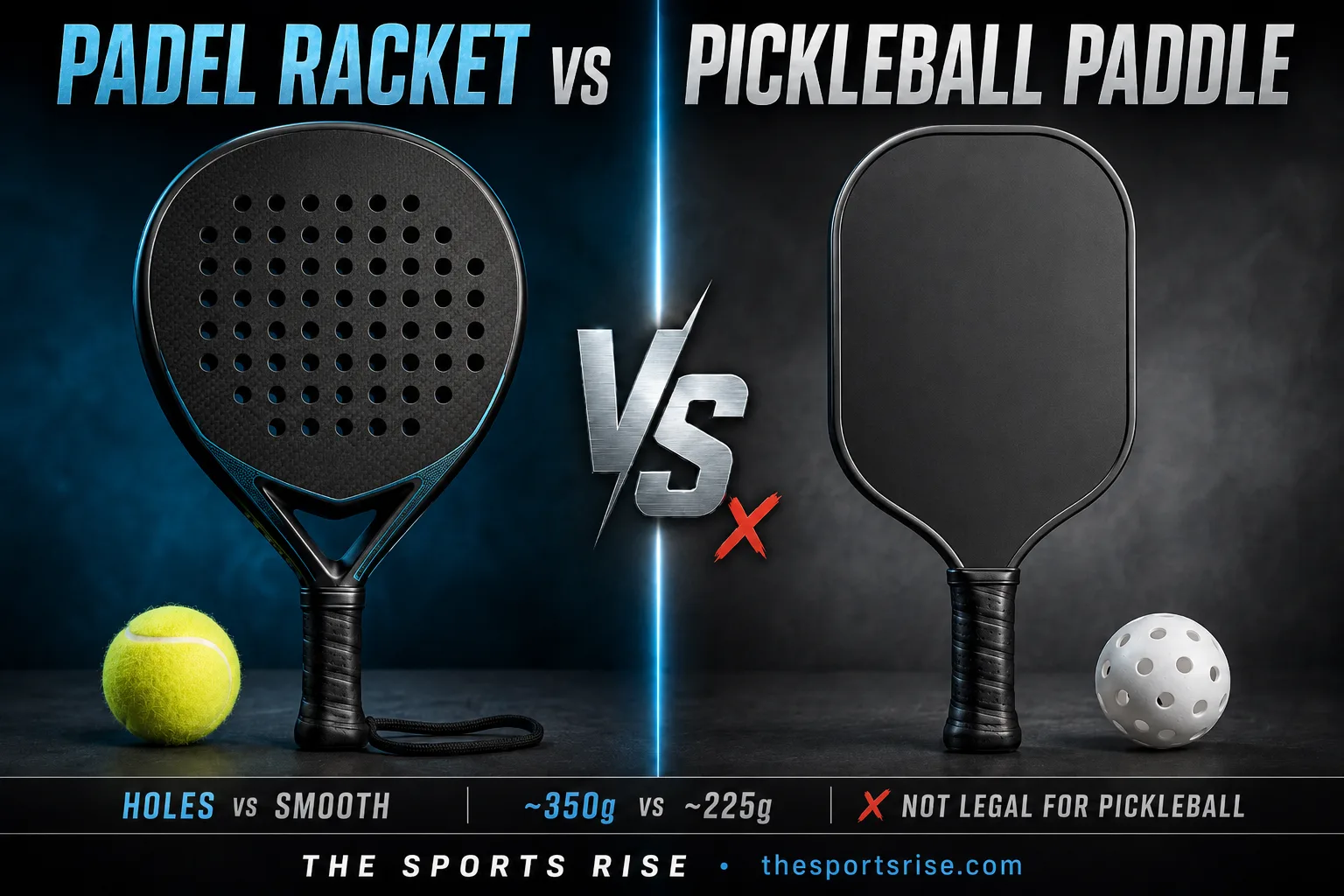
No, you can't use a padel racket for pickleball in any real, sanctioned game. The reason is simple: USA Pickleball's rules require a paddle with a smooth face, and a padel racket's defining feature is a face full of drilled holes. Those holes make it illegal for pickleball before you even get to the fact that it's far heavier and built for a completely different ball.
But "no" is the boring part of the answer. The interesting part is WHY, and what that tells you about two sports that look like cousins and play nothing alike. So let's break it down, then sort out what you should actually buy if pickleball is the goal.
Almost everything here comes back to one feature: the holes. Call it the perforation problem.
Key takeaways
- Short answer: No. A padel racket isn't legal for sanctioned pickleball, mainly because its perforated (holed) face fails USA Pickleball's smooth-surface rule.
- The perforation problem: A padel racket's face is drilled with cylindrical holes 9 to 13 mm wide, while a legal pickleball paddle must have a smooth surface. That single difference is the dealbreaker.
- Weight: A padel racket runs roughly 350 to 375 grams; most pickleball paddles weigh about 200 to 240 grams, so a padel racket feels heavy and slow for pickleball's fast hands.
- Different balls: Padel uses a pressurised, tennis-like rubber ball; pickleball uses a light plastic ball with 26 to 40 holes. Each piece of gear is tuned to its own ball.
- Casual vs legal: You can whack a pickleball with a padel racket in the backyard, but for league or tournament play you need a proper pickleball paddle.
Can you use a padel racket for pickleball?
No, not for sanctioned pickleball. USA Pickleball requires a paddle with a smooth hitting surface, and a padel racket has a face perforated with 9-to-13 mm holes, so it isn't legal. It's also much heavier and shaped for a different ball. For casual backyard play it works fine, just not for real games.
And that's the honest catch with these two paddle sports. From a few feet away a padel racket and a pickleball paddle look like the same idea: a solid, stringless bat. Pick them up, though, and they're built to opposite briefs. The perforation problem is where it starts.
The perforation problem: holes vs a smooth face
A padel racket's face is drilled with a grid of cylindrical holes, each 9 to 13 mm across. They're not a style choice. Padel is played fast inside a glass box, and the holes cut air resistance so you can swing quickly and control the ball. The holes ARE the racket.
Pickleball's rulebook goes the other way. The paddle's hitting surface has to be smooth, with no feature that grabs the ball beyond normal contact. A padel racket, by definition, can't meet that, because its whole face is holes. So in any USA Pickleball-sanctioned match, a padel racket is an instant no.
Weight, size and shape: why it feels wrong
Even if the holes were legal, the racket would fight you. A padel racket commonly weighs around 350 to 375 grams. A typical pickleball paddle sits near 200 to 240 grams. In a sport built on quick hands at the net, that extra mass is a lot, and your wrist feels it after a few rallies.
The shapes don't match either. Under FIP rules a padel racket can be up to 45.5 cm long and 38 mm thick, with a rounded or teardrop head. A legal pickleball paddle is flatter and capped at 17 inches long, with the length and width together no more than 24 inches. A padel racket also carries a mandatory safety cord around the wrist, which no pickleball player uses. Different tool, different job.
Different gear for a different ball
Here's the part people forget: the paddle is designed around the ball, and the two balls aren't close. Padel uses a pressurised rubber ball, much like a slightly smaller, softer tennis ball, that lives off the glass walls. Pickleball uses a light, hard plastic ball drilled with 26 to 40 holes, weighing about 22 to 26 grams.
A padel racket is tuned to compress and place that springy rubber ball off a back wall. Swing it at a hollow plastic pickleball and the feel is dead and clumsy. It's not that it can't make contact, it's that none of the racket's strengths apply.
Padel racket vs pickleball paddle: the full comparison
| Feature | Padel racket | Pickleball paddle |
|---|---|---|
| Face | Perforated (holes 9–13 mm) | Smooth (holes not allowed) |
| Strings | None (solid composite) | None (solid composite) |
| Typical weight | ~350–375 g | ~200–240 g |
| Max size | 45.5 cm long, 38 mm thick (FIP) | 17 in long; L+W ≤ 24 in (USA Pickleball) |
| Shape | Round / teardrop, thick | Flatter, elongated |
| Wrist cord | Mandatory (max 35 cm) | Not used |
| Designed for | Pressurised rubber ball off glass | Light plastic ball, 26–40 holes |
| Legal for sanctioned pickleball? | No | Yes (if approved) |
What to actually use for pickleball
If pickleball is the plan, skip the racket borrow and grab a real paddle. The good news: getting in is cheap. Solid entry-level pickleball paddles start around the price of a few coffees, and any USA Pickleball-approved model is tournament-legal out of the box.
For a first paddle, keep it simple. Aim for a mid-weight model (roughly 7.5 to 8 ounces) for a balance of control and power, a grip that fits your hand, and a USA Pickleball stamp if you ever plan to play in a league. New to the sport entirely? Our beginner's pickleball course walks through the first steps, and the pickleball rulebook covers the kitchen, the serve and the rest.
The bottom line on the perforation problem
A padel racket and a pickleball paddle share a silhouette and almost nothing else. The padel racket's holes, the thing that makes it a padel racket, are the exact thing pickleball's rulebook forbids, and the weight and ball mismatch pile on from there. Borrow one for a laugh in the driveway if you like. For anything that counts, buy the paddle that was built for the ball. If you enjoy these gear face-offs, we also broke down squash vs racquetball and flag vs tackle football, and there's more in our padel hub.
Frequently asked questions
Can you use a padel racket for pickleball?
No, not for sanctioned pickleball. A padel racket's face is perforated with 9-to-13 mm holes, which fails USA Pickleball's requirement that a paddle surface be smooth. It's also far heavier (around 350 to 375 grams versus a paddle's 200 to 240) and built for a different ball. You can use one in casual backyard play, but not in a league or tournament.
Is a padel racket the same as a pickleball paddle?
No. Both are stringless and solid, but a padel racket is perforated, thicker, heavier, and carries a mandatory wrist cord, while a pickleball paddle must have a smooth face, is lighter, and is capped at 17 inches long. They are tuned to two different balls.
Why does a padel racket have holes?
The holes reduce air resistance so the racket swings faster and gives better control in padel's quick, glass-walled rallies. Ironically, that same feature is exactly what disqualifies it for pickleball, which requires a smooth hitting surface.
Can you use a pickleball paddle for padel?
Not really. A pickleball paddle is lighter, smaller and smooth-faced, and it lacks the mandatory wrist cord padel rules require. It also isn't built to handle padel's heavier, pressurised ball coming off the glass walls, so the feel and control fall short.
What paddle do I need to start pickleball?
A USA Pickleball-approved paddle with a smooth face, ideally mid-weight at roughly 7.5 to 8 ounces for a control-and-power balance. Entry-level approved paddles are inexpensive, so you don't need to spend much to play legal, tournament-ready pickleball.
Are padel and pickleball the same sport?
No. Padel is played in an enclosed glass-and-mesh court, almost always as doubles, with a pressurised rubber ball. Pickleball is played on a smaller open court with a light plastic ball and a smooth paddle. Different courts, balls and rackets, despite the family resemblance.
Conversation
Be the first to comment.
Leave a comment
Comments are reviewed before appearing. Your email stays private.