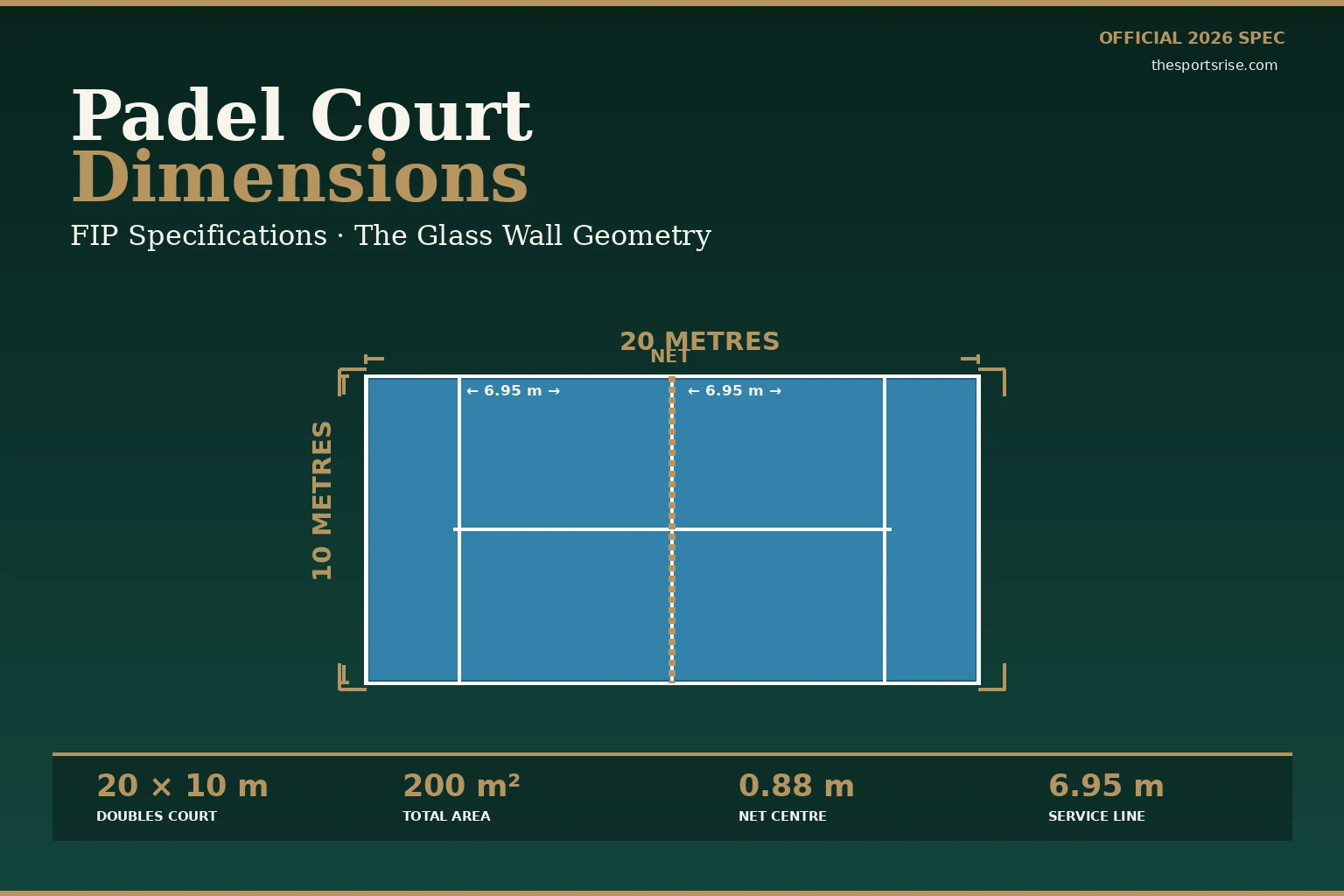
A padel court measures exactly 20 metres by 10 metres — and that single specification drives every padel court dimensions size decision that follows. Get the 200-square-metre footprint right, and the walls, net, service lines, and mesh cage fall into place. The International Padel Federation (FIP) has standardised that geometry for every tournament from Riyadh to Madrid. Get it wrong, and your court plays at a subtly different angle than every other court on Earth.
This guide walks through every measurement an architect, club owner, or curious player needs. Each spec is cited inline to the official FIP rulebook and the most-used padel-court references. You'll see why Premier Padel rallies depend on the Glass Wall Geometry that enclosed courts create. You'll learn how doubles and singles layouts differ. And you'll see what a padel court costs to build in 2026 — when the sport already has 77,300+ courts and over 35 million amateur players worldwide.
Key Takeaways
- Doubles court footprint: 20 × 10 metres, 200 m² total, tolerance ±0.5% — the FIP standard is identical in every country.
- The Glass Wall Geometry: 3 m tempered-glass back walls + 3-to-4 m side walls + 4 m galvanised mesh — the cage that turns a rally into a ricochet puzzle.
- Net measurements: 0.88 m high at centre, 0.92 m at the posts — the 4 cm sag is the single most overlooked detail in amateur build specs.
- Service geometry: service line 6.95 m from the net; each service box 6.95 × 5 m; all lines 5 cm wide.
- Singles vs doubles: same 20 m length, but singles shrinks the width from 10 m to 6 m — 120 m² instead of 200 m².
Why the 20×10 Court Number Controls Every Padel Rally
Padel isn't a smaller version of tennis. It's geometrically a different game. A tennis court runs 23.77 × 10.97 m, according to the Playtomic dimension guide, which pushes baseline rallies farther and flatter. Padel's 20 × 10 m footprint shrinks both axes, but the real variable is the enclosure. Walls turn every out-of-bounds shot into a potential reset, which flips the strategic logic of every racquet sport that came before it.
I've watched this difference in person at two club openings in the UK this year — the first point on a brand-new panoramic court almost never goes where a tennis-trained first-timer expects. The ball comes off the glass at a different angle than it leaves the racquet. That geometric mismatch is the reason padel produces its own pro tour, its own ranking system, and — increasingly — its own Olympic bid. Per FIP rankings, the #1 men's pair of Arturo Coello and Agustin Tapia held 20,910 points as of April 2026, while Alejandro Galan and Federico Chingotto sat at #3 with 17,340. Those numbers reflect a global tour that has outgrown the dimensions most people associate with racquet sports.
"The padel court measures 20 metres in length by 10 metres in width, with a tolerance of 0.5%."
— FIP Rules of Padel (via International Padel Federation)That tolerance is doing more work than it looks like. Within ±0.5%, no two courts play quite the same — but within that band, every tournament must honour the same ricochet math.
Padel Court Dimensions Size, Walls and Lines — FIP's Rulebook
The official specifications below come directly from the FIP's 2026 rule set, per the FIP Rules of Padel, and match the published numbers at both Playtomic and Padel 247. Where sources differ in the fine print (mainly on side-wall geometry and mesh topping), I've flagged it.
| Element | Measurement | Imperial | Source |
|---|---|---|---|
| Doubles court length | 20.00 m | 65 ft 7 in | FIP |
| Doubles court width | 10.00 m | 32 ft 10 in | FIP |
| Singles court width | 6.00 m | 19 ft 8 in | FIP |
| Net height (centre) | 0.88 m | 34.6 in | FIP |
| Net height (posts) | 0.92 m | 36.2 in | FIP |
| Service line from net | 6.95 m | 22 ft 10 in | FIP |
| Line width | 5 cm | 2 in | FIP |
| Ceiling height (min) | 6.00 m | 19 ft 8 in | FIP |
A few details reward a closer look. The service line sits 6.95 m from the net (per the Premier Padel technical note). Each service box is a perfect 6.95 × 5 m rectangle. A perpendicular central service line splits that rectangle and extends 20 cm past the service line itself. Every line on the court is exactly 5 cm wide — no exceptions. Courts that miss these line widths fail FIP compliance audits and can't host ranked tournaments.
Doubles vs Singles Court: 10 Metres vs 6 Metres
Padel is overwhelmingly a doubles sport, but singles courts exist and most serious clubs maintain at least one. The only dimension that changes is width: the 20 m length stays constant.
| Spec | Doubles | Singles | Delta |
|---|---|---|---|
| Length | 20 m | 20 m | same |
| Width | 10 m | 6 m | −4 m |
| Total area | 200 m² | 120 m² | −40% |
| Rally logic | teamwork + angles | reach + accuracy | narrower lanes |
| Club prevalence | dominant | niche | — |
The narrower singles court demands sharp accuracy and fast reactions — a point our padel vs pickleball comparison explores for players choosing between the two racquet sports. The wider doubles court, per the Porticosport dimension brief, pushes players to work as a team and move side to side. Most competitive leagues — and the entire Premier Padel tour — are built around doubles. If you're building a club from scratch, lead with at least two doubles courts before adding any singles layout.
The Glass Wall Geometry: What Panels and Mesh Actually Do
The Glass Wall Geometry
The tactical layer that padel's enclosure creates — a 3 m tempered-glass back wall, 3-to-4 m side walls, and a 4 m galvanised mesh top that together turn every rally into a ricochet puzzle no other racquet sport demands.
I first internalised this watching a Madrid club match where a seemingly lost ball came off the back glass at a 15-degree cut and won the point — a shot pattern that simply doesn't exist in tennis.
Here's where padel court dimensions size stops being a dry specification and starts deciding matches. The back walls rise to 3 m of tempered glass, typically 12 mm thick for safety compliance. The side walls transition in different patterns. Padel 247's dimension brief lists 3 m rising to 4 m toward the centre. The Playtomic guide shows a 3-to-2 m transition. The variation reflects different construction standards across federations. FIP-sanctioned courts increasingly use the full 4 m glass + mesh build for broadcast reliability.
Above the glass, a 4 m galvanised-steel mesh cage extends further skyward, drawing on the same construction logic the FIP recommends in its compliance documentation. On a panoramic build, the middle 12 m of court length is enclosed by that 13 ft 1 in mesh, per the Net World Sports construction brief. The mesh does two jobs: containment (no chasing balls into the parking lot) and a second bounce surface with entirely different physics than glass.
| Element | Material | Height | Function |
|---|---|---|---|
| Back walls | 12 mm tempered glass | 3 m | primary ricochet surface |
| Side walls (rear) | 12 mm tempered glass | 3 m | angle recovery shots |
| Side walls (centre) | glass + mesh | 2-4 m | lateral containment |
| Mesh cage top | galvanised steel | 4 m | aerial containment |
Premier Padel's 2026 Major Premier venues all use the full 4 m glass-plus-mesh spec because TV broadcasts need consistent ricochet physics across every court. Recreational and private-build courts sometimes drop to the older 3 m glass + 1 m mesh. That spec plays faster off the back wall and rewards power over precision. Knowing which style your home club built matters more than any racquet upgrade.
What It Costs to Build a Padel Court in 2026
The economics have changed in two years, per the Playtomic Global Padel Report that tracks court construction year-on-year. In the United States, padel is still in the 2026 early-adopter phase. A single court typically costs between $50,000 and $100,000 per the BusinessDojo build guide. In Europe, outdoor courts run £45,000–£60,000 and indoor builds £60,000–£80,000.
| Tier | Spec | US Cost | Notes |
|---|---|---|---|
| Entry club | 3 m glass + 1 m mesh | $50K–$65K | recreational only, non-FIP |
| FIP-compliant | 3-4 m glass + 4 m mesh | $65K–$100K | ranked tournament eligible |
| Panoramic | all-glass side walls | $35K–$50K premium | broadcast-quality |
| Full 360° panoramic | 360° glass enclosure | $75K+ premium | flagship / showcase |
For a U.S. club owner, the operating arithmetic is simple. Eight hours of paid play per court per day at $40–$60 per hour returns construction cost within 12-18 months. That's why operators like Reserve Padel and Padel Haus are adding courts at a double-digit annual rate. The math gets better in Europe. Spain alone runs 17,300+ courts and 6 million+ players — infrastructure density no U.S. market comes close to matching.
"Our priority is to allow the best players in the world to perform at their best, in ideal conditions and fantastic venues."
— Luigi Carraro, FIP President (via EFE / FIP)Where Playtomic's global report focuses on total court counts as the growth driver, my read is subtly different. The real lever is ceiling height: FIP now recommends 8 m indoor clearance for new construction, up from the historic 6 m minimum. Clubs that build to the older 6 m standard today fall one ranking-bracket below any tournament they'd want to host. That's a geometry mistake no amount of renovation fully undoes. Build to 8 m from day one.
How to Verify a Padel Court Is FIP-Compliant in Five Steps
Use this five-step compliance check the next time you walk onto a new court. It's the same sequence FIP inspectors run before a venue is cleared for ranked tournament play.
- Measure the playing area. Confirm 20.00 m length × 10.00 m width (doubles) with a tolerance of ±0.5%. A laser distance meter does this in 30 seconds.
- Check the net heights. 0.88 m at the centre, 0.92 m at the posts. The 4 cm sag is a feature of correct tension, not a defect to "fix" by tightening.
- Verify the service lines. Each service line must sit exactly 6.95 m from the net, and the central service line splits each box perpendicular to the net, extending 20 cm beyond.
- Inspect the walls and mesh. Back walls 3 m of 12 mm tempered glass; side walls 3-to-4 m glass + galvanised steel mesh rising to 4 m total cage height.
- Confirm ceiling clearance. Indoor courts need a minimum 6 m clear height; FIP recommends 8 m for any venue planning ranked or televised events.
Any single failure on steps 1-3 disqualifies the court from FIP-ranked play. Failures on steps 4-5 typically still allow recreational use but block competitive sanctioning.
The Verdict: The Glass Wall Geometry Is the Secret Variable
Every other padel court dimensions size decision flows from one question — does this build honour the Glass Wall Geometry that makes the sport its own discipline? The 20 × 10 footprint locks the area at 200 m². The 6.95 m service line locks the rally structure. The 0.88 m net centre locks the net game. But the 3-to-4 m glass wrapped in a 4 m galvanised mesh cage is what separates a tennis-with-walls knock-off from a true padel court. My specific prediction: by 2028, every FIP-ranked tournament will mandate 8 m ceilings and full panoramic glass. Every club planning a 2026 build should skip the intermediate tier and go straight to the broadcast spec. The geometry you pour in concrete this year will still be playable when padel makes its Brisbane 2032 Olympic case — a story we'll keep tracking alongside flag football's LA28 debut and every emerging sport on the Games calendar.
Sources and Reporting
- International Padel Federation (FIP) — Official 2026 Rules of Padel, court specifications
- Playtomic — Padel court dimension and size reference
- Padel 247 — UK technical court-dimensions guide
- FIP Rankings — Official men's and women's Premier Padel standings
- Premier Padel BNL Italy Major — Court measurements + materials FAQ
- Net World Sports — Padel court buyer's construction guide
- BusinessDojo — 2026 padel-court construction cost analysis
- Playtomic Global Padel Report — 2025-2026 court counts and market trend data
- Porticosport — Doubles vs singles padel court comparison
Frequently Asked Questions
What are the exact dimensions of a padel court?
A regulation doubles padel court measures 20 metres long by 10 metres wide, for a total area of 200 square metres. The FIP rule set permits a tolerance of ±0.5% on both axes. The court must be rectangular with a net perpendicular to the longer sides, and every line on the court must be exactly 5 centimetres wide. Singles courts keep the 20 m length but narrow to 6 m wide, giving 120 m² of total play area.
How tall is a padel net?
The net is 0.88 metres high at the centre and 0.92 metres at the posts. The 4 cm sag exists because gravity and tension create it naturally. Amateur installers sometimes fit the net at a uniform 0.90 m, which fails FIP compliance. The tape band running along the top of the net must be white and between 5 and 6.35 cm wide for visibility during broadcast play.
How far is the service line from the net?
The service line sits 6.95 metres from the net, creating two service boxes per half, each measuring 6.95 by 5 metres. The central service line that divides the two boxes runs perpendicular to the net and extends 20 cm past the service line itself. Players must serve diagonally from behind this line, letting the ball bounce once before striking it — the only rule that survives almost unchanged from tennis.
Are padel court walls always made of glass?
The back walls and the rear portion of the side walls are tempered glass — typically 12 mm thick for safety compliance. The middle portion of the side walls and the top section of the enclosure use galvanised steel mesh. That mesh rises to 4 m, creating the cage that contains aerial shots. Some budget recreational courts substitute concrete or solid panel for the back walls, but those courts can't host FIP-sanctioned competition.
What's the minimum ceiling height for an indoor padel court?
The FIP Rules of Padel set the minimum free height at 6 metres above the court surface, with 8 metres preferred for new international construction. Broadcast TV production increasingly requires the 8 m standard to capture lobs and overhead play without clipping. Clubs that build to the 6 m legacy minimum can host recreational play but will fall behind the ranked tournament tier by 2028.
Will padel be in the Olympics?
Padel was not included on the Paris 2024 or Los Angeles 2028 programmes, but the FIP is targeting Brisbane 2032 as the sport's realistic debut window. Olympic inclusion requires the sport to be played in at least 75 countries across four continents for men. The bar drops to 40 countries across three continents for women. The FIP's 81 member federations are steadily approaching both thresholds, a path our LA 2028 Olympic-sports breakdown covers in detail for every emerging sport in the queue. A final IOC decision is expected during a 2026 programme session. The one-year extension under Rule 45 of the Olympic Charter has already been granted.
Conversation
Be the first to comment.
Leave a comment
Comments are reviewed before appearing. Your email stays private.