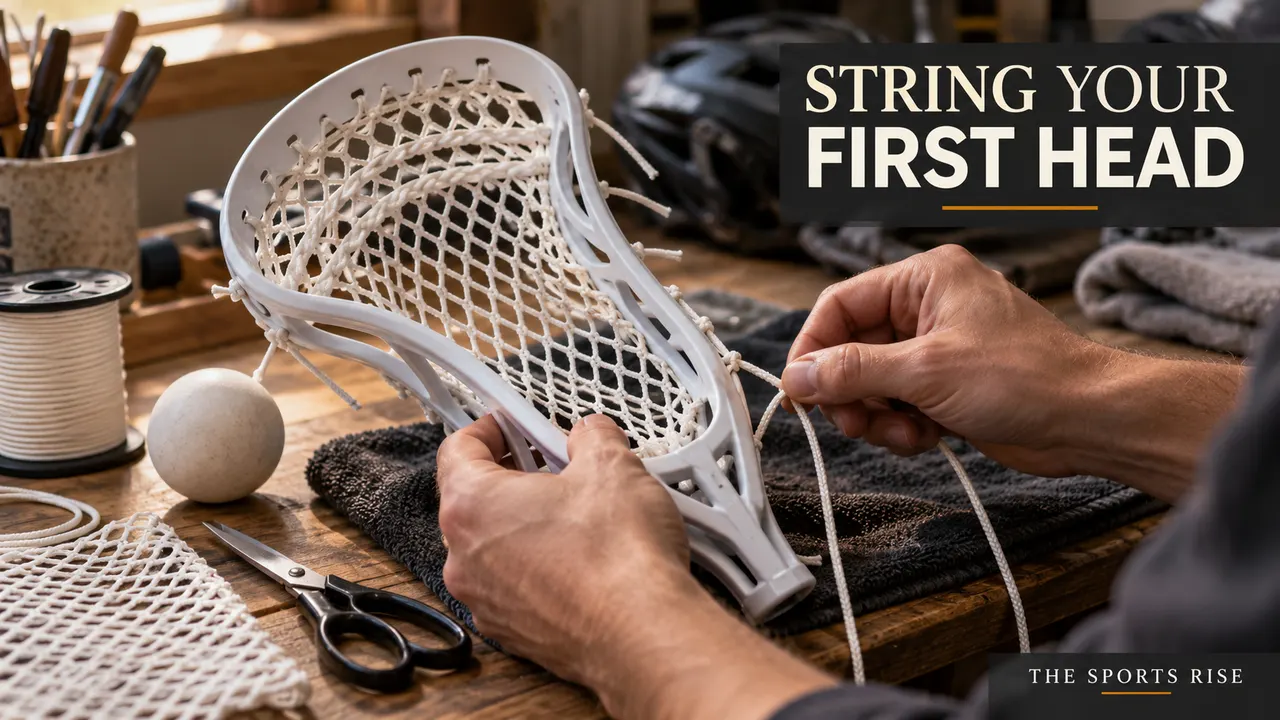
Learning how to string a lacrosse head from scratch takes a first-timer about 2 to 3 hours and roughly $25 to $40 in mesh and string, and no, you are not going to wreck the head. The plastic doesn't care how many times you re-thread a sidewall. Sit down at a kitchen table, give yourself an afternoon, and follow the order top to bottom. That order is the whole secret, and most beginners get scared off before they ever learn it.
Key takeaways
• String a lacrosse head in one fixed sequence, which I call Top-Down Stringing: mesh prep, then the top string, the two sidewalls, the bottom string, and finally the shooters.
• A beginner needs two sidewall strings, one top string, one bottom lace, and two shooters, plus a sheet of mesh. Semi-soft mesh is the forgiving choice for a first job.
• A men's lacrosse pocket is illegal if the top of a ball sags below the bottom edge of the sidewall when the head is held level (the daylight test); this does not apply to the goalkeeper's crosse.
• Men's shooting strings must all sit within four inches of the top of the scoop; there's no hard cap on the number, and most players run two or three.
• Strings alone run about $11.99; a complete kit with mesh included runs roughly $25 to $40 as of June 2026.
How to string a lacrosse head: the order that matters
Here's the sequence, and it's worth pinning to the wall above your workbench. The mesh comes first, then everything builds downward from the scoop toward the throat.
1. Step 1: Prep the mesh. Run the sheet under hot water and stretch it gently so it won't bag out later. Find the top edge (9 diamonds across) and the bottom edge (10 diamonds).
2. Step 2: Top string. Lace the mesh to the scoop, even and tight, to set the channel.
3. Step 3: Sidewalls. Run the left and right sidewall strings down each rail to shape the pocket.
4. Step 4: Bottom string. Tie off the mesh at the throat and set your pocket depth.
5. Step 5: Shooters. Add the nylon and lace shooting strings near the top to tune release.
USA Lacrosse names the same four core components in that order: top string, sidewalls, bottom, shooters. The mesh prep is the unglamorous Step 0 that practical stringers swear by. Skip the hot-water stretch and your pocket will deepen on its own a week later, sometimes right past legal.
What you actually need (and what it costs)
You don't need a full stringer's bench. You need a sheet of mesh, a handful of strings, and a little patience. Below is the complete shopping list with current pricing, so you can walk into a store (or a cart) knowing exactly what to grab.
| Item | How many | What it does | Cost (as of June 2026) |
|---|---|---|---|
| Semi-soft mesh sheet | 1 | The net that holds the ball; semi-soft is forgiving for beginners | ~$25-$35 |
| Sidewall strings | 2 | Lace the mesh to each rail; this is where the pocket is made | Included in kit |
| Top string | 1 | Anchors mesh to the scoop and sets the channel | Included in kit |
| Bottom lace | 1 | Ties off the throat and controls pocket depth | Included in kit |
| Shooters (nylon + lace) | 2+ | Tune whip and release near the top of the head | Included in kit |
| String kit (strings only) | 1 | StringKing or ECD HeroStrings; bundles all the strings above | $11.99 |
| Complete kit (mesh + strings) | 1 | Everything in one box; the easiest beginner buy | ~$25-$40 |
So the honest number: a strings-only kit like the StringKing or ECD HeroStrings set runs $11.99, but that doesn't include mesh. Add a sheet and you're at the $25 to $40 range for a complete job, with premium and goalie kits climbing toward $55. If you'd rather not pick parts à la carte, a complete mesh kit bundles it all. Pair that stick with a head from our guide to the right first stick for new players and you're set.
Is hard mesh or soft mesh better for lacrosse?
For a beginner, semi-soft mesh wins. It stretches easier and forgives the inevitable mistakes of a first job. Soft mesh is the old troublemaker: its classic flaw is a pocket that bags out, especially in the rain, until the stick goes illegal mid-game. Hard mesh holds a sharp, structured pocket but it's stiff and stubborn to thread, which is the last thing you want on attempt number one.
The market has mostly settled on semi-soft for a reason. Today's semi-soft mesh holds its shape far better than the old soft mesh and shrugs off the elements, which is the practical sweet spot: pocket consistency without fighting the material. If you want the deeper trade-offs between shallow and deep builds, our breakdown of low, mid, and high pocket placement walks through how depth changes your throw.
"The sidewall is where a pocket is made and thus it is the most important part of the stringing process."- USA Lacrosse
That line should reframe how you approach the whole afternoon. The top string and bottom string are the easy bookends; the sidewalls are where your pocket actually takes shape, so slow down there and keep the two sides mirror-symmetric.
String it legal: the daylight checkpoint
This is the part nobody interleaves with the steps, and it's exactly why beginners show up to a stick-check with an illegal pocket. Tie each component to the rule it has to satisfy as you go, and you finish with a guaranteed-legal head instead of a nasty surprise.
The daylight test: drop a ball in the pocket and hold the head horizontal to the ground, net facing down. If the top surface of the ball sits below the bottom edge of the sidewall, meaning you can't see daylight over the top of the ball from the side, the pocket is too deep and illegal. This rule does not apply to the designated goalkeeper's crosse.
Run the check at two moments. When you set the bottom string (Step 4), pause and do the daylight test before you tie everything off; that's your depth checkpoint. When you place the shooters (Step 5), confirm every shooting string sits within four inches of the top of the scoop. Get both right as you build and your stick stays within the rules before you ever step on the field.
| Pocket check | Legal | Illegal |
|---|---|---|
| Ball depth (daylight test) | Top of ball visible above sidewall | Ball sags below bottom edge of sidewall |
| Shooter placement | Every shooter within 4 inches of the scoop | Any shooter below the 4-inch line |
How many shooting strings should a lacrosse head have?
Most beginners do fine with two shooters, and many players run three. In men's lacrosse the count isn't capped by a number; it's capped by the four-inch zone, the mesh diameter, and your channel. Think of the count as your release dial. More strings near the top add hold and whip, which makes the shot snappier and faster but delays the ball leaving the pocket by a beat. Fewer strings give a quicker, cleaner release with less hold.
Start with a straight nylon up top and one lace below it, then play catch and feel the throw. If the ball sails high, you've got too much whip; back off a string or loosen one. If it slips out early, add hold. This is the one stage where tinkering is the point, so don't overthink your first setup. Just remember the four-inch rule: every shooter stays within four inches of the scoop, or the head is illegal no matter how nicely it throws.
Common first-timer mistakes (and the quick fix)
Two things sink most first jobs, and both are easy to undo. The first is skipping the hot-water stretch, which lets the mesh deepen on its own days later until the pocket goes illegal; re-prep the sheet and re-string if it bags out. The second is uneven sidewalls, where one rail is tighter than the other and the ball drifts off-center. The fix is to count your sidewall holes and match them side for side.
If the channel feels too loose, your top string is probably the culprit. It's the foundation, and a loose top string makes the entire pocket loose and unreliable. Re-lace it tight and even before you blame anything below it. None of these mistakes ruins the head. They just mean you pull a string and try again, which is how everyone learns.
The verdict: your first pocket won't be perfect, and that's fine
You can absolutely do this yourself, and Top-Down Stringing is the path that gets you there: prep the mesh, lace the top string, build the sidewalls, set the bottom, tune the shooters, and run the daylight test before you tie off. Budget an afternoon and about $25 to $40. Your first pocket might throw a little high or sit a touch deep. That's normal, and it's a five-minute fix, not a do-over.
Pull the shooter that's giving you trouble, re-do the bottom string if the daylight test fails, and play catch until it feels right. Once your hands know the rhythm, the next head drops to under an hour. Whether you're stringing for the field game or the faster Sixes format headed to the 2028 Olympics, the build is the same, and you've just learned it. For more walkthroughs at this pace, keep our step-by-step lacrosse guides bookmarked.
Written by Rahul Gaur, Founder & Editor. Every figure here was checked against USA Lacrosse, World Lacrosse, Stringers Society, and published men's NCAA/NFHS pocket-legality rules, with pricing verified against current StringKing/ECD retail listings. Published June 27, 2026. Questions or corrections: editorial@thesportsrise.com.
Frequently asked questions
How do you string a lacrosse head for beginners?
Start with semi-soft mesh because it forgives mistakes, then work top to bottom: prep and stretch the mesh, lace the top string, run both sidewalls, set the bottom string, and add shooters last. Take your time on the sidewalls, since that's where the pocket forms. A complete beginner kit with mesh and all strings included keeps the parts list simple and runs about $25 to $40.
How long does it take to string a lacrosse head?
A first-time stringing job takes about 2 to 3 hours when you're learning each step and double-checking the order. Once your hands know the pattern, that drops to roughly 45 minutes to an hour per head. Don't rush the first one; slow, even lacing now saves you from re-stringing a sloppy pocket later.
How deep can a lacrosse pocket be?
In men's lacrosse, a pocket is too deep the moment the top surface of a ball sitting in it drops below the bottom edge of the sidewall when you hold the head level. That's the daylight test. The single exception is the designated goalkeeper's crosse, which is allowed a deeper pocket because the goalie's larger head changes the math entirely.
How many shooting strings are allowed in men's lacrosse?
Men's NCAA and NFHS rules don't cap the number of shooting strings; they only require every shooter to sit within four inches of the top of the scoop. Most players run two or three. Women's field lacrosse is the stricter game, limiting players to a maximum of two shooting strings, so double-check which rulebook your league follows.
Do you string a lacrosse head wet or dry?
You string it dry, but you prep the mesh wet first. Running a new sheet under hot water and stretching it gently pre-conditions the fibers so the pocket won't deepen unpredictably after a few practices. Once the mesh is stretched and dry to the touch, lace everything dry. Soaking a finished pocket overnight is a separate break-in trick, not part of stringing.
What strings do I need to string a lacrosse head?
A men's head needs two sidewall strings, one top string, one bottom lace, and at least two shooters (typically one nylon and one lace). Most kits bundle exactly that, plus spare shooting cords. Buy a complete kit rather than loose strings for your first build; you'll avoid running short on a sidewall halfway through and having to stop.
Sources
This guide draws on equipment guidance from USA Lacrosse and shooting-string rules from Stringers Society, with pricing verified against current retail listings as of June 2026.