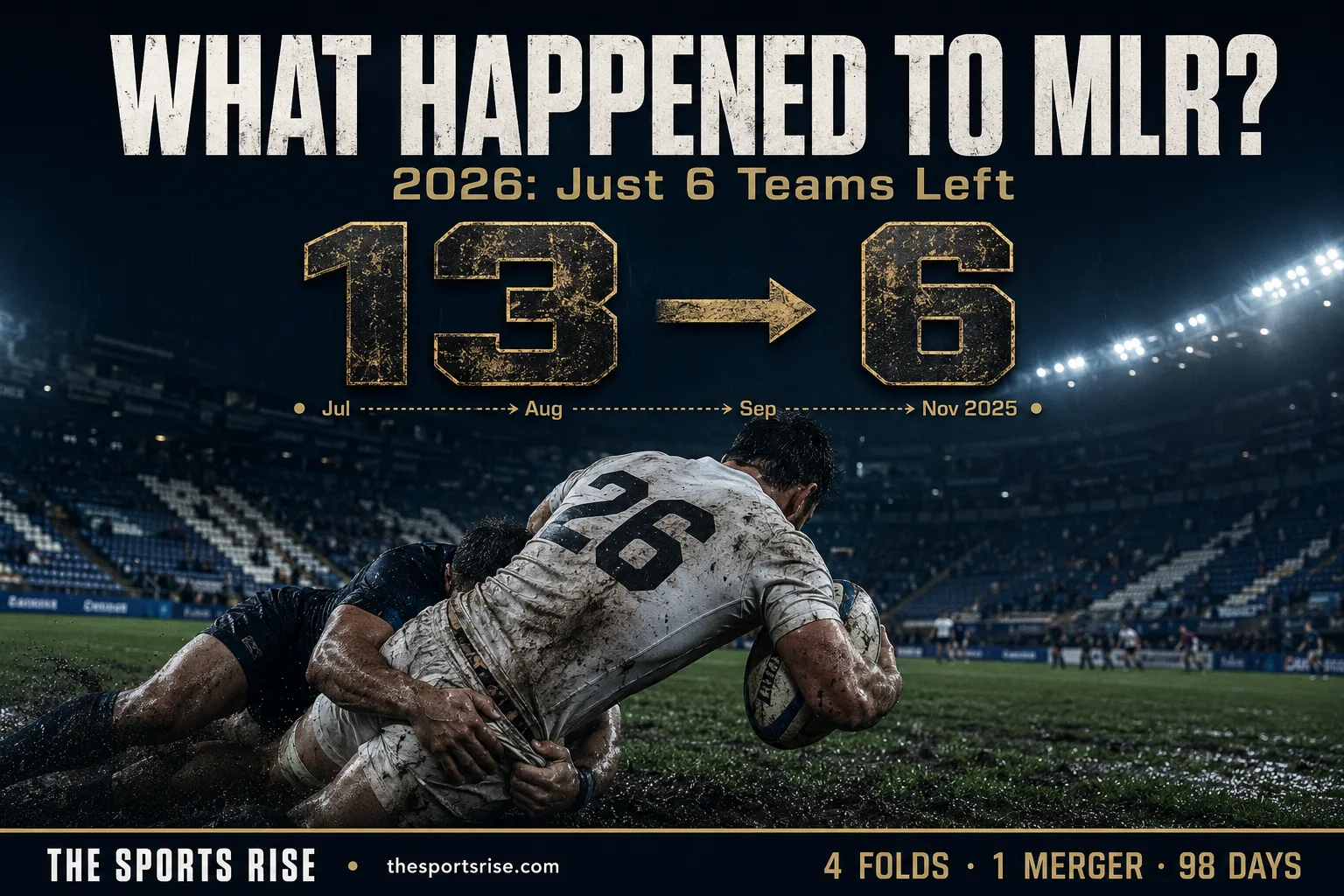
Major League Rugby contracted from 11 teams to just 6 for the 2026 season after the Houston SaberCats, Utah Warriors, Miami Sharks, and New Orleans Gold all exited between July and November 2025, while the San Diego Legion and RFC Los Angeles merged into the new California Legion. The 2026 campaign that ran from March 28 to June 21 was the smallest in MLR history. So if you've heard "what happened to Major League Rugby?" and got fragmented news answers, here's the consolidated story: every fold, every merger, every date.
That's the MLR Contraction Index: a 54% drop in teams in four years (13 in 2022, 6 in 2026), three different league CEOs since 2019, and the commissioner role itself abolished last December. Whether the league survives to host-nation status for the 2031 Rugby World Cup is now the real question.
Key takeaways
- The MLR Contraction Index: Major League Rugby shrank from a 13-team peak in 2022 to just 6 teams in 2026, a 54% contraction in four seasons.
- Five teams gone in 98 days: Between July 30 and November 4, 2025, the New Orleans Gold suspended operations, the Miami Sharks withdrew, the Houston SaberCats folded (despite reaching the 2025 Final), and the Utah Warriors suspended too. The San Diego Legion and RFC Los Angeles merged into California Legion.
- The six left standing: Anthem Rugby Carolina, California Legion, Chicago Hounds, New England Free Jacks, Old Glory DC, and Seattle Seawolves contested 2026. Chicago Hounds finished 12-0 overall (10-0 regular season + 2-0 in the playoffs) and beat California Legion 35-17 in the Championship Final on June 21, 2026 to end the Free Jacks' three-peat era.
- Leadership reset: The CEO/Commissioner role was abolished December 2, 2025. The league now runs on a Co-President model (Alex Magleby for strategy, Graeme Bradbury for operations).
- Survival horizon: The USA hosts the 2031 Men's Rugby World Cup with 27 cities already in the formal applicant phase. MLR is the host-nation league, and it has five years to stabilise.
Major League Rugby in 2026: the six teams left standing
Six clubs contested the 2026 Major League Rugby season: Anthem Rugby Carolina, the new California Legion, Chicago Hounds, New England Free Jacks, Old Glory DC, and Seattle Seawolves. The format was the most minimal in MLR history: a 10-game regular season (each team plays every opponent home and away once), no conference divisions, and the top four seeds advance to a 1v4 / 2v3 semifinal, with higher seeds hosting.
The season opened on March 28, 2026 and ended at the Championship Final on June 21, 2026. Chicago Hounds went 10-0 in the regular season as the dominant top seed, then beat California Legion 35-17 in the Final to finish 12-0 overall. The New England Free Jacks missed the playoffs entirely in fifth place, ending their 2023-24-25 three-peat run with a thud. For a working primer on the sport itself, our MLR rulebook covers the basics, and the beginner's guide walks through the structure. If the scoring and positions are still new to you, our rugby rules for beginners guide explains how the game is actually played in plain English.
The 2025 contraction timeline: five teams lost in 98 days
The collapse came in a tight, dated sequence between July 30 and November 4, 2025. Each one was a separate decision, but the cumulative effect reshaped the league.
Data: the MLR Contraction Index, 2022 vs 2026
| Metric | MLR peak (2022) | MLR 2026 | Change |
|---|---|---|---|
| Total teams | 13 | 6 | -54% |
| Conference structure | Eastern & Western | Unified single league | Conferences abolished |
| Regular-season games per team | 16 | 10 | -6 games per side |
| Playoff teams | 8 (top 4 per conference) | 4 (top 4 overall) | -50% |
| League leadership | Commissioner (Killebrew) | Co-Presidents (Magleby + Bradbury) | CEO role abolished Dec 2025 |
| National broadcast | Mixed (Fox, CBSSN, ESPN+) | ESPN2 + ESPN+ ("Sunday Night Rugby") | Unified ESPN deal |
Team-by-team breakdown: why each franchise folded
Houston SaberCats: from 2025 finalist to folded in 90 days
Houston is the headline casualty. They had been an MLR original (eight seasons), won the 2025 Western Conference, and reached the Championship Final at Centreville Bank Stadium in Pawtucket, where they lost 28-22 to the Free Jacks on June 28, 2025. Roughly 75 days later, on September 11, ownership announced the franchise would not field a team for 2026, citing unsustainable operating costs. A defeated finalist folding the following offseason is genuinely unprecedented in modern US professional sport.
Utah Warriors: the 11th-hour European ownership collapse
Utah's fall was more dramatic. They had been the No. 1 seed in the Western Conference and looked like a serious title contender for 2026. Then, on November 4, 2025, CEO Kimball Kjar announced suspension of operations. His public explanation pointed to a European ownership group whose problems with a sister rugby club they owned overseas had pulled the rug out from under the Warriors. Cross-club ownership is now a flagged risk pattern across MLR going into 2027.
Miami Sharks and New Orleans Gold: quiet exits
Miami went earliest in the timeline (August 6, 2025), with majority owner Marcos Galperin (Mercado Libre's billionaire founder/CEO) walking away from the project. New Orleans Gold went even earlier, suspending operations on July 30, 2025. Both were quieter exits than Houston or Utah, but the pattern was the same: ownership groups whose appetite for sustained loss-making fell faster than the league's path to break-even.
San Diego Legion + RFC LA → California Legion: merger, not death
The California Legion is the most creative response to the contraction wave. Rather than letting Los Angeles or San Diego fold outright, the two markets merged on July 30, 2025, into a single statewide franchise. California Legion plays its 2026 home matches across five different California venues: Championship Soccer Stadium in Orange County, Torero Stadium in San Diego, Wallis Annenberg Stadium in Los Angeles, Saint Mary's Stadium in the East Bay, and Heart Health Park in Sacramento. No other MLR franchise has tried a statewide tour like this.
The "capital fatigue" era: why MLR keeps losing franchises
The label that stuck during 2025 was "capital fatigue". MLR's economic model was always demanding: an expansion franchise fee that has climbed from low single-digit millions in the early years toward roughly $10 million by 2024, average game attendance near 2,000 per regular-season match, and only a record 12,085 at the 2024 Final at Snapdragon Stadium. With no central media-rights deal big enough to backstop losses until the ESPN agreement in 2025, every owner was effectively writing personal cheques to cover annual operating gaps. Once one cycle of investors tapped out, the next group wasn't always ready to step in.
Add the earlier mortality (the Colorado Raptors withdrew in 2020, the LA Giltinis and Austin Gilgronis were disqualified in 2022 for salary-cap breaches, Toronto Arrows closed in 2023 after their founder's death, Rugby New York folded in 2023, the Dallas Jackals sat out 2025) and a pattern emerges: roughly half of MLR's all-time franchise list has now exited the league.
Leadership vacuum: from commissioner to co-presidents
The league's office has churned almost as fast as the franchise list. Dean Howes was the first commissioner, George Killebrew followed, and Nic Benson took over for what turned out to be the contraction years. On December 2, 2025, MLR announced that Benson was stepping down and the CEO/Commissioner role was being abolished entirely. The new structure is a Co-President model: Alex Magleby runs Strategy and Communications, Graeme Bradbury runs Operations and Competition. It's the third major leadership change since 2019 and a tacit admission that a single-CEO model has not served MLR well at this stage of its life.
California Legion's statewide experiment
If MLR is going to find a survival model, the California Legion arrangement is the most-watched test case. By committing to five home venues across the state, the franchise is trying to build a fanbase by visiting it rather than asking it to commute. It's also a hedge against the single-market exposure that doomed standalone San Diego and LA: if one venue underperforms, the franchise still has four others. Whether this scales (and whether ticket holders accept a roving home) will shape 2027 expansion thinking.
The 2026 schedule and "Sunday Night Rugby" on ESPN
The most important commercial development of 2026 is the ESPN deal. Major League Rugby launched "Sunday Night Rugby" on ESPN2 and ESPN+, with 9 regular-season matches plus one playoff semifinal carried on linear, hosted by former player Will Hooley. For a US league whose previous broadcast footprint was fragmented across Fox Sports, CBSSN, and ESPN+, a unified ESPN home is the closest thing to mainstream legitimacy MLR has had. It's the league's bet that distribution, not team count, is the real growth lever now.
Can MLR survive to the 2031 Rugby World Cup?
This is the question that matters beyond the 2026 season. The United States is the confirmed host of the 2031 Men's Rugby World Cup, with the 2033 Women's tournament following two years later. World Rugby has 27 US cities and 33 venues already in the formal applicant phase. So global rugby is investing in the US market with serious money and a serious deadline.
MLR is the host-nation domestic league. It is also, in 2026, smaller than it has been at any point in its history. The paradox is real: contract just as the global game arrives. Survival to 2031 likely hinges on three things: the ESPN deal converting to real revenue, Anthem Rugby Carolina (an MLR/World Rugby/USA Rugby joint venture that doubles as the US Eagles development club) producing visible national-team value, and at least one or two new ownership groups stepping in for 2027. None of those is guaranteed.
The Free Jacks three-peat: a dynasty built during the decline
One more thing worth flagging from this strange era. The New England Free Jacks won MLR titles in 2023, 2024 and 2025, a North American major-sport three-peat in a class with the 2000-02 Lakers. The 2025 Final was held at Centreville Bank Stadium in Pawtucket, Rhode Island — a neutral, MLR-selected site (the brand-new home of USL side Rhode Island FC), not a Free Jacks home venue; New England plays its home matches at Veterans Memorial Stadium in Quincy, Massachusetts. Then in 2026 the dynasty ran out: the Free Jacks finished fifth and missed the playoffs entirely, and Chicago Hounds went unbeaten to lift the trophy. The Free Jacks did the three-peat while the league around them was contracting, which is probably the most rugby thing about this whole story.
What happened to Major League Rugby: the bottom line on a league in survival mode
What happened to Major League Rugby is now possible to summarise in one paragraph: four teams folded and two more merged in a 98-day window in 2025, the commissioner role was abolished, and a 6-team 2026 season was the smallest in MLR history. What happens next will be defined by three external forces: the new ESPN broadcast deal, the LA 2028 Olympics rugby buzz (which we cover in our guide to the 5 new sports at LA 2028), and the slow march toward USA-hosted Rugby World Cup 2031. If MLR makes it intact to that World Cup, it will be one of the great host-nation survival stories in modern sport. If it doesn't, the 2025 timeline above will be where historians look first. For a similar "new US league" breakdown of a different sport, see our Major League Cricket explainer.
Frequently asked questions
How many teams are in Major League Rugby in 2026?
Six teams compete in the 2026 Major League Rugby season — the smallest field in league history. They are Anthem Rugby Carolina, California Legion, Chicago Hounds, New England Free Jacks, Old Glory DC, and Seattle Seawolves. Each plays a 10-game regular season with no conference divisions, and the top four seeds qualify for the playoffs. That is a 54% contraction from the league's 13-team 2022 peak.
Why did the Houston SaberCats fold after reaching the 2025 MLR Championship Final?
Houston SaberCats withdrew on September 11, 2025 — barely three months after losing the 2025 Championship Final 28-22 to the New England Free Jacks. The eight-season franchise cited unsustainable operating costs as MLR's broader "capital fatigue" wave hit. Houston had been the 2025 Western Conference Champions, making them the highest-profile casualty of the contraction era and the first defeated finalist in major US pro sports to fold the following offseason.
What happened to the Utah Warriors and why did they suspend operations?
Utah Warriors suspended operations on November 4, 2025, despite finishing 2025 as the No. 1 Western Conference seed. CEO Kimball Kjar told the Deseret News that a European-based ownership group "pulled out at the 11th hour" after facing "headwinds from within their ecosystem" tied to another rugby club they owned overseas. The collapse exposed the systemic risk of cross-club ownership models in emerging professional rugby leagues.
What is the California Legion and how was it formed?
California Legion launched on July 30, 2025 through a merger between the San Diego Legion and RFC Los Angeles. Rather than picking one home city, the franchise plays 2026 home games across five California venues: Championship Soccer Stadium in Orange County, Torero Stadium in San Diego, Wallis Annenberg Stadium in Los Angeles, Saint Mary's Stadium in the East Bay, and Heart Health Park in Sacramento. It is the first statewide-tour franchise model in MLR history.
Who runs Major League Rugby in 2026 after the commissioner role was abolished?
Major League Rugby eliminated its CEO/Commissioner position on December 2, 2025 when Nic Benson stepped down after nearly three years in charge. The league replaced it with a Co-President model: Alex Magleby leads Strategy and Communications while Graeme Bradbury runs Operations and Competition. It is MLR's third major leadership change since 2019, after Dean Howes and George Killebrew preceded Benson.
Can Major League Rugby survive until the 2031 Rugby World Cup?
The United States hosts the 2031 Men's Rugby World Cup and 2033 Women's tournament, with 27 US cities and 33 venues already in World Rugby's formal applicant phase. MLR's six-team 2026 league is the host-nation paradox: it has contracted just as global rugby invests in the US market. Survival hinges on the new ESPN2/ESPN+ broadcast deal, Anthem Rugby Carolina's Eagles development pipeline, and whether ownership groups can stabilise before 2027 expansion.
Conversation
Be the first to comment.
Leave a comment
Comments are reviewed before appearing. Your email stays private.