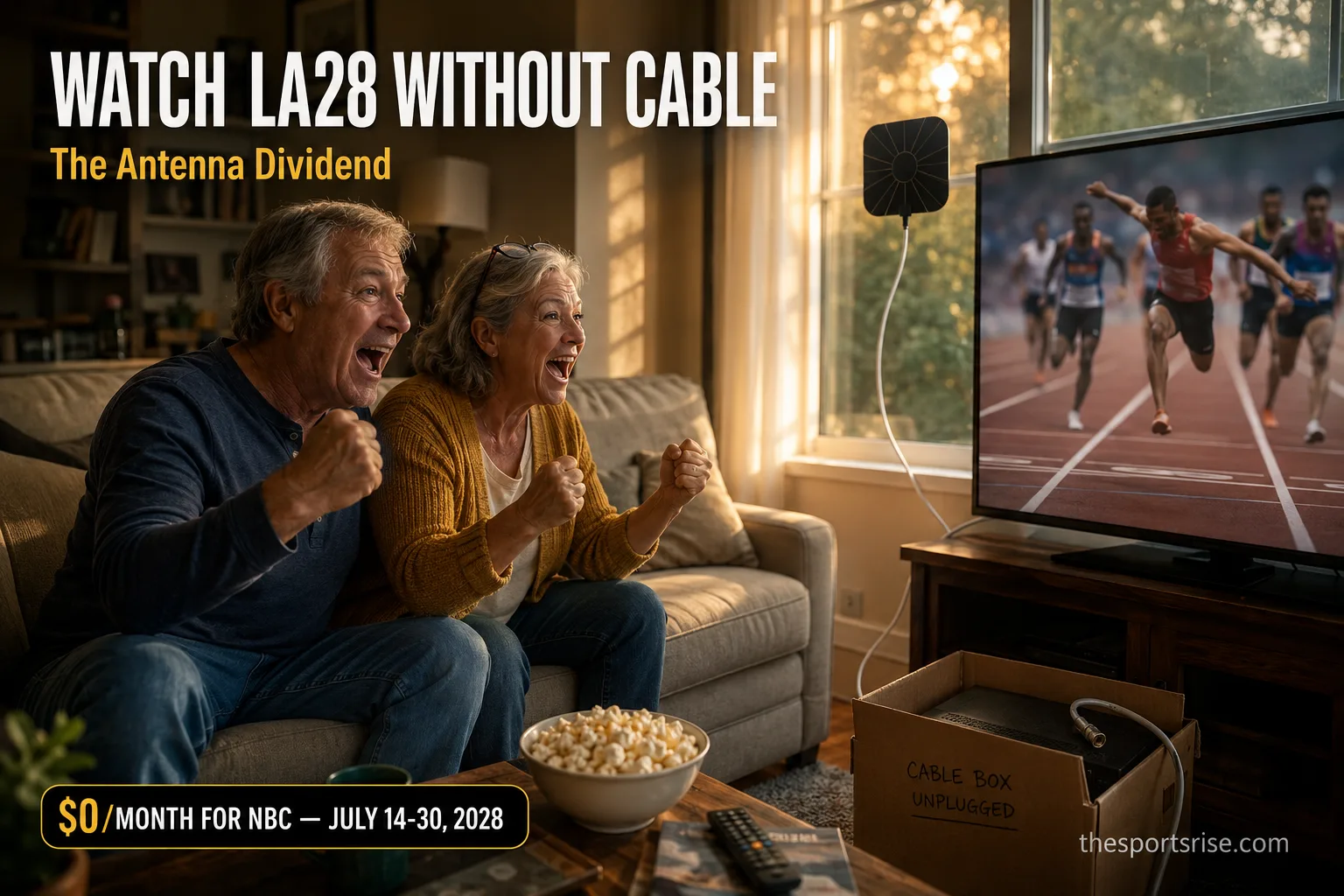
You can watch the 2028 LA Olympics without cable by pairing a cheap indoor antenna, which pulls in NBC's free over-the-air broadcast, with an optional Peacock subscription for everything NBC doesn't put on its main channel. No cable box. No contract. No $200-a-month bill for 180 channels of junk you never watch. This guide lays out exactly how to watch the 2028 Olympics without cable, with every price dated to mid-2026 and the free options clearly separated from the paid ones.
The confirmed facts come first, because a 2028 guide written in 2026 owes you honesty about what's actually locked in. NBCUniversal paid $7.65 billion for US Olympic media rights through 2032 back in 2014, then bought another cycle on top of that in 2025. The Games themselves are set for July 14-30, 2028, per LA28's official announcement. Everything else about 2028 coverage, including every price in this guide, is a mid-2026 snapshot that can and probably will shift before the torch arrives.
Key takeaways
- The free layer: A $20-40 indoor antenna (mid-2026 pricing) pulls in NBC's over-the-air Olympic coverage for $0 a month, the same marquee prime-time show cable subscribers pay for.
- The antenna dividend: One small hardware purchase keeps paying past LA28, covering local news, NFL on NBC, and every Games NBC holds US rights to through at least 2032.
- The everything layer: Peacock streamed every Paris 2024 event and is expected to do the same for the 2028 LA Olympics; Peacock Premium costs $10.99 a month as of July 2026.
- The timing win: LA28 runs July 14-30, 2028 in the Pacific time zone, so live finals should land in US prime time instead of the middle of the night.
How to watch the 2028 Olympics without cable: the short answer
Buy an indoor antenna ($20-40 as of mid-2026) to get NBC free over the air, then add Peacock (from $10.99 a month at July 2026 pricing) if you want every event of the 2028 LA Olympics. A live-TV bundle such as YouTube TV only makes sense if you're replacing all of cable, not just Olympic coverage.
Why would NBC keep anything free when Peacock wants subscribers? Because broadcast reach is the entire point of the rights deal. Advertisers pay Olympic-sized rates for NBC's prime-time show precisely because it reaches every US home with a screen, cable or not.
If NBC ever paywalled the headline finals, that $7.65 billion bet would stop making sense, and I'd happily eat this article. The free layer isn't charity; it's the business model.
But the free layer has limits, and you should know them before the opening ceremony rather than during it. NBC's broadcast is a curated show, not a firehose, so if your favorite sport plays at 11 a.m. on a Tuesday, you'll need the stream. Start with the setup steps below, and if you're building out your Games knowledge too, our LA 2028 Olympics hub gathers venue, ticket, and schedule coverage in one place.
Five steps to a cable-free LA28 setup
Here's the checklist, ordered so you spend the least money first. Steps one through three cost $40 at the very most, and steps four and five are optional spending decisions you can put off until July 2028.
- Confirm you're in an NBC market. Enter your ZIP code on the FCC's DTV reception map or AntennaWeb. If a local NBC affiliate reaches your address, and it does for the vast majority of US households, the free plan works for you.
- Buy a cheap indoor antenna. Flat window-mount models run $20-40 as of mid-2026, and independent testing keeps showing the $30 tier performs as well as pricier models in decent signal areas.
- Rescan your channels. Connect the antenna to your TV's coax port, run the auto-scan in the settings menu, and check that NBC comes in clean. Move the antenna and rescan if it doesn't.
- Decide if you need Peacock. Subscribe only if you want every event rather than NBC's curated broadcast. As of July 2026, Peacock Premium runs $10.99 a month; skip the cheaper Select tier, which drops live sports.
- Consider a live-TV bundle last. YouTube TV charges $82.99 a month as of mid-2026. That's a full cable replacement, not an Olympics purchase, so only go there if you want the whole channel grid year-round.
Two placement notes before you buy. Reception depends heavily on where the antenna sits: a window facing your market's transmitter towers beats an interior wall — every time. And PCWorld's antenna testing found that even budget models pull in dozens of channels when positioned well, so experiment freely; moving it and rescanning costs nothing.
On step five, I nearly told you to skip bundles entirely. Then I thought about households that also want cable news, a shared DVR, and regional sports networks the antenna can't deliver. For them, a bundle is an honest cable replacement. For a pure Olympics viewer, it's the most expensive possible answer to a $30 question.
Free antenna vs Peacock vs live-TV bundles compared
The money view, then: every figure below is what these services charge as of July 2026, and each one can change before the Games. Streaming prices rarely hold still for two years.
| Option | What you get | Cost (as of July 2026) | Best for |
|---|---|---|---|
| Indoor antenna (OTA) | NBC's free broadcast: the prime-time show, headline finals, and both ceremonies, based on the Paris 2024 pattern | $20-40 one-time | Casual viewers who want the big moments for $0 a month |
| Peacock Premium | Every sport and event streamed live plus replays, if NBC repeats its Paris 2024 model | $10.99/mo with ads; $16.99/mo Premium Plus | Fans who want niche sports, full sessions, and replays |
| Live-TV bundle (YouTube TV, Hulu + Live TV) | NBC plus the cable channels that carry overflow coverage, cloud DVR, and a full channel grid | $82.99/mo (YouTube TV); $89.99/mo (Hulu + Live TV, bundled with Disney+ and ESPN) | Households replacing cable completely, year-round |
Now run the math across the 17 days of competition. The antenna costs about $30, once, and keeps working forever; one month of Peacock costs $11-17. One month of a bundle costs $83-90, roughly double the antenna-plus-Peacock combination. The cheapest way to stream the 2028 Olympics in full is sitting right there in the table: cheap hardware for the broadcast, one short Peacock stint for the rest.
One cost detail worth knowing before you upgrade tiers: even Peacock's $16.99 Premium Plus plan shows some ads during live events, because streaming rights carve live programming out of the ad-free promise. Don't pay the extra $6 expecting a commercial-free Olympics.
What was free at Paris 2024, and what LA28 should copy
NBC's Paris 2024 split is the best preview available. The free broadcast carried a nightly prime-time show, headline finals in swimming, gymnastics, and track, and both ceremonies. Cable channels like USA Network took overflow events. Peacock streamed everything, and America gorged on it: NBCUniversal reported 23.5 billion minutes streamed during Paris, more than five times Tokyo's total and 40% more than all prior Summer and Winter Olympics combined.
Nothing about LA28 coverage plans has been announced as of July 2026, so treat this section as an expected pattern rather than a promise. But NBC ran the same free-broadcast-plus-Peacock playbook again at the Milan Cortina Winter Games this past February, and there's no sign of a rethink coming before Los Angeles. Expect the pattern, not a revolution.
Expect the paid layer to matter more in 2028 than it did in Paris, though, and blame the new arrivals. The five new sports joining the LA28 program are exactly the kind of coverage that historically lives on the stream rather than the main broadcast. Want to follow lacrosse sixes pool play at 10 a.m., or catch squash's Olympic debut from the early rounds? That's Peacock territory, almost certainly.
And the free-vs-paid logic carries beyond the Games. Cricket joins the LA28 program too, and American cricket fans already live this exact split; our MLC 2026 watch guide walks through the same decision for Major League Cricket. Same story if flag football has taken over your household: start with whether flag football is worth it for your kid, then budget for the stream.
The LA time-zone advantage: live finals at dinner time
Paris forced a daily choice on American viewers: watch live in the morning or save yourself for the packaged evening show. Tokyo was harsher still. LA28 deletes the problem, because the Games run July 14-30, 2028 in the Pacific time zone, at the first US-hosted Summer Olympics since Atlanta 1996. A 7 p.m. final in Los Angeles is 10 p.m. in New York. Live, in prime time, coast to coast, with zero spoilers waiting in your phone the next morning.
Solomon said that to The Hollywood Reporter in the final days of the Paris Games, and her excitement is your gain. NBC builds its entire production around when Americans are awake, and for the first time in a generation the venue clock and the viewer clock will agree. Antenna owners benefit most of all, since the biggest live moments should hit the free broadcast as they happen instead of arriving as a next-day highlights reel.
Put one date in your calendar now: the two-stadium opening ceremony lands on July 14, 2028, and if the Paris precedent holds, the free NBC broadcast will carry all of it.
The verdict: collect the antenna dividend
The cheapest path to LA28 at July 2026 prices: spend roughly $30 on an antenna now, enjoy two full years of free NBC before the Games even begin, then add a single month of Peacock in July 2028 if the everything-stream tempts you. Total Olympic spend: about $41-47, and most of it is one-time hardware. That's the antenna dividend paying out, and the payments don't stop in 2028, because the same $30 covers every Games NBC holds through at least 2032, plus local news and Sunday football in between.
And expect these numbers to drift upward before the torch reaches Los Angeles. Streaming services rarely enter an Olympic year without a price adjustment, so re-check Peacock and the bundle prices in spring 2028. Until then, the antenna goes up this weekend. So, what's first on your LA28 watchlist: the ceremony, or squash's opening morning?
Frequently asked questions
Will the 2028 Olympics be free to watch on NBC?
NBC's over-the-air signal is free in every US market with an NBC affiliate, and the network has carried every Summer Olympics since Seoul 1988. Nothing for 2028 is formally announced yet, but NBC's ad model depends on a huge free audience, so expect the main LA28 prime-time coverage to cost antenna owners nothing, just as it did for Paris 2024.
Do I need Peacock to watch every event at the 2028 Olympics?
Probably, based on recent Games. At Paris 2024, Peacock streamed all 329 medal events, a first for a Summer Olympics, while NBC's free broadcast carried a curated selection. NBCUniversal hasn't published LA28 plans yet, but the everything-on-Peacock model has now run at multiple Olympics, so budget for one month of Peacock in July 2028 if complete coverage matters to you.
How much will streaming the 2028 Olympics cost?
As of July 2026, Peacock Premium costs $10.99 a month with ads and Premium Plus costs $16.99 a month, and annual plans give you 12 months for the price of 10. Those numbers will likely rise before 2028, so treat one Games-month of Peacock as roughly an $11-20 line item and confirm current pricing in mid-2028 before you subscribe.
What channel shows the Olympics with just an antenna?
Your local NBC affiliate carries the main Olympic broadcast, and it's one of the 20 to 100 free channels a decent indoor antenna typically receives depending on your market. Nearly 23 million US homes already watch TV this way, per Nielsen data cited by Consumer Reports. Rescan your TV's channel list after connecting the antenna so the tuner registers every station available at your address.
Will LA 2028 events air live in prime time?
Yes, that's the built-in advantage of a Pacific-time host city: evening finals in Los Angeles land between 7 p.m. and 10 p.m. across US time zones. The 2028 Olympics run July 14-30, and the LA28 Paralympics follow from August 15-27, 2028 with the same time-zone benefit. Exact session times won't be final until the full competition schedule locks in closer to the Games.
Conversation
Be the first to comment.
Leave a comment
Comments are reviewed before appearing. Your email stays private.