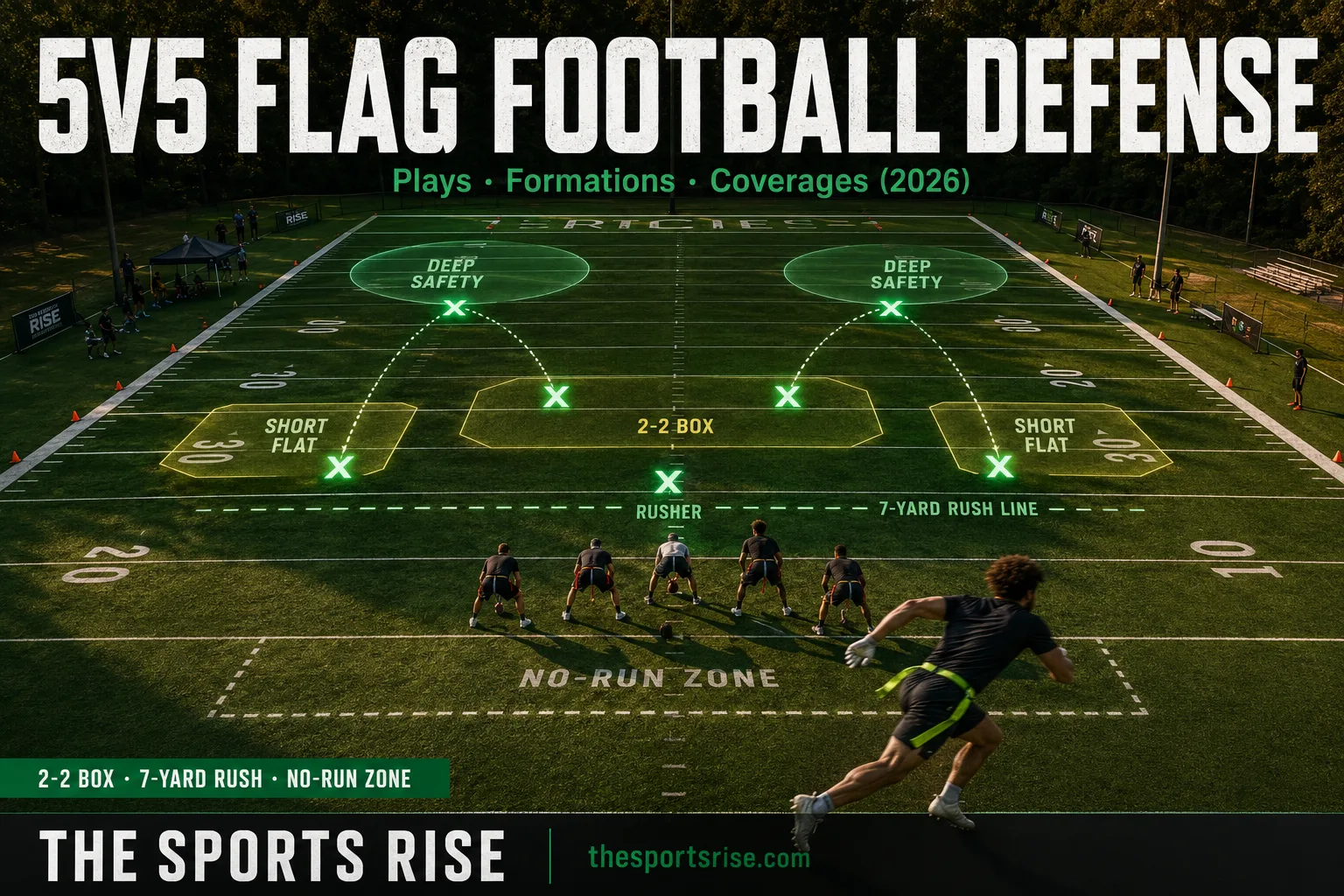
For most 5v5 flag football teams the best base defense is the 2-2 box zone, but the right call on any given snap depends on the offense's formation, where you are on the field, and the 2026 rush rules that decide which schemes are even legal. Get those three inputs right and you can stop almost any offense with five defenders. Get them wrong and a single fast receiver torches you.
This is a coach's playbook, not a buy-my-eBook funnel. Below is the Defense Decision Matrix: the best 5v5 flag football defense plays organized as five schemes, the exact offense each one beats, where on the field to use it, and the weakness to hide. Plus the rule details most flag blogs skip, the ones that quietly cost you points.
Key takeaways
- Base scheme: The 2-2 box zone (1 rusher, 2 short, 2 deep) is the best all-around base for youth and recreational teams. Disguise it from a five-across look.
- The Defense Decision Matrix: Match the scheme to the offense. 2-2 box for balance, 1-3-1 for trips/bunch, 3-1 center safety for deep-ball teams, Cover 1 for the no-run zone, Cover 4 for the last play.
- The 7-yard rule: A rusher must start seven yards back, and only two rushers are allowed per play. Once the ball is handed off, that restriction lifts and everyone can cross the line.
- Zone over man for beginners: Every defender owns an area, so one mismatch doesn't blow up the whole coverage the way it does in man-to-man.
- Defend the center: In NFL FLAG the center can run a route after snapping, which makes them a fifth receiver. The schemes that account for this win; the ones that don't leave you a defender short.
The 2026 rules that shape every defense
You can't pick a defense without knowing what's legal. Five rules govern what your five defenders can do in 2026, under the NFL FLAG, USA Football and IFAF (Olympic) rulebooks. Memorize these and half the strategy writes itself.
The other three: the no-run zones (the five yards before midfield and the five yards before each end zone, where the offense must throw), the center being an eligible receiver who can release into a route after snapping, and the non-contact rule (no tackling, blocking, screening, or bumping receivers off their routes). That last one matters defensively: you cannot jam a receiver, so your positioning and zone spacing are the only tools you have to disrupt timing.
The Defense Decision Matrix: your 5v5 flag football defense plays
Here's the spine of the whole playbook. Five schemes, mapped to the offense each one beats, the best field zone to call it, and the weakness you're accepting. Read it as a menu: identify the offense's look, then pick the row that counters it.
| Defense | Setup (5 defenders) | Beats this offense | Best field zone | Weakness |
|---|---|---|---|---|
| 2-2 Box Zone | 1 rusher, 2 short flat zones, 2 deep safeties | Spread and balanced sets; all-around base | Midfield, open-field downs | Soft middle (the hole between the four zones) |
| 1-3-1 Zone | 1 rusher, 3 underneath, 1 deep safety | Trips and bunch sets flooding short zones | Short-yardage, near your own goal line | Deep sideline shots over the single safety |
| 3-1 Center Safety | 1 rusher, 3 corners on routes, 1 middle safety | Vertical, streak-heavy spread offenses | When the opponent loves the deep ball | Quick out routes and the back in the flat |
| Cover 1 Man-Lock | 1 rusher, 4 defenders locked man-to-man | Predictable timing routes; 3rd-and-short | Goal line and no-run zone (pass is forced) | One mismatch or pick play springs a receiver |
| Cover 4 Quarters | 1 rusher or drop, 4 deep-quarter defenders | Hail-mary, end-of-half deep shots | Last play, protecting a lead | Underneath crossers and the center leaking open |
Scheme 1: the 2-2 box zone (your base)
Start here. The 2-2 box is the most versatile scheme in 5v5 because it splits the field into two short flat zones and two deep halves, with one rusher applying pressure. No single defender is on an island, so one mismatch won't collapse the whole call. Coaches at iFlag and NFL FLAG recommend disguising it: line up five-across, then drop into your zones at the snap so the quarterback can't pre-read the coverage. Its one real soft spot is the middle, the hole between the four zones, so coach your underneath defenders to squeeze any crosser that enters it.
Scheme 2: the 1-3-1 zone (stop trips and bunch)
When an offense stacks three or more receivers to one side (trips or bunch), they're trying to flood your short zones and outnumber you underneath. The 1-3-1 answers it: one rusher, three underneath defenders spread across the short field, and a single deep safety. You win the numbers game at the catch point near the line. The trade-off is obvious from the alignment, only one deep defender, so a disciplined offense can take a deep sideline shot over the top. Use the 1-3-1 in short-yardage and near your own goal line, where there's no room for that deep ball to hurt you.
Scheme 3: the 3-1 center safety (kill the deep ball)
Some offenses just want to run streaks and hit the home run. Against them, play the 3-1 center safety: one rusher, three corners who can turn and run with vertical routes, and one safety planted in the middle of the deep field. Nothing gets behind you. The cost is underneath, quick out routes and the running back leaking into the flat are open, so you're conceding the short completion to take away the long one. That's a good trade when the opponent's whole identity is the deep ball.
Schemes 4 and 5: Cover 1 man-lock and Cover 4 quarters
These are situational. Cover 1 man-lock (one rusher, four defenders in man-to-man) is your call when the offense MUST throw and timing is predictable, the goal line, or inside the no-run zone where the run is illegal. Man coverage is tight, but one mismatch or a well-designed pick play springs a receiver, so only use it when you've taken the run off the table. Cover 4 quarters (four defenders each owning a deep quarter, with a rusher or a fifth dropper) is your prevent look for the last play of a half or to protect a lead, everything stays in front of you. Its weakness is everything underneath: crossers and the center leaking open will move the ball, just not fast enough to beat the clock.
How to stop the run in 5v5
Flag offenses run more than newcomers expect. Three keys. First, your rusher's job on a run read is the flag in the backfield, attack the ball-carrier's belt, not their body (contact is illegal). Second, once the ball crosses the line of scrimmage the seven-yard rule is gone, so swarm: every defender can now converge on the flag. Third, exploit the no-run zones. In the five yards before midfield and before each end zone the offense legally cannot run, so when you're defending there, you already know a pass is coming, drop your rusher, play deeper, and double their best route.
Defending the center (the detail rivals skip)
Here's the wrinkle most online playbooks ignore: in NFL FLAG, the center is allowed to run a route and catch a pass after snapping the ball. That effectively makes the center a fifth eligible receiver. A "lock five defenders on the five offensive skill players" plan leaves you a defender short the moment the center releases into the flat on a quick snap. Every scheme in the matrix above accounts for the center, your underneath zone defenders in the 2-2 and 1-3-1 naturally pick them up, and in man coverage you must assign someone to the center explicitly. If you've ever wondered how you got beaten by "an extra guy," this was it.
Calling it on game day
One decision rule cuts through everything: zone by default, man only when you've forced a pass. Build your foundation on the 2-2 box, mix in the 1-3-1 against bunch sets, and save man-lock and quarters for the no-run zone, the goal line, and the final snap. Disguise every coverage from the same five-across alignment so the quarterback can't pre-snap-read you. And remember a defensive return is live: interceptions are returnable, and a pick-six is worth six points during a scrimmage down, so secure the catch first, then sprint upfield. In a short flag game, one interception swings the result.
Where this is heading: NCAA and LA 2028
This isn't just a backyard game anymore. Flag football was added to the NCAA Emerging Sports for Women program at the 2026 NCAA Convention and recommended toward championship status, with a first NCAA championship projected for spring 2028. And it's officially on the LA 2028 Olympic program, played 5-on-5 under IFAF non-contact rules with separate men's and women's events. The same defensive principles you teach a youth team, own your zone, defend the center, force the pass in the no-run zone, are exactly what Team USA will run on the Olympic stage. If you're new to the sport, our flag vs tackle football guide covers the basics, and the beginner's flag football course walks through positions.
The bottom line: match the scheme to the snap
There's no single "best" 5v5 flag defense, only the best defense for the look you're facing. Run the 2-2 box as your base, reach for the matrix when the offense shows you something specific, defend the center, and let the no-run zone do your work for you. Do that and five defenders is plenty. For the wider flag football world, our flag football hub tracks the youth, college and Olympic game as it grows.
Frequently asked questions
What is the best defense in 5v5 flag football?
For most youth and recreational teams the 2-2 box zone is the best base defense. It splits the field into two short and two deep zones with one rusher, so a single mismatch will not collapse the whole scheme the way it can in man coverage. Coaches at iFlag and NFL FLAG recommend disguising it by lining up five-across, then dropping into zones at the snap.
How far back does a rusher have to start in 5v5 flag football?
Under both NFL FLAG and USA Football 5v5 rules, any player blitzing the quarterback must start at least seven yards behind the line of scrimmage when the ball is snapped, and a referee marks the seven-yard rush line. A maximum of two designated rushers may go per play. Once the ball is handed off the seven-yard restriction is lifted, so all defenders can cross the line.
Is the center an eligible receiver on defense to worry about?
Yes. In NFL FLAG 5v5 the center is allowed to run a route and catch a pass after snapping, which makes them effectively a fifth receiver. Your defense must account for the center releasing into the flat or the middle, especially on quick-snap plays. This is the detail most blog playbooks skip, and it is why a pure five-man lock can leave you a defender short.
Should I play man or zone in youth flag football?
Zone is the safer base for youth and beginner teams because every defender owns an area instead of chasing one fast receiver. In man-to-man a single mismatch can blow up the entire coverage. Use man-lock or Cover 1 situationally, such as on third-and-short or in the no-run zone where the offense must throw, but build your foundation on a 2-2 or 1-3-1 zone.
What is the no-run zone and how do I defend it?
The no-run zone sits five yards before midfield and five yards before each end zone in NFL FLAG and USA Flag rules. Inside it the offense cannot run the ball across the line of scrimmage and must throw a forward pass. Because the run is illegal there, drop your rusher into coverage, play deeper zones, and double the offense's best route, since you know a pass is coming.
Can you return an interception in 5v5 flag football?
Yes. In NFL FLAG, interceptions are returnable and a defensive return for a touchdown is worth six points during a scrimmage down, or two points on an extra-point attempt. Under USA Flag rules an interception not returned past midfield results in a touchback at midfield. Teach defenders to secure the catch first, then look upfield, because a pick-six can swing a short flag game instantly.
Conversation
Be the first to comment.
Leave a comment
Comments are reviewed before appearing. Your email stays private.