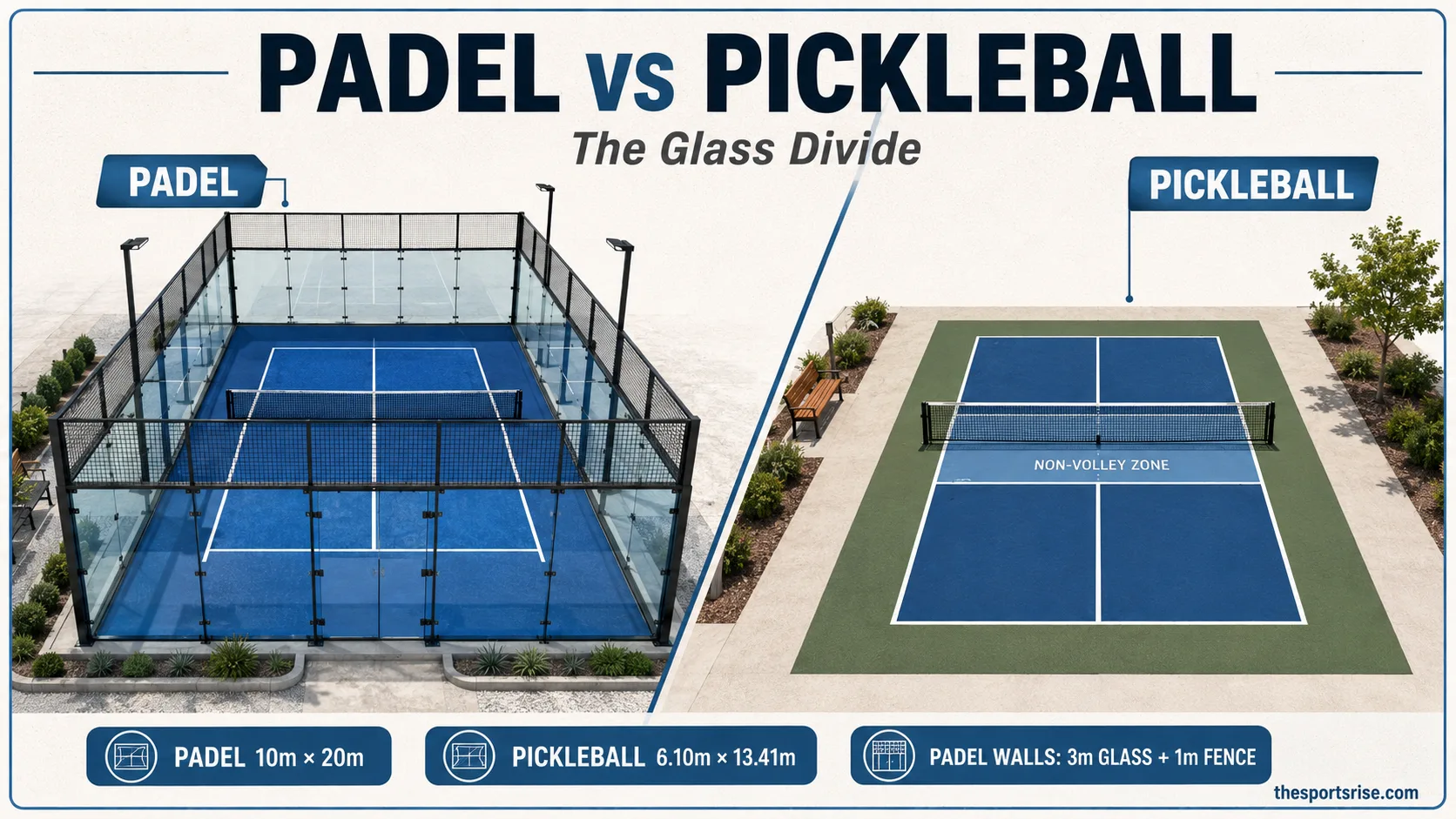
"The walls are part of the game." That one line is the whole fight in padel vs pickleball. Padel locks you inside a court ringed with 3 meters of glass plus a 1-meter fence on top, so the ball lives off the rebound. Pickleball plays open on a flat 20-foot by 44-foot rectangle, no walls, ball's dead the second it crosses a line. Same family, opposite souls. One sport asks you to read glass. The other asks you to respect a painted box. Pick a side, because they don't play the same game at all.
Key takeaways
- The Glass Divide: Padel wraps you in 4 meters of enclosure (3 m wall, 1 m fence per FIP) and the ball stays live off the glass. Pickleball has zero walls. Cross a line and it's over.
- Court footprint: A padel court runs 10 m wide by 20 m long inside. A pickleball court is just 20 ft (6.10 m) by 44 ft (13.41 m), small enough to paint onto a tennis or basketball surface.
- Scoring split: Padel steals tennis scoring outright (15-30-40, games, sets). Standard pickleball races to 11, win by 2, and only the serving side scores.
- The kitchen is pickleball-only: Pickleball's non-volley zone is a 7-foot by 20-foot box where volleys are illegal. Padel has nothing like it.
- Cost and access: A pickleball paddle starts near $50 on a free repurposed court. Padel demands a beginner racket around $89-$119 and a built, bookable enclosed court. That gap decides more than you'd think.
Padel vs pickleball: what each sport actually is
Padel is a doubles-first racket sport played inside an enclosed glass-and-mesh court where the walls are weapons, governed worldwide by the International Padel Federation (FIP). Pickleball is an open-court paddle sport, singles or doubles, run in the US by USA Pickleball. Both use a solid, stringless implement. Both serve underarm. The resemblance dies at the walls.
Here's the cleanest way to tell them apart. In padel, a ball that bounces on your floor and then flies into your own glass is still live, and you can fire it back. In pickleball, anything past the line is just out. That's rebound versus restraint, and it shapes how each game feels in your hand. It's also why borrowing gear across the two isn't as simple as it looks. If you've wondered whether the implements swap, our breakdown of whether you can swap a padel racket onto a pickleball court goes deeper than most.
Is padel the same as pickleball?
No. Padel and pickleball are different sports with different courts, balls, implements, scoring and rules, even though both serve underarm. The table below is the part almost no competitor assembles in full, every figure pulled straight from the FIP Rules of Padel and the USA Pickleball Official Rulebook.
| Spec | Padel (FIP) | Pickleball (USA Pickleball) |
|---|---|---|
| Court size (interior) | 10 m wide x 20 m long | 20 ft (6.10 m) x 44 ft (13.41 m) |
| Walls | Enclosed: 3 m wall + 1 m fence (4 m total), in play | None; open court |
| Net height | 0.88 m center / 0.92 m ends | 34 in center / 36 in sidelines |
| Ball | Rubber sphere, 6.35-6.77 cm, bounces 135-145 cm | Perforated plastic ball |
| Implement | Solid racket, max 45.5 cm, perforated 9-13 mm holes | Solid paddle |
| Scoring | Tennis scoring (15-30-40, games, sets) | First to 11, win by 2 (side-out) |
| Serve | Bounce first, hit at/below waist, diagonal | Volley or drop serve, below waist, diagonal |
| Format | Doubles-dominant | Singles and doubles |
| Cost to start (2026, illustrative) | Racket ~$89-$119 + paid court booking | Paddle from ~$50 + often free courts |
Now look at the net, because the internet keeps lying about it. A few popular comparison pages list the padel net at 36 inches on the sides and 35 in the center. Wrong. FIP rules say 0.88 m at the center rising to 0.92 m at the ends. We went to the source so you don't parrot a number that's been quietly copied around the web for years.
How the walls change everything
The glass is the soul of padel. A ball that bounces on your floor and then rebounds off your own back glass stays alive, and you can drive it back over the net. Defense turns into a chess match. You let the hard shot pass, wait for the rebound, then counter. But there's a trap newcomers walk into constantly.
Hit the ball into the opponent's wall or fence before it bounces on their floor and you lose the point. It has to hit their ground first. That single rule (FIP Rule 13.g) is why padel pays off loop and control over flat power. Smash it too clean and it just dies against the cage on the far side.
That clause is the technical heart of why padel breathes in a way no open court can. Pickleball has no answer to it. Once the ball leaves the 20-by-44 rectangle, the rally is finished, full stop. Want the open-court take on a soft game? Pickleball builds its finesse around a painted box instead of a wall.
The kitchen, the serve, and the rest of the rulebook
Pickleball's signature rule is the non-volley zone, the "kitchen," a 7-foot by 20-foot strip spanning the full width on each side of the net where you can't hit the ball out of the air. Step in to volley and you've faulted. It exists to stop net-campers from bashing every ball straight down. New to it? Our explainer on why the kitchen line trips up beginners walks through the edge cases.
The serve splits them too. Both go underarm and diagonal. But padel makes you bounce the ball first, then strike it at or below waist with a foot planted. Pickleball lets you take a volley serve, contacting below the waist with the paddle head below your wrist on an upward arc, or a drop serve where you bounce it first like padel. Then pickleball stacks on its Two-Bounce Rule: the serve and the return must each bounce before anyone volleys, which strangles early net-rushing.
Scoring is where casuals get buried. Padel lifts tennis wholesale, 15, 30, 40, deuce, advantage, games into sets. Pickleball runs to 11, win by 2, and under standard side-out rules only the serving team can score (rally scoring exists but stays provisional in the 2026 rulebook). If the pickleball call still sounds like a foreign language, our guide to cracking the three-number pickleball call untangles it.
Is padel harder than pickleball, and which burns more?
Padel has the steeper early climb, mostly because reading rebounds off the glass takes weeks, not minutes. Pickleball drops a beginner into real rallies on day one. The smaller court, slower plastic ball and underhand serve let a total novice sustain a fun rally inside an hour. Padel's walls add a dimension your brain has to build from scratch.
On fitness, I'll be straight about the limits. There's no governing-body calorie figure I'd stake this article on, and the confident numbers floating around trace back to nobody. What I'll defend is structural. Padel's enclosed court keeps more balls alive, so rallies run longer, which usually means more continuous movement. Pickleball's lower net (34 in center vs padel's 0.88 m) and tighter court reward quick hands over sustained running. Both go easier on the body than tennis. Neither stays soft once you climb the levels.
Singles flips the math. Pickleball is officially built for both singles and doubles, so a solo workout is baked in. Padel is written almost entirely for doubles, and a singles padel court is a rare sight. (One-on-one padel exists on narrow courts, but it's a fringe format.)
What does it cost to start, and which should you play?
Cost-to-start is the gap almost every comparison skips, and it's where these two split hardest. A beginner pickleball paddle starts around $50 and tops out near $130 for entry models. A beginner padel racket clusters around $89 to $119 in 2026 (illustrative current models, not a governing-body price). But the gear isn't the real bill. The court is.
Pickleball lines drop onto existing tennis, basketball or even driveway surfaces, so you often play for free. Padel needs a purpose-built enclosed court, which means booking and paying per session at a club nearly every time. Free repurposed asphalt versus a built glass box. That single reality makes pickleball dramatically cheaper and faster to start. Weighing the build side? Our look at padel court dimensions and what a US build runs in 2026 spells out why access is the actual barrier.
| Your situation | Lean padel | Lean pickleball |
|---|---|---|
| Budget and access | You have a nearby club and a per-play budget | You want free or near-free, play-anywhere access |
| Space | A built enclosed court is reachable | Any flat surface or repurposed tennis court works |
| Age and joints | You want longer rallies and tennis-style scoring | You want the gentlest learning curve and quick wins |
Popularity tilts global versus local. Padel's worldwide footprint is huge and still climbing, with 19.4 million players, 58,300 courts and nearly 20,000 clubs reported, projected to hit 91,000 courts by 2028 per the Playtomic Global Padel Report. Pickleball, meanwhile, owns US participation. So the honest answer often comes down to what's already near you. To see each sport's coverage, browse our full padel coverage or get the complete pickleball rundown.
The verdict: let the Glass Divide pick for you
The Glass Divide settles this before you grip a racket. If a glass-walled club sits within a sane drive and you don't mind paying to play, padel rewards you with longer, craftier rallies and a ceiling that never stops rising. If you want to start this weekend, free court, paddle under $60, rallying inside the hour, pickleball wins access by a mile. My call, checkable by the 2028 Playtomic update: padel clears 91,000 courts globally while US pickleball stays the cheaper on-ramp. So here's the verdict that ends the argument. Find the nearest court first, and the sport picks itself.
Frequently asked questions
Can you play padel on a tennis court?
No. Padel needs a purpose-built enclosed court 10 m wide by 20 m long with glass walls and a mesh fence, and a standard tennis court is bigger (about 23.77 m long) with no walls, so it can't host a regulation padel match. Tennis courts do get converted sometimes by building padel structures on the footprint, but you can't just line a tennis court for padel the way you can for pickleball.
Why do padel courts have sand?
Padel courts use artificial turf topped with a fine silica sand infill that stabilizes the carpet fibers, controls the ball bounce and gives players grip for fast direction changes. The sand depth sets the pace: less infill makes a faster, bouncier surface, while more sand slows the ball. It's a turf-and-sand system, not the hard acrylic surface most pickleball courts use.
Which is more popular, padel or pickleball?
Padel leads globally with 19.4 million players and 58,300 courts worldwide per Playtomic's 2026 report, while pickleball owns United States participation. So the honest answer rides on geography: outside North America padel is far more visible, especially across Spain and Latin America, while inside the US pickleball stays the household name with millions of domestic players and fast-growing court counts.
Does the padel ball bounce differently from a tennis ball?
Yes. The FIP-approved padel ball is its own thing, slightly smaller at 6.35-6.77 cm in diameter and a touch less pressurized than a tennis ball, built to bounce between 135 and 145 cm when dropped from 2.54 m. It looks like a tennis ball and gets mistaken for one constantly, but it's a separate approved specification, which is why serious players never sub in tennis balls for real padel.
Can beginners learn pickleball faster than padel?
Yes. Most beginners rally in pickleball within an hour because the court is small, the plastic ball moves slowly and the underhand serve is simple. Padel piles on wall rebounds that take weeks to read, so the first sessions feel harder. The Two-Bounce Rule in pickleball also slows the early game on purpose, giving newcomers time to set up shots before anyone attacks at the net.
Conversation
Be the first to comment.
Leave a comment
Comments are reviewed before appearing. Your email stays private.