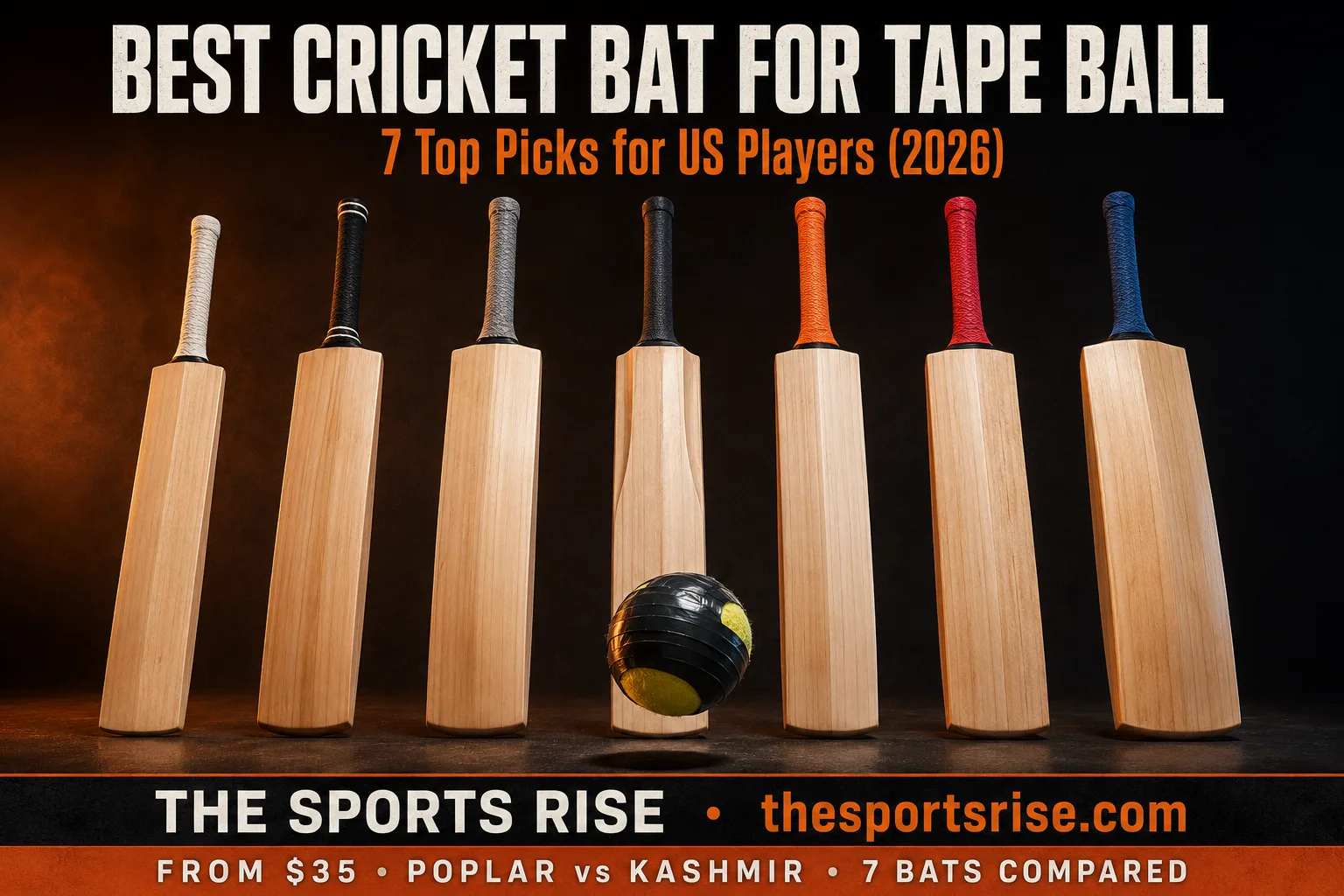
The best cricket bat for tape ball cricket in 2026 is a lightweight 800-1,150 gram poplar-wood or Kashmir-willow bat with a wide face, thick edges and a full-cane handle, and for US players that means buying from CricketZoneUSA, Best Cricket Store, Cricket Store Online or Amazon US rather than importing from Sialkot. Below: seven bats verified at US retailers in June 2026, with prices, weights, and the Tape-Ball Bat Triangle that picks one for you in 30 seconds.
This is the US-context guide that didn't exist online before. The query is dominated by ecommerce category pages and India-focused content; there was no editorial buyer's guide for the roughly 200,000-plus cricketers playing tape-ball or tennis-ball formats in the United States. Until now.
Key takeaways
- Tape-Ball Bat Triangle: three corners decide your buy. Budget ($35-50) = Ihsan SIXER or CA Pro Force. Mid-range ($60-85) = CA Rustam or Hammer Steele. Premium ($100+) = Kookaburra TB 1000 Scoop.
- Weight sweet spot: 2 lb 4 oz to 2 lb 8 oz (~1.02-1.13 kg) for adult tape-ball play. Dedicated bats often run lighter (780-950 g) to swing fast against a tape ball that travels ~20% quicker than a regulation cricket ball.
- Material decides life: Poplar willow is the standard for tape-ball-only bats (light, cheap, durable enough for soft balls). Kashmir willow is the crossover option for players who also face Incrediballs or leather. English willow is overkill and chips under tape impact.
- Don't import: MB Malik HMZ trims sell for PKR 4,000-5,000 (~$15-18) from Sialkot, but shipping and duty push the delivered US price to $40-70. Four US retailers stock comparable bats at that price already.
- Tape-ball needs no knock-in: a tape ball is soft enough that traditional bat-prep is unnecessary. Most US-stocked bats ship with a protective film plus a 3-layer rubber-sheet handle wrap and play out of the box.
Why tape-ball cricket needs its own bat
Three reasons. First, a tape ball (a tennis ball wrapped in electrical tape) is widely reported to travel meaningfully faster through the air than a regulation 156-gram leather cricket ball because the tape smooths the felt and reduces drag, with Wikipedia and tape-ball league sources citing a roughly 20% pace gain in informal testing. Faster ball off the surface, less reaction time, premium on bat speed. Second, the tape kills the spin grip that a leather ball gets from its seam, so deliveries skid through low rather than gripping and rising. Hitters need a flatter, wider face to make contact on lower trajectories. Third, the impact load is far gentler than leather, so the heavy reinforcement and knock-in protocols built into a $300 English willow bat are wasted.
Net effect: the optimal tape-ball bat is lighter, cheaper, thicker-edged, and made of poplar or Kashmir willow instead of English. Buying a $300 English willow bat for tape-ball cricket is like buying a Ferrari for a school commute. The MLC 2026 league is hardball professional cricket, but most of the United States' 300,000+ cricketers play tape-ball or tennis-ball formats in parks, school gyms, and league nights. The bat market that matters in the US is this one. (USA Cricket and Wikipedia together put US cricket participation at roughly 200,000+, with the soft-ball tape-ball and tennis-ball formats dominating informal play.)
The three ball types and which bat each demands
Cricket in the US comes in three soft-ball variants and you need to know which one you actually play before buying. Pure leather red/white ball cricket is the format MLC uses and demands English willow with full knock-in. A taped tennis ball (Pakistani / PSL street style, electrical tape over a fluorescent tennis ball) is the most common backyard / MLTB format, and that's what this guide is about. A plain uncovered tennis ball is the lightest, slowest variant, popular in informal park games, and works fine with a cheap tennis-ball bat or even a regular tape-ball bat.
If you play with electrical-taped balls (the Pakistani PSL style), buy a dedicated tape-ball bat: scoop or thick-edge profile, poplar or Kashmir willow, 800-1,150 g weight range. If you play with plain tennis balls only, a lighter tennis-ball bat is fine. If you play both, pick a versatile mid-range like the CA Rustam.
Weight, material, profile: what actually matters
Weight is the variable that decides bat speed. The recommended tape-ball range for most adult and late-teen players is 2 lb 4 oz to 2 lb 8 oz (1.02 to 1.13 kg), per Cricket Store Online's weight guide. Dedicated tape-ball models often go lighter still: the CA Pro Force 10000 sits at 780-820 g (1.72-1.81 lb) for maximum bat speed, and Ihsan's official tape range is 850-950 g. Lighter equals faster swing against a quicker ball.
Material decides longevity. Poplar wood is the entry-tier choice, light and cheap, durable enough for soft balls but it will chip in 1-2 years of heavy use. Kashmir willow is the upgrade: denser, holds an edge longer, the manufacturer-recommended starter material for Incrediballs, tennis balls, taped balls and Wonderballs. English willow is the leather-ball material; do not buy it for tape-ball play. Sri Lankan Mara wood appears on imported bats occasionally and is a niche choice.
Profile matters for hitters. A scoop back (Kookaburra TB 1000-style) pushes mass into the sweet-spot middle and is the choice for power-hitters who want six-hitting maximums. A flat-face thick-edge profile (CA Rustam, CA Pro Force) is the all-rounder choice and the more common style. Handle should be full-cane with at least two layers of rubber sheet wrap for shock absorption.
7 best tape-ball cricket bats: verified US retailer specs (June 2026)
| Bat model | Material | Weight | Price (USD) | Best for |
|---|---|---|---|---|
| CA Pro Force 10000 (2026) | Poplar willow, full-cane handle | 780-820 g (1.72-1.81 lb) | $49.99 (CricketZoneUSA) | Sub-$50 dedicated tape bat, max bat speed |
| CA Rustam Tape Tennis Bat | Poplar willow, 3-layer rubber cane handle | 2 lb 7 oz - 2 lb 9 oz (1,105-1,162 g) | $63 (Best Cricket Store) | All-rounder for backyard + MLTB 10-over innings |
| CA Gold Dragon (2025) | Poplar willow, full-cane handle | ~850-950 g (1.87-2.09 lb) | $69.99 (CricketZoneUSA) | Premium poplar build, thicker edge profile |
| Kookaburra TB 1000 Scoop | Willow, scoop back profile | ~1,100-1,180 g (2.42-2.60 lb) | $125.99 (Cricket Store Online) | Scoop-profile power hitters who want a brand name |
| Hammer Steele Kashmir Willow | Kashmir willow | ~1,200-1,270 g (2.64-2.80 lb) | $62.99 (Cricket Store Online) | True-willow value for soft-ball crossover play |
| SS Rinku Singh Premium Bronze | Kashmir willow | ~1,170-1,250 g (2.58-2.75 lb) | $83.99 (Cricket Store Online) | Crossover players who also face Incrediballs or leather |
| Ihsan SIXER | Poplar willow, cane handle | 850-950 g (1.87-2.09 lb) | $34.95 (Amazon US, list $45) | Ultra-budget first tape-ball bat |
The best cricket bat for tape ball cricket: 7 picks for US players reviewed
CA Pro Force 10000 (2026), $49.99 at CricketZoneUSA
The best sub-$50 dedicated tape-ball bat on the US market right now. Poplar willow construction, full-cane handle, 780-820 g (about 1.75 lb) for maximum bat speed against a tape ball. The thick-edge profile gives generous middle, and the CricketZoneUSA US warehouse means 2-3 day delivery to most states without import friction. If you want one bat to start with and you don't want to overthink it, this is the pick.
CA Rustam Tape Tennis Bat, $63 at Best Cricket Store
The all-rounder. 50-inch length, 34-34.5 cm blade, poplar willow, three layers of rubber sheet on the full-cane handle, 2 lb 7 oz - 2 lb 9 oz (1,105-1,162 g). It sits in the heart of the recommended adult weight range, which makes it the natural choice for MLTB 10-over hitters and backyard players alike. The Best Cricket Store US warehouse handles shipping.
CA Gold Dragon (2025), $69.99 at CricketZoneUSA
The premium poplar option from CA's 2025 line. Thicker edge profile than the Pro Force, slightly heavier at ~850-950 g, designed for players who want a step up without crossing into Kashmir willow pricing. CricketZoneUSA also carries the CA Gold Smash 12000 (a tennis-ball variant) at $54.99 for plain-tennis-ball players.
Kookaburra TB 1000 Scoop, $125.99 at Cricket Store Online
The premium scoop-back tape-ball bat. Kookaburra is the household brand globally, the scoop profile pushes mass into the middle for six-hitting maximums, and the build quality justifies the price premium for committed players. At ~1,100-1,180 g (2.42-2.60 lb) it's near the heavier end of the adult range. Best for power hitters who want a Kookaburra name on the bat.
Hammer Steele Kashmir Willow, $62.99 at Cricket Store Online
The best Kashmir-willow value on this list. At $62.99 you get a true willow blade (not poplar) that holds an edge longer and crosses over to harder soft balls (Incrediballs, taped balls). Weight 1,200-1,270 g, so it's a heavier bat best suited to players with developed forearm strength. Worth the upgrade from poplar if your forearms can handle it.
SS Rinku Singh Premium Bronze Kashmir, $83.99 at Cricket Store Online
The crossover bat. SS is one of India's most-trusted brands, the Rinku Singh signature model is Kashmir willow at 1,170-1,250 g, and the construction is solid enough to face both tape balls and Incrediballs without complaint. Pick this if you play in multiple formats and you want one bat that survives all of them.
Ihsan SIXER, $34.95 on Amazon US
The ultra-budget pick. Ihsan's official tape-ball range (Master, Power, Bhuru, SIXER) is built to 850-950 g spec at PKR 1,100-4,600 in Pakistan; the SIXER variant on Amazon US (list $45, frequently discounted to $34.95) is the simplest entry into tape-ball cricket. Poplar willow, basic cane handle, ready to play. Good for kids or as a backup bat.
Imported from Pakistan vs on-shelf in the US
The pricing on Sialkot factories is, on paper, dramatic. MB Malik HMZ trims sell for PKR 4,000-5,000 (~$15-18 USD) from the official factory storefront on mbmaliksports.com.pk. Ihsan's full range is PKR 1,100-4,600. So why not just import? Three reasons. Shipping a single cricket bat from Pakistan to the US is typically $25-45 by air, customs duty on sporting goods runs 4-8%, and lead time is 2-3 weeks. The delivered US cost lands at $40-70, which is identical to or above what CricketZoneUSA and Best Cricket Store already charge for comparable bats with 2-3 day US warehouse shipping. Skip the import unless you're buying a specific custom build.
Knock-in and care: the tape-ball truth
You almost certainly don't need to knock in a tape-ball bat. Knock-in exists because a 156-gram leather ball strikes hard enough to crack unconditioned willow on first contact, so the standard pre-prep is 4-6 hours of mallet work to compress the fibres. A tape ball is a tennis ball wrapped in tape: maybe 60-80 grams, soft surface, gentle impact load. Poplar wood is also denser than English willow and less prone to early splitting. Most US-stocked tape-ball bats (CA Pro Force, CA Rustam, CA Vision 5000) ship with a protective film over the face and three layers of rubber sheet on the handle. Out of the box, into the innings.
Care is simpler too. Oil only Kashmir willow (linseed oil, once or twice a season). Tape the toe if you live in a wet climate. Replace the rubber grip on the handle every season or when it gets shiny. Store the bat upright in a dry place. Done.
How tape-ball bats built world-class talent
One thing worth knowing for anyone serious about tape-ball cricket: most of Pakistan's greatest fast bowlers learned to bowl in tape-ball circuits before they ever touched a leather ball professionally. Wasim Akram came up through Lahore tape-ball circuits in 1983. Mohammad Amir was scouted at 14 in 2006 by Mudassar Nazar at Pakistan's National Cricket Academy after coming up through tape-ball cricket. Shaheen Afridi, Haris Rauf and Umar Gul all share the same backstory. The reason tape-ball produces fast bowlers is that the lighter, faster ball rewards a quick wrist and an extreme arm action, both of which translate directly to leather-ball pace once a player makes the transition.
The takeaway for a US player choosing a bat: a bat that lets you swing fast and connect cleanly against a faster ball is also a bat that will teach you the most about timing. The Tape-Ball Bat Triangle reflects that. Lighter, wider, cheaper — pick the bat that lets you take the most balls in your first year.
Where US tape-ball cricket is going
The institutional picture for tape-ball in the US is brighter than at any point in the format's history. Major League Tapeball (MLTB) is a New York-based corporation headquartered at 75 South Broadway, White Plains, NY 10601, operating across 13 US states with a 10-over, 11-player format. USA Cricket now officially recognises tapeball as one of its core domestic formats alongside hardball, softball, indoor, and disabled cricket. The Major League Cricket 2026 season (June 18 to July 18) is hardball, but it's drawing new US fans into the broader cricket ecosystem, many of whom will pick up a tape-ball bat first.
Add the LA 2028 Olympic cricket inclusion (one of the 5 new sports added at LA 2028) and the US tape-ball bat market is the fastest-growing it has ever been. For the professional hardball context, our Major League Cricket explainer covers MLC's six teams and the 2026 season.
Final verdict: the Tape-Ball Bat Triangle applied
Pick by budget tier. Under $40, buy the Ihsan SIXER on Amazon US ($34.95). Between $40-65, buy the CA Pro Force 10000 ($49.99 at CricketZoneUSA) if you want maximum bat speed or the CA Rustam ($63 at Best Cricket Store) if you want the all-rounder. Between $65-90, buy the Hammer Steele Kashmir willow ($62.99) or SS Rinku Singh ($83.99) if you also face harder balls. Above $100, buy the Kookaburra TB 1000 Scoop ($125.99) for the brand and the scoop. Three corners of the Tape-Ball Bat Triangle, one bat for every player. For the broader US cricket scene, see our cricket USA hub.
Frequently asked questions
What is the best cricket bat for tape ball cricket in the US in 2026?
For most US adult players, the CA Rustam Tape Tennis Bat at $63 from Best Cricket Store is the strongest all-rounder: 50-inch length, 34-34.5 cm blade, poplar wood construction, and a full-cane handle wrapped with three layers of rubber sheet. It hits the 2lb 7oz to 2lb 9oz weight band that MLTB-style 10-over hitters prefer, and it ships from a US warehouse so you skip Sialkot import fees.
What weight should a tape ball cricket bat be?
Most adult and late-teen tape-ball players hit best in the 2 lb 4 oz to 2 lb 8 oz range (roughly 1,020 to 1,130 grams), per Cricket Store Online's weight guide. Dedicated tape-ball models often run lighter still: the CA Pro Force 10000 sits at 780-820 grams (about 1.72-1.81 lb) for maximum bat speed, while Ihsan's official tape-ball range is stated at 850-950 grams (the SIXER variant on Amazon US weighs closer to 1,000 g). Lighter equals faster swing against a 20%-quicker tape ball.
Can you use a regular English willow cricket bat for tape ball cricket?
Technically yes, but it's poor economics. Tape balls deliver heavier impact than tennis balls and skid unpredictably, which chips and cracks English willow blades that were prepared for leather-ball cricket. Kashmir willow is the manufacturer-recommended starter material for soft balls including Incrediballs, tennis balls, taped balls, and Wonderballs. Save a $300 English willow bat for hardball league play and grab a $50-65 poplar or Kashmir willow tape bat for tape-ball innings.
What is the difference between a tape ball bat and a regular tennis ball bat?
A dedicated tape-ball bat is engineered for the extra weight and skid of a taped tennis ball, with an exceptionally wide face, thick edges, and a pronounced profile, often with a scoop back like the Kookaburra TB 1000. A plain tennis-ball bat is lighter, flatter, and aimed at street cricket with an uncovered tennis ball. If you play with electrical-taped balls (Pakistani PSL style), buy a tape-specific bat; if you play with plain tennis balls only, a lighter tennis-ball bat is fine.
Where can you buy tape ball cricket bats in the United States?
Four US retailers stock tape-ball bats in USD with US-warehouse shipping: CricketZoneUSA (CA Pro Force, CA Gold Dragon, CA Gold Smash), Best Cricket Store (CA Rustam), Cricket Store Online (Kookaburra TB 1000, Hammer Steele, SS Rinku Singh), and Amazon US (Ihsan SIXER). For Pakistan-direct buys, MB Malik HMZ trims sell for PKR 4,000-5,000 on mbmaliksports.com.pk, though shipping and duty typically push the US delivered price to $40-70.
Do you need to knock in a tape ball cricket bat before using it?
Almost never. Knock-in exists to compress willow fibers so a 156-gram leather ball does not crack the face on first contact. A tape ball is a tennis ball wrapped in electrical tape, far softer and lighter than leather. Most poplar-wood tape-ball bats (CA Pro Force, CA Rustam, CA Vision 5000) ship with a protective film and three layers of rubber sheet on the handle, and are ready to face an MLTB 10-over innings straight out of the box.
Conversation
Be the first to comment.
Leave a comment
Comments are reviewed before appearing. Your email stays private.