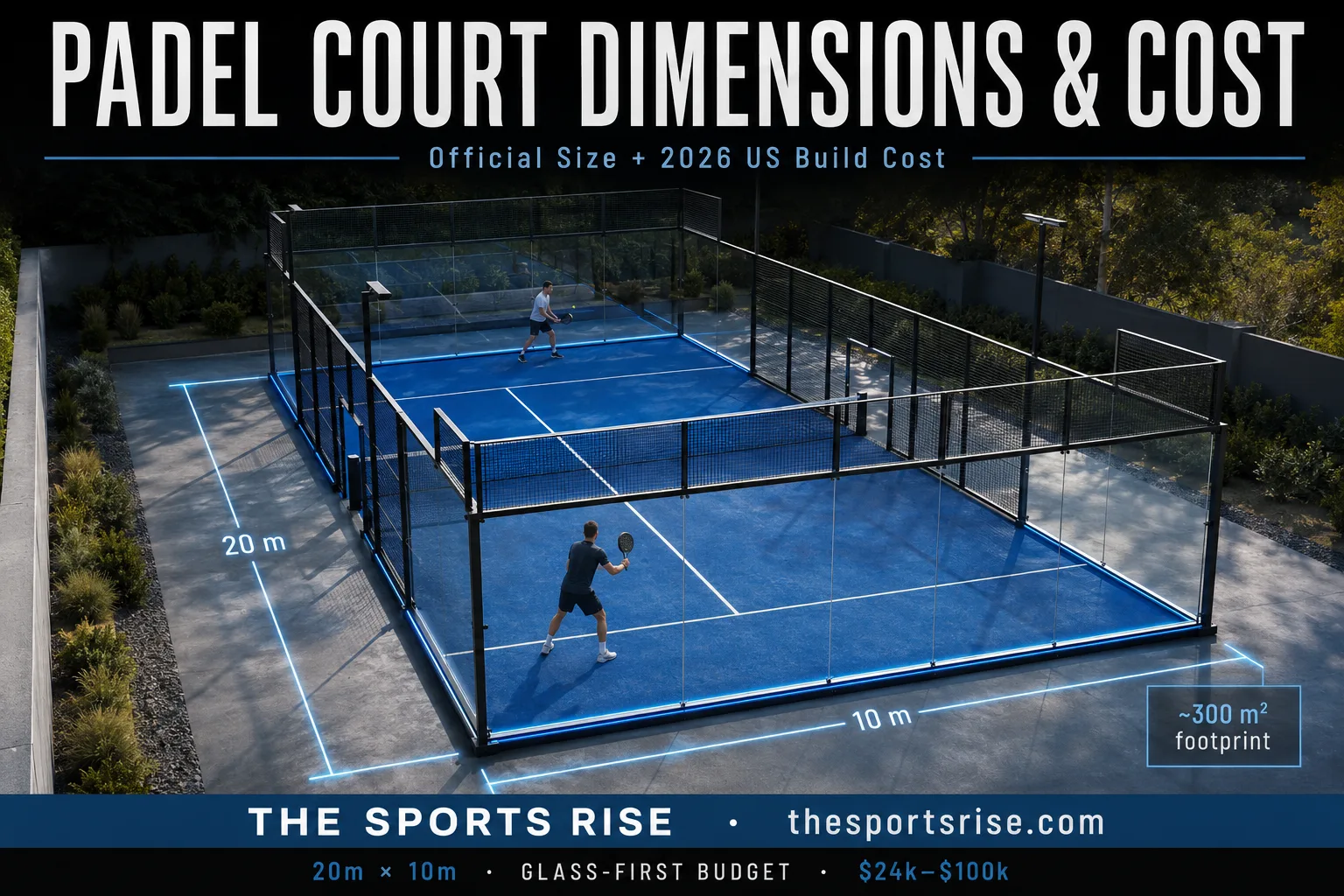
A regulation padel court is exactly 20 meters long by 10 meters wide, but the number most US builders actually need is the second one: a single turnkey court typically costs between $24,000 and $100,000, and it's the glass-and-steel enclosure, not the playing surface, that drives that budget. Get those two facts straight and you can plan a court that's both FIP-legal and on budget. Get them wrong and you'll either fail homologation or blow past your number on the part you least expected.
This is a builder's guide to padel court dimensions and cost to build, not a sales pitch. Below are the official 2026 FIP dimensions in metric and feet, a space-fit planner, and a fully itemized US cost table, organized around the one idea that decides your budget: the Glass-First Budget.
Key takeaways
- Court size: 20 m long by 10 m wide (interior), a 0.5% tolerance, divided by a net. That's about 65.6 ft by 32.8 ft.
- Total footprint: Add FIP safety run-off (3 m minimum, 4 m recommended, each side) and you need roughly 23 m by 13 m (about 75 by 43 ft), close to 300 square meters.
- The Glass-First Budget: The steel-and-tempered-glass enclosure is 40-60% of the project, the single biggest cost. The playing surface is only 10-20%.
- US build cost (2026): $24,000 to $100,000-plus per court. An itemized 2026 build lands at $43,000-$96,100; a documented real outdoor install came to about $73,000.
- Indoor premium: An indoor court runs 20-40% more once you add a roof, lighting and ventilation, typically $8,000-$25,000 extra for the structure alone.
Official padel court dimensions (FIP 2026)
Padel's dimensions are set by the FIP Rules of Padel, with the current version in force from January 1, 2026. The court is a rectangle 10 meters wide by 20 meters long, measured on the interior, with a 0.5% tolerance. A net divides it in half. On each side, the service lines sit 6.95 meters from and parallel to the net, and a central service line splits each service box. Every court line is 5 cm wide, preferably white or black for contrast against the surface.
The net itself is 10 meters long, 0.88 meters high at the center, rising to 0.92 meters at the two ends, with a tolerance of just 0.005 meters and posts no taller than 1.05 meters. These are tight tolerances, padel is a precise, standardized sport, which is exactly why you can't freelance the build.
The walls and enclosure
The walls are what make padel padel, you play off them like squash. The back walls (the ends) total 4 meters in height: the first 3 meters are a solid wall (tempered glass, brick, or similar) and the top 1 meter is metallic fence. The sides come in two FIP-approved variants: a stepped wall (a 3 m x 2 m step then a 2 m x 2 m step) or a single crystal wall 3 meters high by 4 meters long with no step, with metallic fencing completing the enclosure up to 4 meters at the ends and 3 meters across the central 6 meters. Clear height must be at least 6 meters everywhere, and FIP suggests 8 meters for new facilities.
Will it fit my space?
This is where backyard dreams meet reality. The court is 20 m x 10 m, but FIP requires an out-of-court safety zone with no obstacles, at least 3 meters wide (4 recommended) and 4 meters long on each side, and a minimum of 3 meters of clear height in that run-off. Add it up and your real footprint is roughly 23 meters by 13 meters, around 300 square meters, or about 75 by 43 feet. For an indoor court, the ceiling is the constraint: 6 meters is the legal minimum, but 8-10 meters is strongly preferred so high lobs play correctly. Measure your space against 300 sq m before you price anything.
Cost to build a padel court in the US (2026)
Now the number you came for. A single turnkey court in the US runs from about $24,000 at the absolute budget end to over $100,000 for a premium indoor build. Sports Venue Calculator's 2026 itemized estimate lands at $43,000 to $96,100 complete, and a documented real US outdoor install totaled about $73,000 including civil work. Here's where the money actually goes:
| Build component | Typical US cost (2026, per court) | Share of project | Notes |
|---|---|---|---|
| Steel structure + tempered-glass enclosure | $22,500 - $38,300 | 40-60% | Largest line item; 12 mm glass to EN 12150-1, steel posts |
| Reinforced concrete base / groundwork | $0 - $25,000 | up to 40% (US) | 6-inch rebar slab; depends on existing site & soil |
| Playing surface (synthetic turf) | $5,600 - $13,500 | 10-20% | Sand-filled turf, green/blue/terracotta; cement also allowed |
| LED sports lighting | $2,800 - $10,000 | 10-15% | 8x 200W LEDs typical; minimum 6 m mounting height |
| Doors, net, padding & accessories | $2,600 - $10,200 | ~10% | Access doors, anti-shock padding, net & posts |
| Freight / transport | $8,000 - $22,000 | 5-15% | Under 5% if US-stocked; 10-15% if imported |
| Installation & assembly labor | $3,000 - $10,000 | 10-15% | Roughly one week for frame, glass, turf, lighting |
| Indoor roof / building (optional) | +$8,000 - $25,000 | adds 20-40% | Steel canopy or building; 8 m ceiling recommended |
The Glass-First Budget: where the money really goes
Here's the insight that reframes the whole project. On most sports surfaces, the playing field is the main cost. Padel is the opposite: the structural enclosure, the steel frame and tempered glass, is the single biggest expense at 40 to 60 percent of the build. The glass-and-steel package alone runs roughly $15,000 to $25,000. In the US, contractors often flag the reinforced concrete base as the largest single line, near 40 percent on a difficult site. The turf you'll actually play on? Just 10 to 20 percent. Budget glass-first, and the rest falls into place. Budget surface-first, and you'll be shocked by the enclosure quote.
Indoor vs outdoor: the real decision
Outdoor courts are cheaper upfront but need proper drainage (a maximum 1% slope where there's no built-in drainage) and they're weather-exposed, so playing hours drop in heat, rain or cold. Indoor courts cost 20 to 40 percent more, an extra $8,000 to $25,000 for the roof or building, plus lighting and ventilation, but they deliver year-round play and year-round revenue if you're running a club. The math usually comes down to climate and whether the court is private or commercial. A backyard court in a mild climate stays outdoor; a club court that needs to book sessions 12 months a year almost always goes indoor.
Surface, drainage and lighting specs that affect cost
A few FIP specs quietly shape your budget. The ground surface may be cement, synthetic material, or artificial grass in green, blue, or terracotta, with level differences under 3 mm measured against a 3-meter rule. Where there's no drainage system, a maximum transverse slope of 1% is allowed. For lighting, recreational play needs roughly 200-300 lux, but a court built for broadcast needs closer to 1,000 lux, which means more and higher-output LEDs, more cost. Decide your court's purpose before you spec the lights.
Permits, foundation and US site prep
Don't forget the unglamorous parts. Most US installs need a reinforced concrete slab (commonly a 6-inch rebar slab), and in hurricane or high-wind regions you'll need engineered anchoring for the steel structure, which adds cost. Local permits typically add around 5% to the project and several weeks to the timeline. Soil condition is the wildcard: a flat, stable, already-paved site can skip much of the groundwork (dropping the concrete line toward zero), while a sloped or soft site can make the base your biggest single expense.
The bottom line on padel court dimensions and cost to build
A padel court is 20 meters by 10 meters, needs about 300 square meters of total space, and costs $24,000 to $100,000-plus to build in the US, with the glass-and-steel enclosure eating 40 to 60 percent of the budget. Plan the space first, budget the enclosure first, and decide indoor-vs-outdoor on your climate and revenue goals. If you're newer to the sport, our padel racket vs pickleball paddle guide covers the gear, the beginner's padel course covers how to play, and our squash vs racquetball comparison tackles a related walled-court question. If you're still deciding which sport to play, our padel vs pickleball breakdown lays out how the two games differ on court, rules and feel. Everything padel lives on our padel hub.
Frequently asked questions
What are the official dimensions of a padel court?
Under the FIP Rules of Padel (in force 01.01.2026), the court is a rectangle 10 meters wide by 20 meters long measured on the interior, with a 0.5% tolerance. A net divides it in half, and service lines sit 6.95 meters from the net on each side. All court lines are 5 cm wide, preferably white or black for contrast.
How much space do I need to build a padel court?
The court itself is 20 m x 10 m, but FIP requires safety run-off of at least 3 meters (4 recommended) wide and 4 meters long on each side, plus 3 meters of clear height in that zone. In practice you should plan a total footprint of roughly 23 m x 13 m (about 75 x 43 feet), or near 300 square meters including run-off and structure.
How much does it cost to build a padel court in the US in 2026?
A single turnkey court typically runs $24,000 to $100,000-plus. Sports Venue Calculator's 2026 itemized build lands at $43,000 to $96,100 complete, and a documented US outdoor install totaled about $73,000 including civil work. Indoor courts run roughly 20 to 40 percent higher once a building or roof, lighting, and ventilation are added.
What is the most expensive part of building a padel court?
Unlike most sports surfaces, the structural enclosure rather than the playing surface is the biggest cost, accounting for 40 to 60 percent of the project. Tempered glass with steel framing alone runs roughly $15,000 to $25,000. In the US, contractors often cite the reinforced concrete base as the single largest line, near 40 percent of total spend on a difficult site.
How tall are the walls on a padel court?
Back walls total 4 meters: the first 3 meters are solid wall (tempered glass, brick, or similar) and the top 1 meter is metallic fence. Sides use a stepped or crystal variant up to 4 meters at the ends and 3 meters in the center. FIP requires at least 6 meters of clear height throughout, with 8 meters suggested for new facilities.
What glass and surface does an official padel court use?
Walls must give a uniform bounce and be hard and smooth; glass must meet FIP homologation standards for tempered glass, commonly 12 mm panels to EN 12150-1. The ground surface may be cement, synthetic material, or artificial grass in green, blue, or terracotta, with level differences under 3 mm over a 3-meter rule and a 1% drainage slope where used.
Conversation
Be the first to comment.
Leave a comment
Comments are reviewed before appearing. Your email stays private.