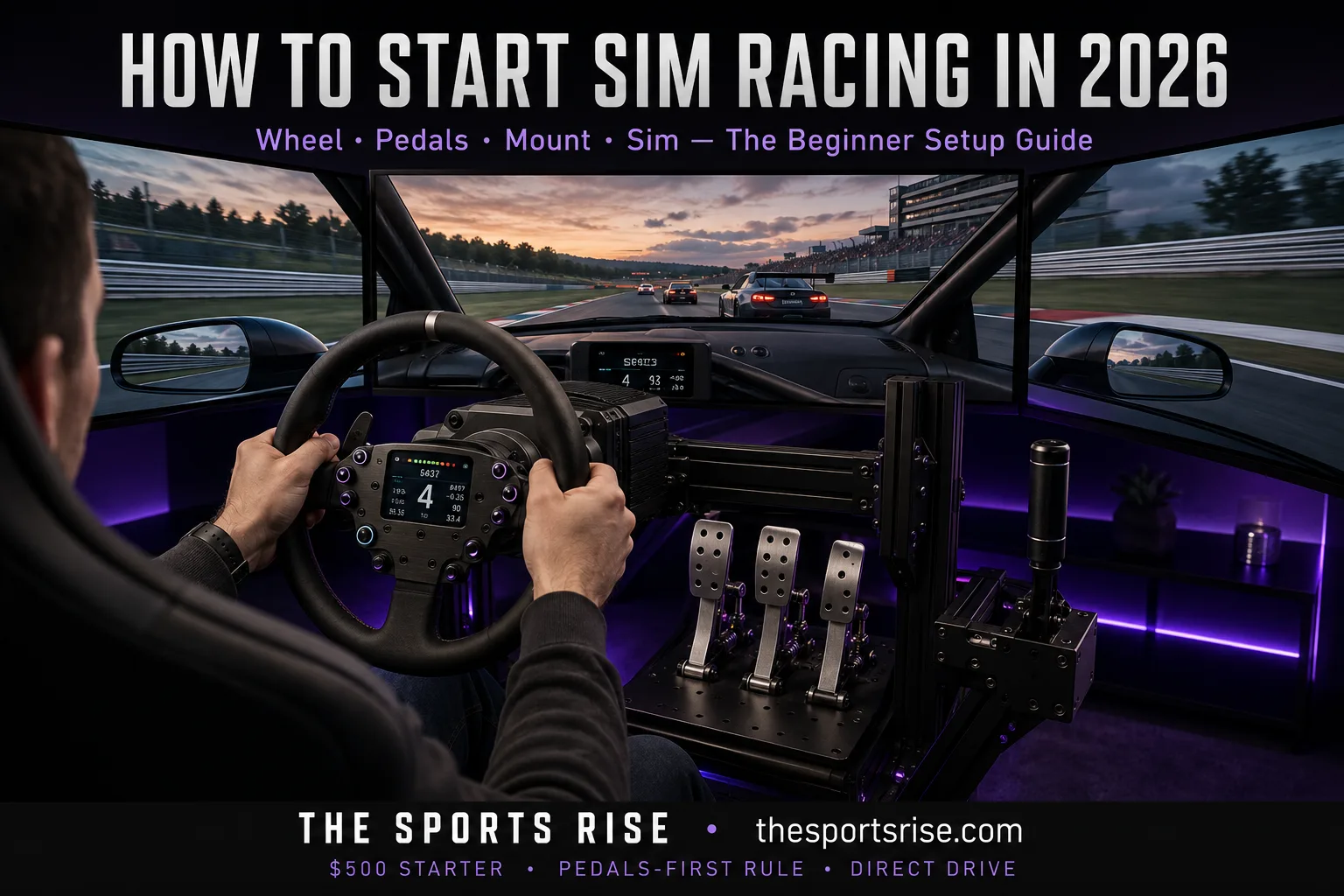
To start sim racing you need four things: a wheel and wheelbase, a set of pedals, a way to mount them, and a sim platform (the game) to drive on. You can get the whole package for about $400 with the Moza R5 bundle, or under $250 if you build cheap. And here's the contrarian advice most beginner guides miss: spend the marginal dollar on the pedals, not the wheel.
That's the pedal-first rule, and once you understand it you'll stop wasting money where most newcomers do. Below is the full beginner setup, in the order you should actually buy and build it, with prices and product types verified against the current 2026 sim-racing market.
Key takeaways
- Starter kit cost: A complete beginner sim-racing setup runs about $250 (budget) to $1,000-plus (enthusiast). The Moza R5 direct-drive bundle (~$400 at MOZA Racing US) is the consensus "best value" of 2026.
- The four things you need: a wheelbase + wheel, pedals, a mount (desk clamp or wheel stand), and a sim platform such as iRacing, Assetto Corsa Competizione or rFactor 2.
- The pedal-first rule: Better pedals (especially load-cell brakes) cut lap times more than upgrading the wheel. Most beginners do the opposite, and it shows.
- Direct drive is now affordable: Entry-level direct-drive bundles (Moza R5, Fanatec CSL DD, PXN V12) used to start at $1,000-plus and now start near $250-500, killing the case for the old gear-driven Logitech G29 in 2026.
- Pick one sim, don't sample five: iRacing for online competition, Assetto Corsa Competizione for everything else. Stick with one until you can lap a single track consistently.
How to start sim racing: what you actually need
Four pieces, nothing more, nothing less. A wheelbase (the motor that creates force feedback), a steering wheel that attaches to the base, a set of pedals (throttle and brake at minimum), and a way to mount the whole rig so it doesn't slide around. Then a sim platform to drive in, and you're racing. Everything else (shifters, handbrakes, button boxes, triple monitors, motion rigs) is optional and comes later.
Treat that list as the bill of materials and you stop falling for the upsell. Some guides will tell you that you also need a dedicated PC, a racing seat and a 49-inch curved monitor. You don't. You need the four things above. Drive on whatever screen you already own.
Step 1: The wheelbase and wheel
The wheelbase is the most important hardware choice, and 2026 has made the decision easy: get a direct-drive base, not a gear-driven one. Direct drive used to cost over a thousand dollars and now starts at about $400 with entry bundles like the Moza R3 (~$299) and PXN V12 Lite (~$469), climbing to ~$400 for the Moza R5 bundle (a wheelbase + wheel + pedals package widely cited as the best starter value of the year). Older gear-driven options like the Logitech G29 still work, but the force feedback is noticeably weaker; only buy second-hand if budget is tight.
The wheel itself (the part you hold) typically comes bundled with entry bases. You can swap it later for a wheel with more buttons or a different feel (round, F1-style or rally-style), but the bundled wheel is fine for at least a year of beginner driving. Don't overthink it.
Step 2: Pedals (where the contrarian advice lives)
This is where the pedal-first rule lands. Standard "potentiometer" pedals measure how far you push the brake. Load-cell brake pedals measure how hard you push. Real cars work the way load-cell pedals do, and your brain has spent your whole driving life learning that pressure-not-distance is what controls a brake. Switch to a load-cell brake and your lap times drop within hours.
Many entry bundles ship with potentiometer pedals to hit a price point. That's the upgrade to make first, before you ever think about a fancier wheel. Standalone load-cell pedal sets range from about $200 (Fanatec CSL pedals plus the load-cell kit) up to ~$400 for the Moza CRP2 and ~$500 for the Heusinkveld Sprint, and they are the highest-ROI single upgrade in the entire sport. Spend $200 here before spending $500 on a wheel rim.
Step 3: A mount you can actually push against
The cheapest option is a desk clamp on a sturdy desk. It works, but you'll feel the desk flex under hard braking, and the pedals tend to slide on carpet. A wheel stand (around $150-250 from brands like Playseat, Next Level Racing or Trak Racer) is the better all-rounder: stiffer, foldable, takes up less space than a cockpit.
A full cockpit (rigid aluminum-profile frame with bolted seat, pedals and wheel) is the gold standard at $500-1,500 and is what you'll eventually want. But it's not required to start. Start with a wheel stand, upgrade to a cockpit when you know you'll stick with the hobby.
Step 4: Pick one sim and learn it
Three platforms dominate. Pick one, don't sample three. iRacing is the gold standard for online competition: every track scanned in LIDAR, every race ranked and ranked, but you pay a subscription plus per-content fees and the learning curve is steep. Assetto Corsa Competizione (ACC) runs on Unreal Engine 4, looks gorgeous, is available on PlayStation and Xbox as well as PC, and is the best all-rounder for beginners. rFactor 2 has the deepest tyre and physics model and is the technical purist's choice; great if you love the engineering, niche otherwise.
For a first sim, pick ACC if you want to drive solo or with friends and learn at your own pace, or iRacing if you want competitive online racing with a real licensing system. Lap a single track (try Brands Hatch or Monza) until you're within a second of your fastest time. Move on only then.
Sim racing setup costs at three budget levels
| Tier | Wheelbase + wheel | Pedals | Mount | Total |
|---|---|---|---|---|
| Budget (~$250) | PXN V12 Lite or used Logitech G29 | Bundled potentiometer pedals | Desk clamp | ~$250 |
| Best value (~$550) | Moza R5 direct-drive bundle (~$400) | Bundled (upgrade later) | Wheel stand (~$150) | ~$550 |
| Enthusiast (~$1,000-1,500) | Moza R9 or Fanatec CSL DD Pro + better wheel rim | Standalone load-cell set (Moza CRP, Fanatec CSL Elite) | Aluminum cockpit | ~$1,000-1,500 |
When (and what) to upgrade first
After your starter rig, the upgrade order that actually pays off is: load-cell brake pedals first, then a better wheel rim (more buttons, paddles, F1- or GT-style), then a sequential shifter or handbrake if your sim favours that style, and finally a triple-monitor or VR setup for immersion. Most beginners do this in the opposite order, spending on screens before pedals, and wonder why their lap times don't improve.
The bottom line: pedals first, then the rest
How to start sim racing in 2026 boils down to one decision more than any other: that determines whether you'll improve is where you spend the marginal dollar. Spend it on the pedals, especially the brake. That's the pedal-first rule, and it's the contrarian truth most beginner guides bury under wheel reviews. Get the four pieces, pick one sim, and start driving. You'll be on a leaderboard within a week, and you'll know in a month whether sim racing is the hobby you'll stick with. For more on the world it leads to, see our sim racing hub. If you enjoy these gear deep-dives, we did the same kind of breakdown for padel racket vs pickleball paddle and squash vs racquetball gear, both with full spec tables and buying advice.
Frequently asked questions
How much does it cost to start sim racing in 2026?
A complete beginner sim racing setup costs about $250 on a tight budget, $400 for the popular Moza R5 bundle (the consensus best value of 2026), and roughly $1,000-1,500 for an enthusiast rig with a cockpit, load-cell pedals and a rigid cockpit. You can run almost any modern sim on a mid-range PC or a recent console, so you don't need to buy new hardware to drive on.
What is the best sim racing setup for beginners?
The Moza R5 bundle is the most-recommended starter setup in 2026, pairing a direct-drive wheelbase, wheel and pedals at roughly $400. PXN V12 Lite and the entry-level Fanatec CSL DD are also strong choices. Pair any of these with a basic wheel stand ($150-250) and a single sim, and you have everything you need to be racing the same day.
Do I need a PC for sim racing?
Not necessarily. Assetto Corsa Competizione runs on PlayStation and Xbox, and most entry wheelbases (Moza, Fanatec, Logitech) support both consoles as well as PC. iRacing and rFactor 2 are PC-only. So if you already have a console, you can start there. If you're committed to iRacing competitive online play, a PC is required.
What is the difference between iRacing and Assetto Corsa Competizione?
iRacing is the gold standard for ranked online competition, with LIDAR-scanned tracks and a strict licensing system, but it's subscription-based and PC-only. Assetto Corsa Competizione is a one-time purchase, runs on PC and consoles, looks visually stunning, and is more beginner-friendly. ACC for casual or solo driving; iRacing for serious online competition.
Why are load-cell pedals so important?
Load-cell brake pedals measure pressure (how hard you push) instead of distance (how far the pedal travels). Real cars brake by pressure, so your existing driving instincts transfer directly, making your braking far more consistent and shaving meaningful time off your lap. Load-cell pedals are widely considered the highest-ROI single upgrade in sim racing.
Can I sim race with a controller or mouse and keyboard?
You can, and many people start that way on Assetto Corsa Competizione (the only major sim with built-in keyboard support). But a wheel and pedals transform the experience. If you want to know whether sim racing is for you, a basic $200 wheel-and-pedal rig answers that better than another hundred hours of pad driving.
Conversation
Be the first to comment.
Leave a comment
Comments are reviewed before appearing. Your email stays private.