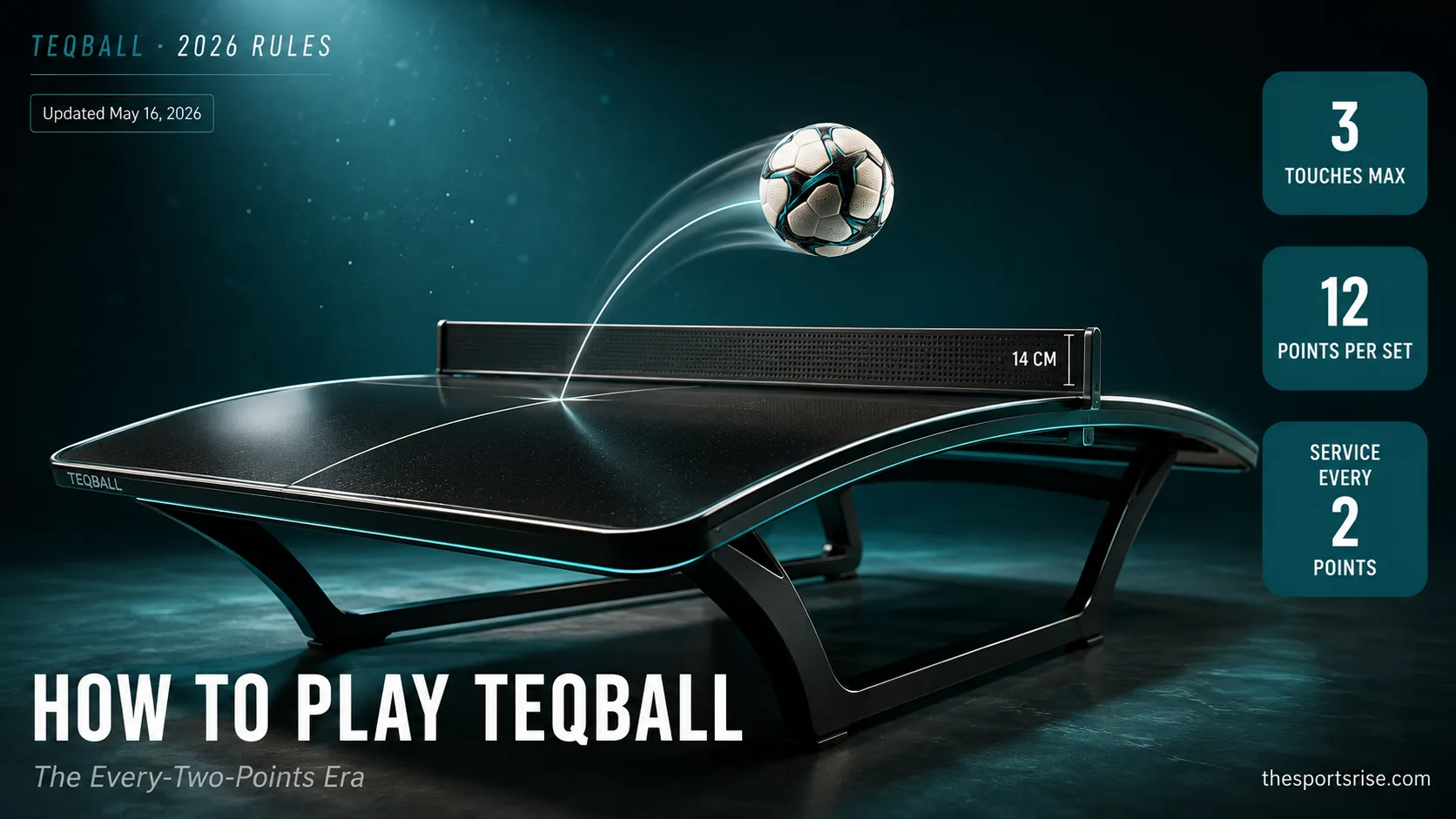
Here's the odd part: to learn how to play teqball you never touch the ball with your hands, you return a size-5 football across a curved table in a maximum of 3 touches, using any body part except the hands and arms, and the first side to 12 points takes the set. That's the whole sport in one breath. The details ambush newcomers, though, and the rulebook just shifted under everyone's feet. On May 16, 2026, FITEQ changed one of the sport's most-quoted rules, which means half the beginner guides floating around are already wrong.
Key takeaways
- The core loop: Teqball gives each side a maximum of 3 touches with any body part except the hands and arms, and you can't strike the ball with the same body part twice in a row.
- The Every-Two-Points switch: Since May 16, 2026, teqball service changes every 2 points (rule 10.1.9), down from the every-4-points cadence most stale guides still publish.
- Scoring: A teqball set runs to 12 points and a match is best-of-three, with the deciding set needing a two-point margin.
- The table: The curved teqball table is 3 m long, 1.7 m wide including the net, peaks at 0.76 m, and is split by a 14 cm net.
- New 2026 limits: FITEQ capped out-of-play smashes at two per set (rule 17.2.1) and clarified that an edgeball after the first service is replayed (rule 15.2.4).
How to play teqball: the core loop
Teqball is played by two players (singles, 1v1) or four players (doubles, 2v2) on a curved table, where each side has up to three touches with any body part except the hands and arms to send the ball back over a low net, and you score when your opponent fails to return it within the rules. Feet, thighs, chest, head, shoulders are all fair game. Just nothing below the elbow. And here's the catch that trips everyone: you can't hit the ball with the same body part twice running, so a cheeky foot-foot juggle is flat-out illegal.
The ball gets exactly one bounce on your side before you have to send it back, the same way a tennis groundstroke works. Miss the table, double-bounce, sneak in a fourth touch, or sky it out, and the point's gone. What surprises people is that control wins here, not power, and that's the very thing footballers underestimate the first time they step up. (More on that humbling moment in a second.)
Can you use your hands in teqball?
No. Teqball forbids any contact with the hands or arms during a rally, and the official FITEQ rulebook allows returns "by any body part, except for the hands and arms." Brush it with a hand and the point's gone, no argument. The legal surfaces are feet, legs, torso, and head, which is exactly why the sport pulls so much from football technique.
There's one delicious wrinkle. The second service is even stricter than open play.
Second service: If your first serve fails, FITEQ requires the second service to be "undertaken with one touch with any part of the body, except for the hands and arms and feet." So no feet either. That usually means a thigh or chest serve, and it's where a lot of beginners cough up cheap points.
The rules that govern a rally
Every rally in teqball runs on a tiny stack of constraints, and the moment they click, the whole game cracks open. Here's the spine of it.
- Three touches, no more: "Every player/team is allowed to return the ball with a maximum of 3 touches by any body part, except for the hands and arms."
- No repeat body part: "It is forbidden to touch the ball with the same body part twice consecutively." Left foot then right foot is fine; right foot twice is not.
- No touching the table or your opponent: you play around the table, never on it, and contact with an opponent ends the point.
- The doubles pass: in 2v2, "the teammates must pass the ball at least once to each other" inside those three touches, so you can't solo a whole possession.
That doubles rule is the one casual players blank on under pressure. You get three touches as a team, but at least one has to change hands. Skip the pass and you've gifted the point, however clean the return looked.
That one line is the single biggest practical shift for anyone picking up the game in 2026, because the serve now swaps hands twice as often as the older guides claim, and that quietly rewires how momentum swings inside a set.
What changed in the 2026 teqball rules?
FITEQ's 2026 update, first applied from May 16, 2026, changed three things: service now rotates every 2 points instead of every 4 (rule 10.1.9), smashes that send the ball out of play are capped at two per set (rule 17.2.1), and an edgeball after the first service is now replayed from a fresh service (rule 15.2.4). Everything else about the core game stayed put. I almost wrote that the scoring changed too, then went back to the rulebook, the 12-point set is alive and untouched.
No competitor page bothers to line the old rules up against the new ones, and several of the big guides still print the retired every-4-points serve. So here's the before-and-after, built straight from FITEQ's own press release and rules page. Call it the Every-Two-Points era. This is the table you'll want to screenshot.
| Rule | 2025 (pre-May 16) | 2026 (from May 16) | Rule no. |
|---|---|---|---|
| Service rotation | Change service every 4 points | Change service every 2 points | 10.1.9 |
| Out-of-play smashes | Effectively unlimited | Max two per set that leave the Field of Play | 17.2.1 |
| Edgeball after first service | Not explicitly clarified | Rally replayed, restart with a new first service | 15.2.4 |
| Points per set | 12 | 12 (unchanged) | — |
| Touches per possession | 3 max | 3 max (unchanged) | — |
| Ball | Size-5 football | Size-5 football (unchanged) | — |
The Every-Two-Points change punches harder than it reads on paper. Serving in teqball is a small edge, and rotating it twice as fast spreads that edge thin across both sides, which tends to keep sets nail-bitingly tight. FITEQ first ran the new package at the Adriatic Teqball League stop in Herceg Novi.
How many points do you need to win in teqball?
You need 12 points to win a teqball set, and a full match is best-of-three sets. In the deciding set you also have to win by a two-point margin, so a tense set can stretch well past 12, the same tiebreak logic pickleball players already know in their bones. Every rally scores, served or not, pure rally-scoring. You don't have to be serving to put a number on the board.
If you've kept score in other paddle and net sports, teqball will feel like home. For a side-by-side on a different system, our breakdown of why pickleball's side-out scoring feels so fiddly shows how much simpler rally scoring is to track. And if roundnet is more your speed, the beginner rules for Spikeball and roundnet run on a comparable first-to-a-number format.
The table, the ball, and the serve
The gear list is gloriously short, which is half the charm. A teqball court is one curved table plus a ball, and the official specs are locked down tight.
| Spec | Table | Ball |
|---|---|---|
| Size | 3 m long, 1.7 m wide with net (1.5 m without) | Size-5 football |
| Height | Peaks at 0.76 m, 14 cm net | Inflated to 0.3-0.5 atm |
| Role | Curved playing surface and divider | Lower than match pressure for control |
That lower ball pressure is a clever little design choice. A softer size-5 clings to your foot a fraction longer, which is the only reason control feels possible for a beginner at all. To serve, you stand roughly two meters back from the table and send the ball above table level with at least one leg on the ground, and each side gets two attempts to land a legal serve. Botch the first and that one-touch, no-feet second serve is your safety net.
If you're eyeing a real table for a garage or club, the official teqball hub tracks the current lineup, and our comparison of the TEQ ONE, SMART, and LITE tables lays out where the money goes. The flagship TEQ ONE lists at $3,999 on the US store, so this is no impulse buy. For the full ruleset beyond this primer, our teqball rules library keeps every granular clause.
One honest note from watching beginners, and it's my favorite quirk of the whole sport. The first time a five-a-side footballer steps to the table, they wind up for a smash and bury it into the net or off the back edge. Teqball humbles raw power, every time. The new two-smash cap only sharpens that lesson, because now you can't even spray winners for free.
Frequently asked questions
What ball is used in teqball?
Teqball uses a regular size-5 football, which FITEQ lists as the official and recommended ball, but it's inflated to a lower pressure of roughly 0.3 to 0.5 atm. That softer ball deadens the bounce and lingers on your foot longer, which is what turns three-touch control from chaos into something a new player can actually pull off.
How big is a teqball table?
A teqball table is 3 meters long and 1.7 meters wide including the net, though the official playing width is 1,500 mm without the net. The surface curves up to a high point of 0.76 meters in the middle, and a 14 cm net divides the two halves. That curve is the secret sauce, sending the ball back at angles you don't quite expect.
What are the rules of teqball doubles?
In teqball doubles (2v2), a team still gets a maximum of three touches per possession, but at least one of those touches must be a pass between teammates. You can't have one player handle the whole return solo. Beyond that, the no-hands, no-repeat-body-part, and one-bounce rules of singles all carry over unchanged.
How many touches are allowed in teqball?
Each side gets a maximum of three touches to return the ball, using any legal body part. In singles one player owns all three; in doubles the team shares them but has to slip in a pass. The classic combo is a control touch, a setup touch, then the return, and you can't use the same body part on consecutive touches.
When did the new teqball service rule start?
FITEQ's revised ruleset, including the every-2-points service rotation, took effect on May 16, 2026, and was first applied at the Adriatic Teqball League event in Herceg Novi. Any guide still listing service changing every four points predates that update and is no longer accurate for sanctioned play.
The verdict on the Every-Two-Points era
Teqball is one of the easiest emerging sports to start and one of the hardest to fake, because the three-touch, no-hands core exposes your first touch inside the first few minutes. Learn the legal surfaces, respect the one-bounce limit, and burn the new every-2-points serve into muscle memory, and you're playing real teqball instead of a backyard impression of it. My checkable prediction: by the close of the 2026 season, the every-4-points cadence will have vanished entirely from FITEQ-sanctioned play, and the last holdouts will be the third-party guides nobody bothered to update. Print the before-and-after table and you're already ahead of most of them.
Conversation
Be the first to comment.
Leave a comment
Comments are reviewed before appearing. Your email stays private.