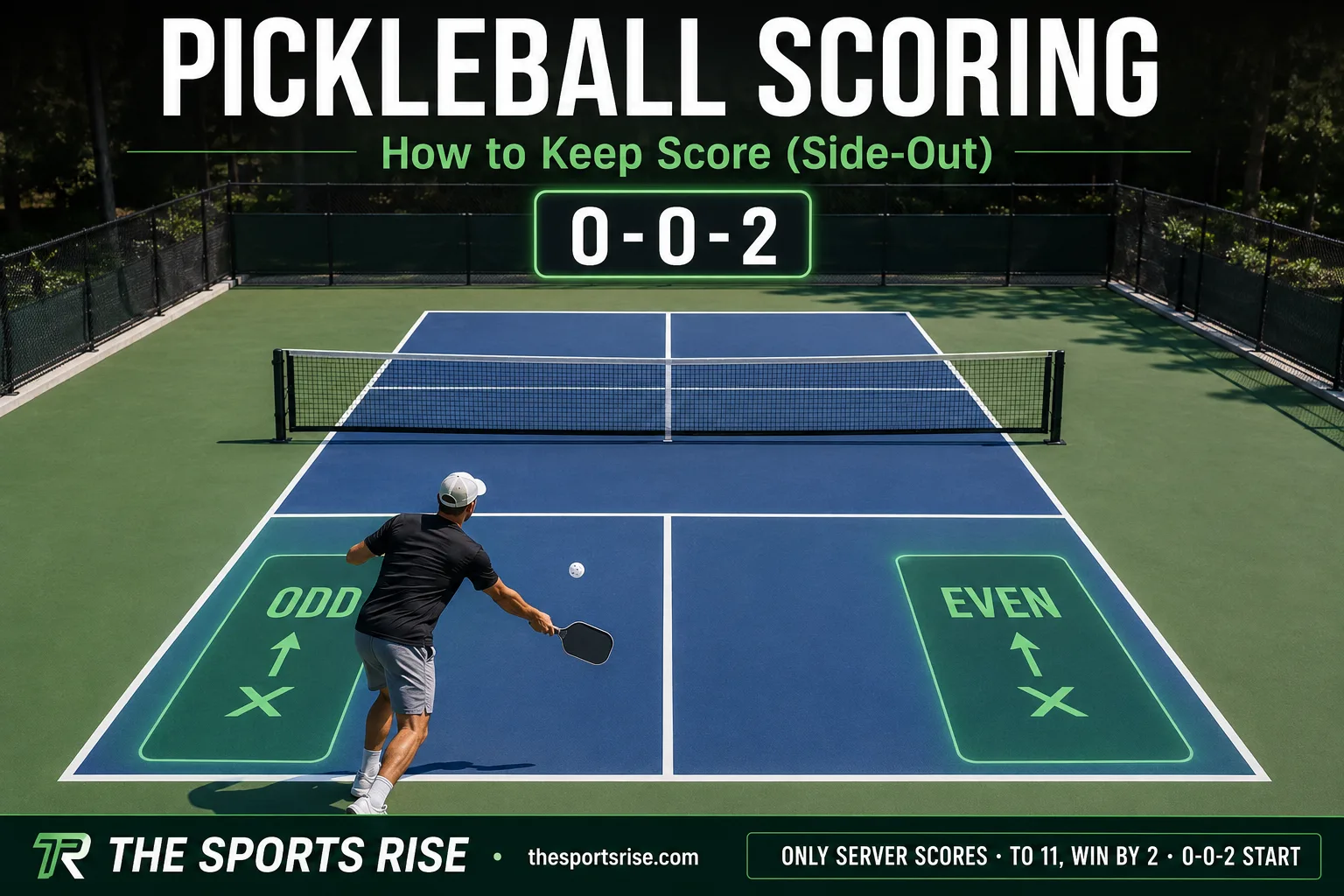
Pickleball uses side-out scoring: only the serving team can score a point, games are played to 11 and you must win by 2, and the score is called as three numbers in doubles, your score, their score, and the server number. That three-number call is the single thing that confuses every new player, and once it clicks, the whole game makes sense. So let's make it click.
This is the complete guide to pickleball scoring rules and how scoring works, the three-number call, the strange "0-0-2" start, even-and-odd serving positions, and how singles differs from doubles. Master The Three-Number Call and you'll never lose track of the score again.
Key takeaways
- Only the server scores: Win a rally on your serve and you get a point. Win a rally while receiving and you only earn the serve back, no point. This is side-out scoring.
- Games to 11, win by 2: First to 11 points wins, but you must lead by two, so at 10-10 play continues to 12-10, 13-11, and so on. Tournaments are often best of three.
- The Three-Number Call (doubles): Call the score as server score, receiver score, server number (1 or 2). "6-3-2" means your team has 6, theirs has 3, and you're the second server.
- The 0-0-2 start: Every game begins at 0-0-2, because the very first serving team gets only one server before the side-out, to stop them running away early.
- Even-odd positioning: Serve from the right when your team's score is even, from the left when it's odd. This rule alone tells you where to stand.
The core rule: only the serving team scores
Start here, because everything else builds on it. In standard pickleball (called side-out scoring), a point can only be won by the team that is serving. If your team is receiving and you win the rally, you do not score a point. Instead you win the right to serve, which is called a side-out. Then you get your chance to score. This is the biggest difference from sports like tennis (where every point counts for someone) and the reason pickleball games can swing back and forth.
So scoring is a two-step process: first earn the serve (by winning a rally while receiving), then score points (by winning rallies while serving). USA Pickleball calls this side-out scoring, and it's the format used in nearly all recreational play and most tournaments.
How a game ends: 11 points, win by 2
Pickleball games are played to 11 points, and the winner must lead by at least two. So if the score reaches 10-10, the game keeps going until one team is ahead by two, 12-10, or 13-11, or 14-12. There's no cap unless an event specifies one. In tournaments, matches are usually best of three games, and a deciding third game is sometimes played to 11 or 15 depending on the format. For casual play, a single game to 11 is the norm.
The Three-Number Call (doubles scoring)
Here's the part everyone trips on. In doubles, you call the score out loud before every serve as three numbers, in this exact order: your team's score, the receiving team's score, and the server number (1 or 2). So "6-3-2" means: the serving team has 6 points, the receiving team has 3 points, and the player serving is the second server on their team. Say it before you serve, every time. It keeps everyone honest about the score and whose serve it is.
Why every game starts at 0-0-2
This one looks like a typo and isn't. Every doubles game begins with the score called "0-0-2", which means the team serving first starts on its second server. Why? To stop the first serving team from gaining an unfair early advantage. Normally a team gets two server turns before a side-out. But the very first service turn of the game is limited to one server only, so the starting team is effectively already on "server 2" and loses the serve to the opponents after a single fault. After that first side-out, every team gets both servers normally. Remember "0-0-2" and you'll start every game correctly.
Even-odd: which side do I serve from?
The serving positions follow a simple parity rule. When your team's score is even (0, 2, 4...), the server stands on the right side of the court. When your score is odd (1, 3, 5...), the server stands on the left. The server's partner stands on the other side. After scoring a point, the serving team's two players switch sides and the same server keeps serving from the new side. This even-odd rule is also a built-in error check: if your score is even and you're somehow on the left, someone's in the wrong place.
Doubles vs singles: what changes
Singles uses the same to-11, win-by-2, server-only scoring, but it's simpler because there's no partner and no server number. Here's the side-by-side.
| Scoring element | Doubles | Singles |
|---|---|---|
| Score call | Three numbers (server-receiver-server#) | Two numbers (your score-their score) |
| Servers per turn | Two (server 1, then server 2) | One (just you) |
| Game start | 0-0-2 | 0-0 |
| Serve side | Even score = right, odd = left | Even score = right, odd = left |
| Who scores | Serving team only | Serving player only |
| Win condition | 11 points, win by 2 | 11 points, win by 2 |
A worked example, point by point
Picture a doubles game. It opens "0-0-2", the first team serves from the right and wins the rally. Point. Now it's "1-0-2", and that same team switches sides and serves from the left (odd score). They fault. Because they started on the limited single-server turn, that's a side-out, and the serve goes to the other team, called "0-1-1". Now the new serving team has server 1 up, on the right (their score is 0, even). They win two rallies, "2-1-1", then fault, serve passes to their server 2, "2-1-2", who also faults, side-out back. See how the three numbers track everything? Score, score, server. That's the whole system.
A note on "rally scoring"
You may hear about rally scoring, where every rally scores a point for whoever wins it (like in squash or volleyball), regardless of who served. Some leagues and the pro Major League Pickleball have experimented with it for faster, more predictable game lengths. But standard recreational and most tournament pickleball still uses side-out scoring, the three-number system above. If you're learning the game, learn side-out scoring first; it's what you'll play 95% of the time.
The bottom line: pickleball scoring rules in a nutshell
Pickleball scoring boils down to a few rules that all hang off one idea: only the server scores. Games go to 11, win by 2. In doubles you call three numbers, and you start at 0-0-2. Serve right on even, left on odd. Get comfortable saying the score out loud before every serve and you'll never be the player asking "wait, what's the score?" again. Next, learn the rule that decides the most points at the net, our pickleball kitchen rules guide, and if you're brand new, the beginner's pickleball course walks through serving and strategy in order. Everything pickleball lives on our pickleball hub, and if you came from another paddle sport, our padel racket vs pickleball paddle guide is a useful read. Now that you can keep score, our pick for the best pickleball paddle for beginners points you to a smart first paddle.
Frequently asked questions
How does scoring work in pickleball?
Pickleball uses side-out scoring: only the serving team can score a point. Win a rally while serving and you score; win a rally while receiving and you only earn the serve back. Games are played to 11 points and you must win by two. In doubles, the score is called as three numbers, your score, the opponents' score, and the server number.
Why is the pickleball score called with three numbers?
In doubles, the three-number call, for example "6-3-2", states the serving team's score, the receiving team's score, and which server is up (1 or 2). The third number matters because both players on a team serve before a side-out. It tells everyone whose serve it is and how many service turns the team has left before the serve passes to the opponents.
Why does a pickleball game start at 0-0-2?
Every doubles game begins at "0-0-2" because the team serving first is limited to a single server on its opening turn, effectively starting on server 2. This prevents the first serving team from gaining an unfair early advantage. After that first side-out, both teams get two servers per turn for the rest of the game.
What side do you serve from in pickleball?
Serve from the right side of the court when your team's score is even (0, 2, 4 and so on) and from the left side when your score is odd (1, 3, 5). Your partner stands on the opposite side. After each point your team scores, both players switch sides and the same player continues serving from the new position.
Do you have to win pickleball by 2 points?
Yes. A standard pickleball game is played to 11 points but must be won by a margin of two. If the score reaches 10-10, play continues until one team leads by two, such as 12-10 or 13-11. There is no automatic cap unless a specific tournament format sets one, so close games can extend past 11.
How is singles scoring different from doubles in pickleball?
Singles uses the same to-11, win-by-2, server-only scoring, but the score is called with just two numbers (your score, then your opponent's), because there is no partner and no server number. There is only one server, the game starts at 0-0, and you still serve from the right on an even score and the left on an odd score.
Conversation
Be the first to comment.
Leave a comment
Comments are reviewed before appearing. Your email stays private.