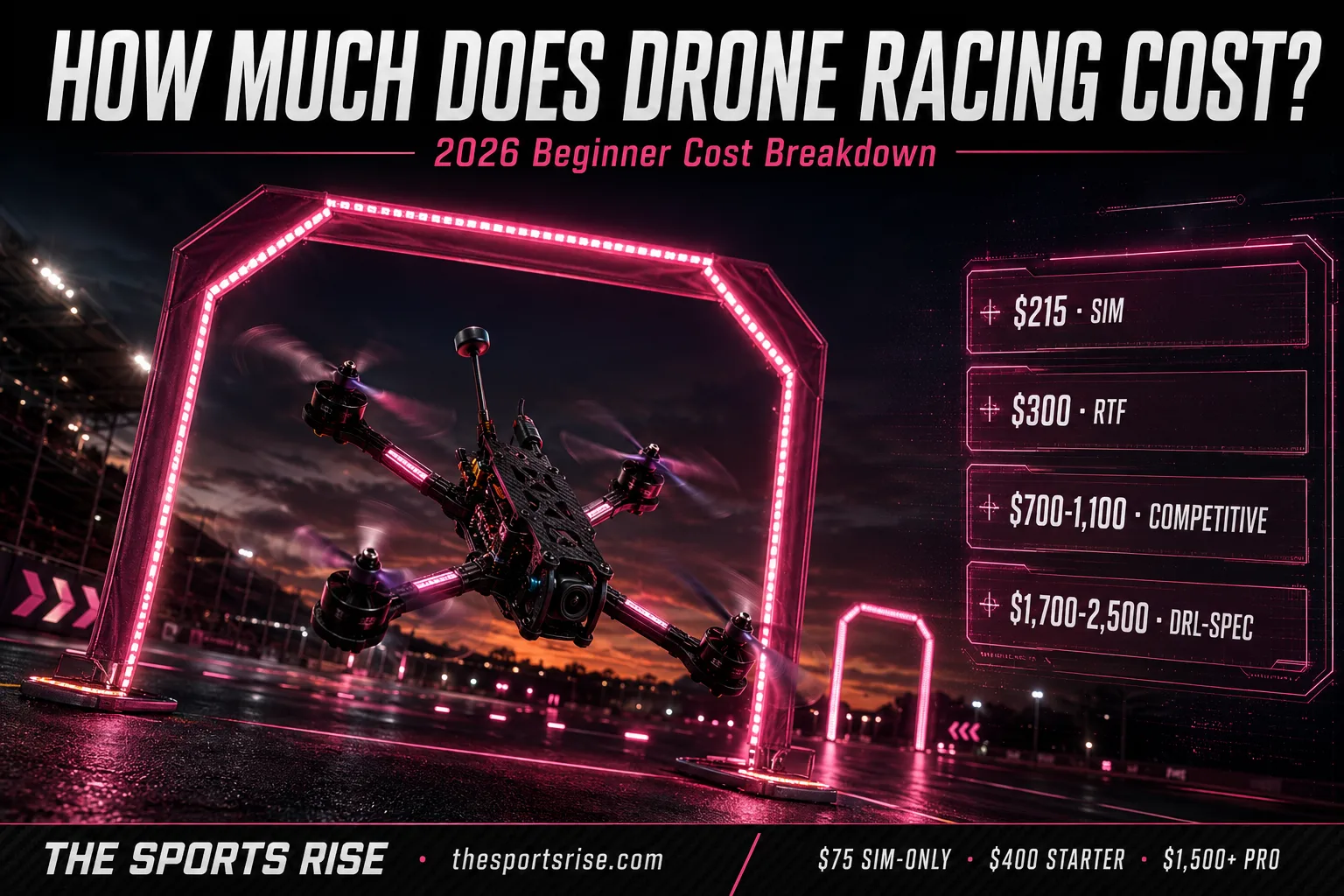
The realistic 2026 cost to start drone racing ranges from about $20 for a simulator-only setup to $1,500-plus for a DRL-spec build, with most beginners landing between $260 (the BetaFPV Cetus X ready-to-fly kit) and $700 (a competitive 5-inch quad with goggles, radio, batteries and FAA registration). That's the honest answer, and it's the one most beginner guides quietly hide because they exist to sell you a single product. The TSR Drone Racing Cost Ladder breaks down every line item.
If you've ever budgeted $400 for "a drone and goggles" only to be standing at your first MultiGP race day having spent $1,200, you've already met the gap this article exists to close. Sim, hardware, fees, batteries, props, race entries: all of it, with verified 2026 prices.
Key takeaways
- The four tiers (Cost Ladder): Sim-only ~$75, Tiny-Whoop RTF ~$215, Competitive 5-inch ~$700-1,100, DRL-spec build ~$1,700-2,500. Pick a rung honestly.
- The $175 myth: FAA Part 107 is NOT required for hobbyist racing. The mandatory test is the FREE FAA TRUST exam, plus a $5 drone registration valid for three years.
- MultiGP is the real entry point: Pilot membership is FREE and starting a chapter is FREE. The Drone Racing League (DRL) itself is an invite-only pro circuit, not a beginner league.
- Sim first, hardware second: A $20 VelociDrone subscription plus a used USB controller for $50 saves you several hundred dollars in crashed motors before you ever buy your first quad.
- The hidden monthly bill: Active racers spend $35-75 per month on consumables (batteries, props, motors, carbon arm spares). Year-1 capex is the headline number; year-2 opex is the real one.
The TSR Drone Racing Cost Ladder (four rungs)
Most beginner cost guides quote a single number ("a great starter setup is $500") and skip everything else. That's where the pilots-spending-$1,200 problem comes from. The honest answer is a ladder, not a number, because what you actually want from the hobby determines which rung you should be on.
Rung 1, the simulator-only path, is for the curious. Rung 2 is for someone who wants their first real outdoor flight without learning to build. Rung 3 is for a pilot ready to race at a local MultiGP chapter event. Rung 4 is for someone targeting the very top of competitive amateur racing, with the gear specification that mimics what DRL pilots run.
Cost to start drone racing in 2026: the breakdown across all four tiers
| Cost item | Tier 1: Sim + tiny-whoop | Tier 2: Brushless RTF | Tier 3: Competitive 5-inch | Tier 4: DRL-spec build |
|---|---|---|---|---|
| Drone + radio + goggles kit | Cetus Pro $226 (BetaFPV) | Cetus X $309.99 (BetaFPV reg.) | DIY 5-inch build $250-$450 | Custom 6S race build $800-$1,200 |
| Goggles upgrade (optional) | Included in kit | Included in kit | DJI Goggles 2 $649 (DJI) | DJI Goggles 2 $649 (DJI) |
| Video link / VTX | Included | Included | Eachine TX805 $22 (analog) | DJI O3 Air Unit $229 (DJI) |
| Simulator (mandatory practice) | DRL Sim $9.99 or VelociDrone $20 | VelociDrone $20 | VelociDrone $20 | VelociDrone $20 |
| FAA fees (TRUST + registration) | $5 (TRUST is free) | $5 (TRUST is free) | $5 (TRUST is free) | $5 (TRUST is free) |
| MultiGP league + 1 race entry | $0 + ~$15 entry | $0 + ~$15 entry | $0 + ~$15 entry | $0 + ~$15 entry |
| Year-1 all-in total | ~$255 | ~$300 | ~$700-$1,100 | ~$1,700-$2,500 |
The $175 myth: FAA Part 107 is not required for racing
The single most-budgeted-for cost that hobbyist racers do not actually owe is the FAA Part 107 license. Part 107 costs $175 per attempt and is required only for commercial drone work (real estate photography, inspections, paid filming). For recreational FPV racing the FAA's required exam is the TRUST test, which is FREE, untimed, open-book, never expires and administered by approved partners including FAA-listed providers and even the Drone Racing League itself.
You also need a $5 FAA drone registration valid for three years, required for any drone over 250 grams (which is every 5-inch racing quad). So the actual government bill for a first year of FPV racing in the US is $5, not $175. Anyone telling you Part 107 is mandatory for racing is incorrect, and you can verify that directly on the FAA's recreational flyer page.
Sim-first onboarding: do this BEFORE you buy any hardware
Crashing a 5-inch racing quad into a tree costs $40-80 in replacement motors and props every time. Crashing in a simulator costs nothing. So the highest-ROI dollar a new FPV pilot can spend is the $20 for a VelociDrone subscription (the de facto competitive standard) or the $9.99 DRL Simulator if you want a cheaper start.
Pair that with a used USB game controller for around $50 (any RadioMaster or FrSky transmitter works as a USB joystick too), put 20-40 hours of practice in, and your first real quad will survive its first month. Pilots who skip the sim step typically rebuild their drones twice in their first weekend, which costs more than the entire simulator investment. There's a reason every guide that's actually written by working pilots leads with this rule.
RTF kit versus DIY build at the $260-$450 decision point
The fork in the road comes at the second hardware purchase. Two paths are reasonable, and they suit different temperaments. The ready-to-fly path is the BetaFPV Cetus X at $309.99 (regular price; often discounted to ~$259.99), which ships with a brushless quad, the LiteRadio 3 transmitter, the VR03 goggles, four batteries and a charger in one box. You unbox it, charge the batteries and fly. The downside: proprietary parts make repairs harder and upgrades almost impossible.
The DIY 5-inch path is a parts list that totals $250-$450, depending on choices. A typical 2026 build is a Source One frame ($35), a SpeedyBee F405 V4 flight controller and ESC stack ($80), Xing-E Pro 2207 motors ($68 for four), an Eachine TX805 VTX ($22) and a Happymodel EP1 receiver ($14). You add your own radio and goggles. It takes a weekend to assemble. The upside: every part is replaceable, every spec is upgradable, and your repair bill drops sharply once you've done it once.
Analog versus digital: the goggles fork
The largest single cost variable in the build is whether you go analog or digital for the video link. Analog (the old-school FPV standard) uses a small VTX like the Eachine TX805 for $22 and box goggles for $90-130. The whole video system runs about $115-150. Digital, dominated by DJI in 2026, means the DJI O3 Air Unit at $229 plus the DJI Goggles 2 at $649, so $878 for the same job. Picture quality and latency are substantially better digital; the price gap is also substantial.
The honest decision rule: if your year-1 budget is under $850, go analog and don't apologise. Most MultiGP chapter racing still runs analog. If your budget is $1,100 or more, start digital and skip the "migration tax" of $200-300 you'd otherwise pay to switch later. Both ecosystems are mature; both work.
League fees, registration and the entries 90% of guides miss
This is the section where most beginner cost articles fall over. The actual line items, in 2026 dollars:
- FAA TRUST exam: $0
- FAA drone registration: $5 (valid 3 years)
- FAA Part 107: $175 (NOT required for racing, only for commercial work)
- MultiGP pilot membership: $0
- MultiGP chapter creation: $0 (and Tier 3 chapters get a free 5x5 Fabric MultiGP Official Gate Kit)
- Local MultiGP race entry: typically $10-25 per event
- Annual props: roughly $60-120 if you race regularly
- Annual battery amortised cost: about $40-90 (a 4-pack of 6S 1300mAh LiPos costs $120-180 total and lasts 2-3 years)
So a full year-1 budget for a serious hobbyist who races monthly looks like: hardware $700, sim $20, FAA $5, MultiGP $0, ten race entries $150, consumables $300. Total: about $1,175. That is the realistic, honest "Serious Hobbyist" number, and it's roughly twice what most beginner guides quote.
Where the Drone Racing League fits in 2026
Quick institutional-status note, because this is the league most beginners assume they should be trying to join. The Drone Racing League (DRL) was acquired by Infinite Reality on April 23, 2024 for $250 million and continues operating in 2026, with the DRL World Championship scheduled for June 2026. But DRL is an invite-only pro circuit, not a grassroots entry point. It runs a closed pilot roster on custom DRL-spec hardware (~$1,500-$2,500 worth) and broadcasts the season for spectators.
The grassroots equivalent is MultiGP, and it's the league anyone learning to race should join. The MultiGP Regional Series 2026 is the new international amateur circuit feeding into the International Open 2026 and the MultiGP Championship 2026. Pilot membership is free; you fly the same gear you'd use in your backyard. That's the realistic path from "I just got my first 5-inch quad" to "I'm racing in a sanctioned event."
Year-1 capex versus year-2 OpEx: the bill nobody itemises
Once you've bought the hardware, you start paying the ongoing cost of actually flying it. The numbers, verified against working-pilot consumable spreadsheets: 6S 1300mAh racing LiPo batteries cost $30-45 each, you need at least four to fly a meaningful session, and they last about 2-3 years before voltage sag makes them slow. Propellers are $3-5 per set, and an aggressive afternoon at the track can burn three sets. Spare motors run $15-25 each and replacement carbon arms cost $5-12. Crashing is when, not if.
So year-2 onward, an active racer spends $35-75 per month on consumables. That's about $500-900 a year just to keep flying after the original purchase. Plan for it and the hobby is sustainable. Don't and your gear quietly degrades until you're racing a battery pack that's no longer competitive. For a comparable "true cost of getting started" exercise in a different niche, see our how to start sim racing guide, which tackles the same buyer-trap problem for racing simulators.
Three realistic budget paths summarised
If you only remember three numbers from this article, make them these. The Curious budget is about $75: VelociDrone subscription, a used USB controller, no hardware yet. You learn whether you actually like the hobby for the cost of a couple of dinners. The Serious Hobbyist budget is about $600 all-in for the first year: a Cetus X RTF kit, sim, FAA $5, one MultiGP race entry, some spare props and one battery upgrade. You're racing legally and improving.
The Racing Chapter Member budget is about $1,100 all-in plus $50 per month afterward: a DIY 5-inch build with analog video, digital goggles (optional, +$650 for digital), sim, FAA, MultiGP, and a year of monthly chapter race entries with consumables. That's the real Racing Chapter Member number, and once you've spent it you're a working FPV racer, not a beginner.
The bottom line: pick a rung honestly
The cost to start drone racing in 2026 is not a single number, and any guide that quotes one is selling something. It's a ladder with four real rungs, the right one for you depends on how serious you are, and the year-2 consumables bill is the one that catches most pilots out. Start with the simulator, climb to the BetaFPV Cetus X RTF kit if you stick with it, and only commit to a custom 5-inch build once you know you'll race. The DRL hub tracks the pro circuit as the 2026 World Championship plays out, and our drone racing beginner course is the next step if any of the above sounds like you.
Frequently asked questions
How much does it cost to start drone racing as a complete beginner in 2026?
A realistic all-in beginner budget for FPV racing in 2026 is $260 to $600. The BetaFPV Cetus X FPV Kit ships at $309.99 regular price (often discounted to ~$259.99) and bundles a brushless quad, LiteRadio 3 transmitter, VR03 goggles, four 1S batteries, charger and props in one box. Add a $20 VelociDrone subscription and a $5 FAA registration and you can legally fly and practise for about $335 at regular price.
Do you need an FAA Part 107 license to race drones in the United States?
No. The $175 Part 107 knowledge test is required only for commercial drone work. Recreational FPV racers need the FREE FAA TRUST exam, which is untimed, open-book, never expires, and is administered by approved partners including The Drone Racing League itself. You also need a $5 FAA registration valid three years for any drone over 250 grams, which covers every 5-inch racing quad.
Is the Drone Racing League (DRL) still active in 2026 and do you have to pay to compete?
Yes. DRL was acquired by Infinite Reality on April 23, 2024 for $250 million and continues operating in 2026, with the DRL World Championship scheduled for June 2026. However, DRL is an invite-only pro circuit, not an entry point. For grassroots racing, MultiGP is the actual league to join, where pilot membership is FREE and starting a local chapter is FREE.
How much do FPV goggles cost for drone racing, digital DJI versus analog?
The 2026 split is stark. DJI Goggles 2 paired with the DJI O3 Air Unit (the dominant digital HD setup) cost $649 plus $229, roughly $878 just for the video link. Analog box goggles like Eachine EV800D start at $90-130, and an Eachine TX805 VTX is $22. Digital is sharper and lower-latency; analog is two-thirds cheaper and what most MultiGP chapters still fly competitively.
Is it cheaper to build a 5-inch racing drone or buy a ready-to-fly kit?
A 2026 DIY 5-inch build runs $250 to $450 in parts: roughly $35 for a Source One frame, $80 for a SpeedyBee F405 V4 flight stack, $68 for Xing-E Pro 2207 motors, $22 for an Eachine TX805 VTX and $14 for a Happymodel EP1 receiver. RTF kits like the Cetus X cost $259.99 but use proprietary parts. DIY is cheaper to repair; RTF is faster to first flight.
What are the real monthly costs to keep racing after the initial purchase?
Active pilots spend $35-75 per month on consumables. Racing 6S 1300mAh LiPo batteries cost $30-45 each and you need at least four per session for meaningful flying, and they last about 2-3 years. Propellers are $3-5 per set and a hard afternoon can burn three sets, around $20 per month. Spare motors run $15-25 each and replacement carbon arms are $5-12. Both are when, not if, costs.
Conversation
Be the first to comment.
Leave a comment
Comments are reviewed before appearing. Your email stays private.