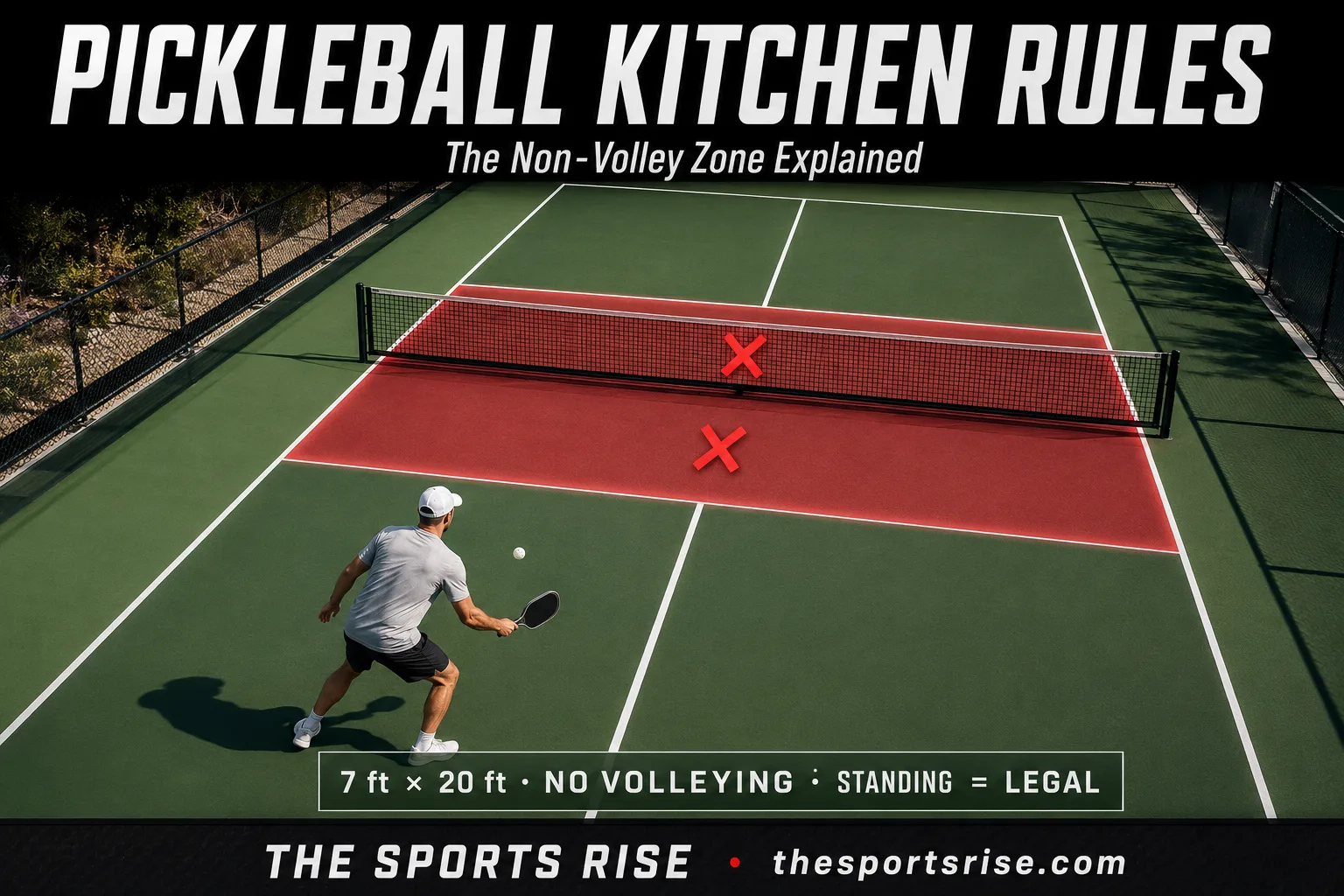
The kitchen in pickleball is the 7-foot zone on each side of the net where you're not allowed to hit the ball out of the air. Its official name is the non-volley zone, and every beginner gets caught by the same trick: you CAN stand in the kitchen all day. You just can't volley while you're in it. Most "kitchen faults" come from breaking that one detail, not from stepping in. The full pickleball kitchen rules are short, but the edge cases are where points get lost.
So that's the headline answer. But the kitchen has more nuance than any other rule in pickleball, and it decides more points than most newcomers realize. Let's break it down properly, then sort out every common fault and misconception in one place.
Think of it as the seven-foot tax. Step on it during a volley, and you pay.
Key takeaways
- What it is: The kitchen is the non-volley zone, a 7-foot strip on each side of the net stretching the full 20-foot width of the court.
- The seven-foot tax: You can't volley (hit the ball out of the air) while any part of you is touching the kitchen or its lines. Step on the line, even with one toe, and it's a fault.
- Standing is fine: You can stand, walk or dance inside the kitchen at any time. The only thing the kitchen forbids is volleying from it.
- Momentum counts: If you volley from outside the kitchen and your momentum carries you in (or anything you're wearing falls in), it's still a fault.
- Why it exists: Without it, tall players would camp at the net and smash every ball. The kitchen forces patient, strategic dink rallies, the heart of pickleball.
What is the kitchen in pickleball?
The kitchen is the section of the pickleball court that runs along both sides of the net, 7 feet deep and 20 feet wide. It's marked by a line called the non-volley zone line, and the area between that line and the net is officially the non-volley zone. "Kitchen" is the nickname, born from the old shuffleboard phrase "stay out of the kitchen," and it's stuck because everyone uses it.
So the court has three big sections on each side: the kitchen at the front, the service boxes in the back, and a baseline at the very rear. You'll spend most of a typical rally either at the kitchen line (the best attacking spot) or behind the baseline (the safest defensive spot). The middle of the court, between baseline and kitchen, is called transition land, and you don't want to live there.
The core rule, in one line
You cannot volley while any part of your body or anything attached to you is touching the kitchen or the kitchen line. That's it. Everything else is a footnote on that single sentence. A volley means hitting the ball before it bounces. So the kitchen bans one specific action (volleying) in one specific place (the kitchen), and allows everything else.
If the ball bounces in the kitchen first, though, you can absolutely step in, hit it, and step back out. That's how dinks work. The kitchen punishes overhead smashes at the net, not bounce shots.
Every pickleball kitchen rules fault, in one table
Here's the full list of things that get called faults around the kitchen, plus what's legal. Print this, screenshot it, save it on your phone, whatever helps. These are the rules that decide the most beginner points.
| Action | Legal or fault? | Why |
|---|---|---|
| Standing in the kitchen between shots | Legal | Standing is always allowed; only volleying is restricted |
| Letting the ball bounce in the kitchen, then hitting it from inside | Legal | The ball bounced, so it's no longer a volley |
| Volleying with one foot inside the kitchen | Fault | Any contact with the zone during a volley is illegal |
| Volleying with a foot touching the kitchen line | Fault | The line itself counts as part of the zone |
| Volleying just outside the line, then drifting in from momentum | Fault | Momentum carrying you in still counts as touching the zone |
| Your hat or sunglasses falling into the kitchen mid-volley | Fault | Anything attached to you counts as you touching the zone |
| Your paddle landing in the kitchen after a volley follow-through | Fault | The paddle is part of you for fault purposes |
| Reaching OVER the kitchen to hit a ball, feet outside | Legal | Air space over the zone is fine; only feet matter |
| Partner pulls you back out before the next shot | Legal (between rallies) | You only have to be clear when you actually volley |
The four myths beginners believe
Almost every pickleball court has someone confidently repeating one of these. None of them are right.
"You can't step in the kitchen." Yes you can. Anytime. The rule only kicks in during a volley.
"If the ball bounces and rolls into the kitchen, you can't hit it." Wrong, and this one costs people real points. Once it bounces, it's not a volley anymore. Walk in, hit it, walk out.
"You have to wait 1 second after a volley before stepping into the kitchen." No such rule. You can step in instantly after the volley is complete, as long as your momentum from the volley itself didn't already carry you in.
"The kitchen is only on the serving side." Both sides have one. Mirror image, same rules.
Why the kitchen exists (and why good players love it)
Pickleball without a kitchen would be a 30-second sport. Tall players would camp at the net and put every ball into the floor. The non-volley zone fixes that by saying: yes, you can come to the net, but you can't smash from there. So the rallies stretch, the soft shot becomes king, and small-stature players can win.
This is also where the famous "dink" comes from. A dink is a soft shot that lands in your opponent's kitchen, forcing them to either let it bounce (so they can hit it, but from a tough low position) or back off the line. The whole pro game lives in those exchanges. If you want to get better at pickleball, more than anything else, get better around the kitchen line. Our beginner's pickleball course walks through the dink and the kitchen footwork in order, and the pickleball rulebook covers serving, scoring and the rest. A controlled paddle helps you hold the kitchen line, so it's worth checking our guide to the best beginner pickleball paddle before your next session.
Where the kitchen sits on the court
Quick measurements, since pictures of pickleball courts can be confusing. A standard pickleball court is 20 feet wide by 44 feet long, same footprint as a doubles badminton court. The net runs across the middle. The kitchen on each side is 7 feet deep, leaving 15 feet of "service court" behind it before the baseline. Multiply 7 by 20 and the kitchen takes up 140 square feet on each end, about 32% of one side. So almost a third of your half of the court is technically a no-volley area.
And if you're switching from a paddle sport that has no kitchen, like racquetball or paddle tennis, this is the single biggest adjustment. We broke down a related gear question in our can you use a padel racket for pickleball piece, and the contact-versus-non-contact question in squash vs racquetball. Different sport, similar "what's the rule actually saying" energy. If you're weighing the two paddle sports side by side, our padel versus pickleball breakdown shows how each court and ruleset compares.
The bottom line: it's the seven-foot tax
The pickleball kitchen rules sound tricky until you boil them down: no volleying while you (or your stuff) touches a 7-foot strip in front of the net. Stand there, dance there, smash a bounced ball from there, all fine. Hit a single ball out of the air with so much as a shoelace on the line, fault. That's the seven-foot tax. Master that, learn to dink, and you've learned the engine of the entire sport.
Frequently asked questions
What is the kitchen in pickleball?
The kitchen is the non-volley zone, a 7-foot-deep section on each side of the net that spans the full 20-foot width of the court. You can stand in it anytime, but you can't volley (hit the ball out of the air) while any part of you is touching it or its line.
Can you ever stand in the kitchen?
Yes, you can stand, walk or wait in the kitchen at any time. The rule only restricts volleys. If the ball bounces first, you can step in, hit it, and step back out without any penalty.
Is touching the kitchen line a fault?
It is, if you do it during a volley. The kitchen line is considered part of the non-volley zone, so even one shoe touching the line while you hit the ball out of the air counts as a kitchen fault and loses you the rally.
Does your momentum count for kitchen faults?
Yes. If you volley from outside the line but your momentum carries you into the kitchen afterward, it's still a fault. The rule applies until your motion from the volley fully stops, including anything you're wearing that falls in.
Why is it called the kitchen?
The nickname comes from shuffleboard, where "the kitchen" was a penalty area you wanted to avoid. Pickleball borrowed the term informally, and it caught on. Officially, both USA Pickleball and the PPA Tour rulebook call it the non-volley zone.
How big is the kitchen?
The non-volley zone is 7 feet deep and 20 feet wide on each side of the net, about 140 square feet per side. That's roughly 32% of one half of the court, an unusually large dead-zone-for-one-action compared with any other racket sport.
Conversation
Be the first to comment.
Leave a comment
Comments are reviewed before appearing. Your email stays private.