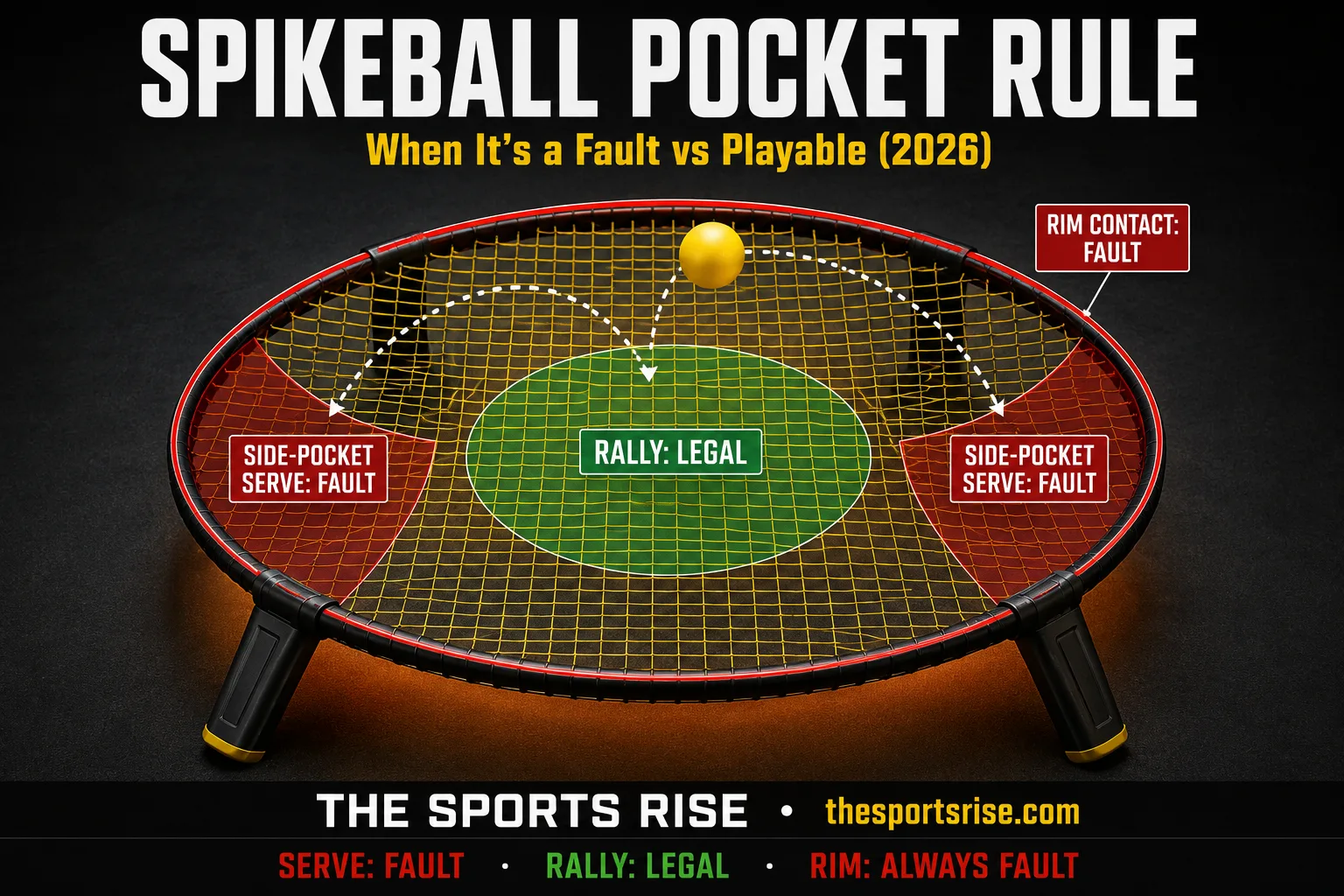
The Spikeball pocket rule treats a pocket as a fault on a serve but as legal play during a rally, with the dividing line being whether the ball touches the rim and whether it deflects to the opposite side per IRF rule 4.5.7. That single sentence settles roughly 90% of the pocket arguments you'll have on a backyard set. The remaining 10% (roll-ups, side-third deflection exceptions, multiple contacts on serve) is what this guide exists to settle.
Below is the Pocket/Rim Decision Matrix, every IRF rule number that governs a pocket call, and how the Spikeball Tour Series observers actually enforce it in 2026. If you're trying to win an argument mid-rally, scroll to the table.
Key takeaways
- Single-contact rule: A clean net contact with no rim touch is legal during a rally (IRF rule 5.5.2). The same contact on a serve becomes a "side pocket" fault only if the ball deflects to the opposite side (rule 4.5.7.1.1).
- Pocket vs rim: A pocket is a trajectory change near the rim with no metal contact. A rim hit is direct contact with the rim or legs and is always a fault (rule 4.5.6 on serve, 5.5.1.2 on initial rally contact).
- The ear test: One soft net sound = legal pocket. A "ping" of metal = rim fault. That's the universal pickup-play arbiter.
- Roll-up is legal: A ball that lands on the netting, rolls along it, then rolls into the rim and off, plays on (rule 5.5.3). Possession changes only when the ball leaves the net (rule 5.5.4.1).
- 2026 rulebook: The IRF Rulebook updated October 17, 2025 takes effect January 1, 2026 for all IRF events. The Spikeball Tour Series follows the USA Roundnet ruleset, which mirrors IRF.
What the Spikeball pocket rule counts as a "pocket"
A pocket is what happens when the ball lands in the awkward zone where the netting curves up to meet the rim, close enough to the metal frame that its trajectory changes, but never actually touching the rim. The result is an unpredictable bounce that looks like a rim hit and isn't one. Spikeball.com's consumer-facing rule states it plainly: "pockets are not allowed on serves but are allowed during rallies."
The International Roundnet Federation (IRF) rulebook is more precise. A legal rally pocket is governed by rule 5.5.2: any shot that changes trajectory from proximity to the rim, without contacting the rim, plays on. On the serve, the rule flips entirely (more on that in two sections). Distinguish all of this from a "roll-up" (ball lands fully on the net, rolls along it into the rim, comes off), which has its own rule (5.5.3) and is also legal during a rally.
The Pocket/Rim Decision Matrix
Six scenarios cover almost every pocket dispute you'll have. Each one carries the exact IRF rule citation so you can pull up the rulebook and end the argument.
| Scenario | Where | Rim contact? | IRF rule | Legal or fault? |
|---|---|---|---|---|
| Clean net rebound | Serve or rally | No | 4.5 / 5.5 | Legal |
| Side-third deflection on serve (ball changes to opposite side) | Serve | No | 4.5.7.1.1 | Fault (side pocket) |
| Side-third contact on serve, no opposite-side deflection | Serve | No | 4.5.7.1.3 | Legal |
| Trajectory change near rim during rally | Rally | No | 5.5.2 | Legal (pocket) |
| Direct rim or legs contact | Serve or rally (initial) | Yes | 4.5.6 / 5.5.1.2 | Fault |
| Roll-up (ball rolls on net into rim and off) | Rally | Yes, after net roll | 5.5.3 / 5.5.4.1 | Legal |
Pockets on the serve: why they're always a fault
The serve is the strictest moment in the entire roundnet rulebook. IRF rule 4.5.7.1.1 defines the "side pocket" geometry exactly: after the served ball strikes a side third of the net traveling relatively parallel to its incoming trajectory, its horizontal direction changes toward the opposite side. That's a fault. The reasoning is competitive integrity: a serve that pockets into a hard sideways change becomes nearly unreturnable, so the rules eliminate the shot entirely.
Rule 4.5.7.1.3 carves out the only exception: a ball that hits the side-pocket area but does NOT move to the opposite direction is a legal serve. So a serve can land in the side third of the net cleanly, as long as it doesn't trigger the lateral deflection. The other serve-pocket gotcha is rule 4.5.11, which makes any multiple contact (net then rim, or net then legs) on a single serve an automatic fault. One contact, no rim, no opposite-side flip: that's the only legal serve outcome involving the side area.
Pockets during the rally: why they're legal
The instant the serve is over, the pocket rule inverts. Rule 5.5.2 protects the "trajectory change without rim contact" case for the entire rest of the point, on the principle that the rally is dynamic, contacts get awkward, and a fraction-of-an-inch difference between the ball brushing the netting vs the metal shouldn't decide a point. So you'll see top-level players intentionally aim toward the rim during a rally, because the bounce is unpredictable but legal.
The roll-up is the other rally exception worth knowing. If the ball lands fully on the netting (not at the rim), rolls along the net, then rolls off via the rim before leaving the set, the play continues. Rule 5.5.3 makes it explicit. The underlying logic, captured in rule 5.5.4.1, is that possession changes only when the ball leaves the netting, so a roll-up is treated as a single hit with an unusual exit. It's not common, but it's legal, and it produces some of the most absurd "did that count?" moments in pickup play.
The ear test: calling pockets in unrefereed play
Tournament games have observers. Pickup games have ears. The universal arbiter in casual roundnet, used at every pickup set across the United States, is the simple sound test: a single soft "thwack" off the netting means the ball never touched the rim, which means the contact was clean (rally) or judged on direction (serve). A "ping" of metal mixed with the net sound means the rim was contacted, which is always either a fault or a roll-up requiring a closer look.
It's not a perfect test, especially on noisy beach days or carpet floors that swallow the sound. But it's the test almost every casual player implicitly uses, and it gets the call right most of the time. The cleaner rule of thumb: if anyone on the court genuinely isn't sure whether the ball touched the rim, play continues. The benefit of the doubt favours the rally.
How Spikeball Tour Series observers actually call it
The Spikeball Tour Series (STS) is the leading US tournament series, and its rules page confirms it follows the USA Roundnet ruleset, which is based on the IRF rulebook with minor North American adjustments. At STS events, dedicated observers (not players) make pocket and service-height calls in real time, exactly to remove the ambiguity that ruins pickup play. Observers focus disproportionately on two things: pockets and serve-height violations. Both are split-second judgments that benefit from a third pair of eyes.
The practical upshot for amateur tournament players: if you're competing in an STS-sanctioned event in 2026, you can't argue a pocket call. The observer's ruling stands. Get used to the IRF rule numbers, because they're the language the observer is using.
The 2026 IRF Rulebook: what changed
The most recent rulebook update was published October 17, 2025, and takes effect for all IRF events starting January 1, 2026. The IRF labels this cycle "Revolution to Evolution," meaning most of the substantive rule rewriting happened in the 2024-2025 cycle (the Roundnet Rule Revolution, RRR25, results were published October 16, 2025), and the 2026 document is mostly clarifying language and edge-case codification.
The pocket and rim rules above didn't change in 2026. What did change is the document's overall structure (clearer numbering, expanded examples) and a few service-height clarifications that are out of scope here. For the broader sport, our roundnet/Spikeball hub tracks the latest tournaments and ruleset updates.
Pocket-rule mental models from other net sports
If you're new to roundnet, you can borrow intuition from other net sports. In volleyball, a serve that touches the net and lands in is legal (the "let serve" rule was removed years ago). In pickleball, a serve that catches the net cord but lands in the proper service court is also legal as of the 2021 rulebook. Roundnet is stricter than both: the net touch is always allowed, but the side-pocket geometry can still trigger a serve fault that has no equivalent in volleyball or pickleball.
The mental model: think of the rim, not the net, as the boundary that triggers most faults. The net is a deflector. The rim is a wall. For pickleball's parallel "is this contact legal" debate, see our pickleball kitchen rule explainer.
Equipment that affects pocket calls
One last practical thing. The IRF set specifications (rule 1.1.2) require a 91.4 cm inner top diameter and 20.3 cm height; rule 1.1.3 requires the ball to bounce 50 cm when dropped from 1.5 m. The official tournament-sanctioned Spikeball Pro Set sells for $119.99 on Spikeball.com (verified June 2026), and its net tension is calibrated to those specs out of the box. Cheaper imitation sets often have a looser net or a wider rim, both of which produce more frequent pockets and harder-to-call contacts. If you're playing competitively, use the Pro Set.
The bottom line: single contact, no rim, no flip
Three conditions, in this order, settle every pocket call: did the ball touch the rim (always a fault on the initial contact)? Was it a serve or a rally (serves are stricter)? On a serve, did the ball flip to the opposite side (rule 4.5.7.1.1 fault) or not (rule 4.5.7.1.3 legal)? Run those three checks and you'll get the call right 99% of the time, even without the rulebook open. For the rest of the IRF rules and the basics of the game, our beginner's roundnet course covers serving, scoring and positions.
Frequently asked questions
Is a pocket legal in Spikeball?
It depends on when it happens. Under IRF rule 5.5.2, a pocket during a rally is legal: any shot that changes trajectory from proximity to the rim, without contacting the rim, plays on. But on a serve, rule 4.5.7 makes a side pocket (where the ball deflects toward the opposite side after hitting a side third of the net) an immediate fault. The single-contact, no-rim test is what separates the two.
What's the difference between a pocket and a rim hit in roundnet?
A pocket changes the ball's trajectory because of how close it lands to the rim, but the ball never actually touches the metal. A rim hit means the ball contacts the rim or legs directly, which IRF rule 4.5.6 calls a service fault and rule 5.5.1.2 treats as a lost point during a rally if it's the initial contact. The "ear test" — one soft net sound versus a hard metallic ping — is how most pickup players call it.
Can you pocket a serve in Spikeball?
No clean pocket is legal on a serve. IRF rule 4.5.7.1.1 defines the side-pocket fault as a serve striking a side third of the net parallel to the incoming ball, then deflecting horizontally to the opposite side. Rule 4.5.11 adds that the ball contacting the set (net, rim, or legs) multiple times on a serve is also a fault. Spikeball.com states this plainly: "pockets are not allowed on serves, but are allowed during rallies."
What is a roll-up in Spikeball and is it legal?
A roll-up is when the ball lands fully on the netting, rolls along it, and then rolls into the rim before coming off the net. IRF rule 5.5.3 makes this explicitly legal during a rally. The reason: rule 5.5.4.1 says possession changes only when the ball leaves the netting, so the rim contact happens during the same single hit, not a separate fault. Distinguish this from a "roll-over," an informal term with no official ruling.
What is a side pocket fault on a Spikeball serve?
IRF rule 4.5.7.1.1 defines it precisely: after the served ball hits a side third of the net, traveling relatively parallel to its incoming trajectory, its horizontal direction changes toward the opposite side. Rule 4.5.7.1.3 carves out an exception: a ball hitting the side-pocket area that does not move the opposite direction is a legal serve. This is the single rule most often misapplied at casual tournaments.
Who calls a pocket: the server or the receiver?
In unrefereed pickup play, either team can call it, but the Spikeball Tour Series uses dedicated observers whose primary job is watching for pockets and service-height violations. The STS rules page confirms STS "follows the USA Roundnet ruleset," which is itself based on the IRF rulebook with minor North American adjustments. For the 2026 IRF events starting January 1, the RRR25-updated rulebook (published October 17, 2025) governs all official calls.
Conversation
Be the first to comment.
Leave a comment
Comments are reviewed before appearing. Your email stays private.