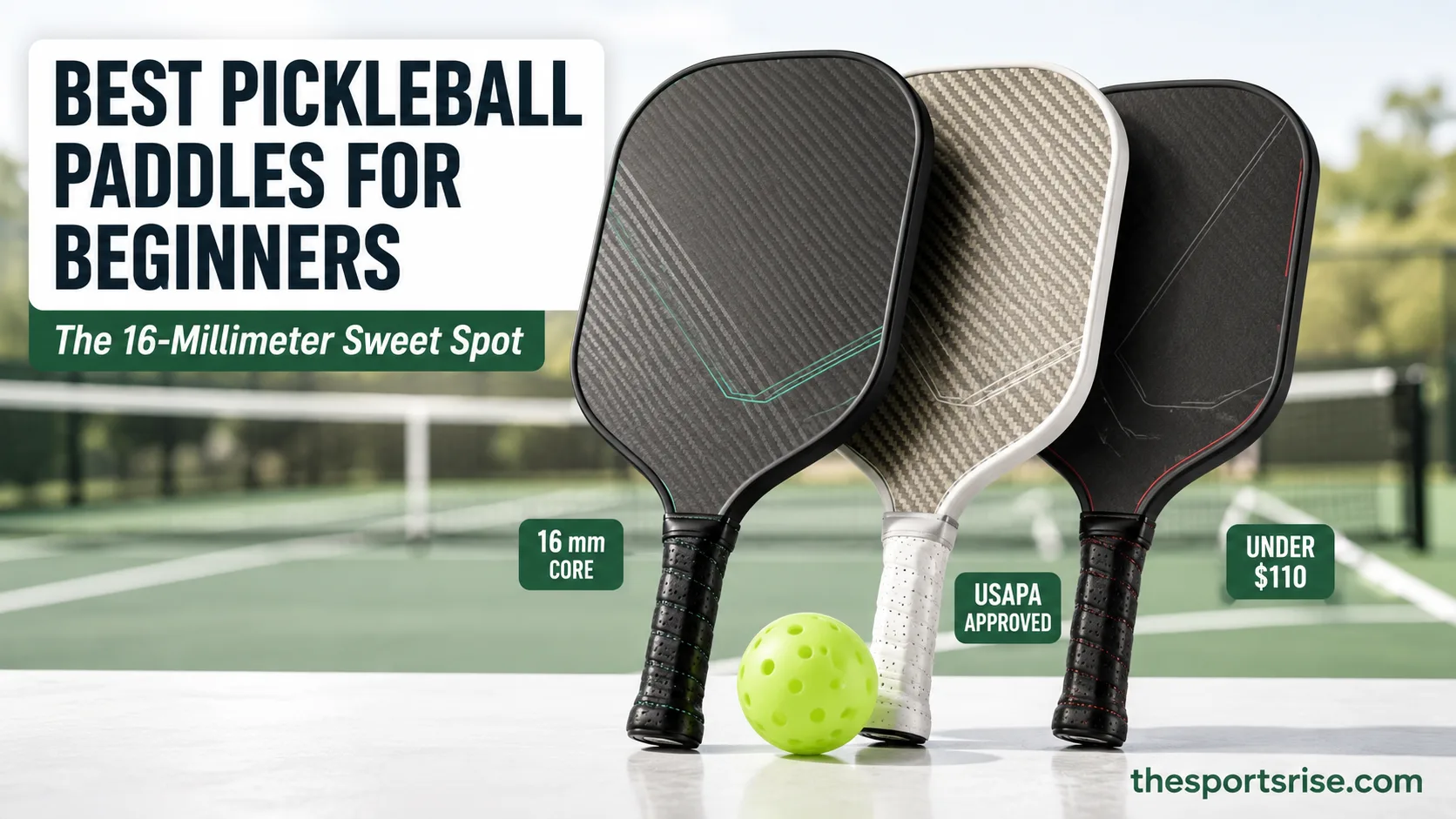
You don't need a $250 paddle to start, and anyone who tells you otherwise is selling something. The best pickleball paddle for beginners in 2026 is a 16mm carbon-faced midweight in the $80 to $110 band, and three paddles fit that brief cleanly: the 11SIX24 Pegasus Jelly Bean at $99.99, the Vatic Pro V-Sol Pro (Flash shape) at $109.99, and the JOOLA Ben Johns Hyperion CFS 16 at $95.95 on sale. Each one is PBCoR .43 certified, the live USA Pickleball power limit for 2026. Each gives a new player the thing that actually wins early points. Control.
Key takeaways
- Control first: A 16mm core delivers more control and a softer feel, so a thicker control core is the single most useful spec a beginner can buy for under $110.
- Best everyday value: The 11SIX24 Pegasus Jelly Bean ($99.99) is a true sub-$100, USA Pickleball-approved paddle with a triple-layer T700 carbon and fiberglass face.
- Weight window: A midweight paddle around 7.3 to 8.0 oz balances power and control, though several strong 2026 picks land at 8.0 to 8.4 oz.
- Face material settled: Carbon fiber buys control and consistent feel; fiberglass buys more power and a lower price, so newcomers chasing accuracy want carbon.
- No amateur weight cap: USA Pickleball's amateur manual sets no weight or thickness limit, so the 10.0 oz and 0.945-inch numbers you'll see online are pro-tour rules, not a ceiling on your recreational paddle.
Pickleball rewards the player who can place the ball, not the one who can crush it. That's the whole logic behind a control-first beginner paddle, and it's why the marketing pressure to spend big is mostly noise. The reassuring part for 2026 is that the gap between a $100 paddle and a $250 paddle has narrowed to something most new players won't feel for months.
What weight pickleball paddle is best for beginners?
A midweight pickleball paddle in the 7.3 to 8.0 oz range is best for most beginners, because it balances power and control without straining the wrist on long sessions. That's the guidance pickleball.com sets out in its paddle buying guide, and it lines up with how the paddle market actually builds beginner gear. Pickleheads buckets weight a touch differently, calling anything 7.6 oz and under lightweight, 7.6 to 8.2 oz midweight, and 8.2 oz and over heavyweight. The practical takeaway is calmer than the debate makes it sound.
Lighter paddles give you faster hands at the net and gentler dink control. Heavier paddles add free power and stability against hard drives, but they tire a new player's arm and can feel clumsy in fast exchanges near the kitchen. Most of the strong 2026 beginner picks land between 8.0 and 8.4 oz, which is heavier than the textbook ideal yet still manageable because the weight sits balanced through the face. If you're coming from tennis with a strong arm, the heavier end is fine. If you've got any wrist or elbow history, drift lighter.
That's the safe default, and I'd start there. But don't treat the number on the box as the verdict. A balanced 8.0 oz paddle with a forgiving face often plays easier than a head-heavy 7.6 oz one, so where the mass sits matters more than the spec sheet. Weight is a starting filter, not the final answer.
Is a 13mm or 16mm paddle better for beginners?
A 16mm paddle is better for beginners than a 13mm one, because thicker cores produce more control and a softer feel while thinner cores under 14mm deliver more raw power and a crisper, less forgiving response. New players don't need more power. They need the ball to behave when they catch it slightly off-center, and a 16mm-plus core absorbs that mishit instead of rocketing it long. Every paddle on this shortlist runs a 16mm core for exactly that reason.
Here's the trade in plain terms. A thinner 13mm or 14mm core pops the ball off the face with more pace, which feels great in a power drive and awful in a soft dink. (Plenty of intermediate players carry a thin paddle for that pop.) The thicker core mutes the trampoline effect, so your third-shot drops land shorter and your resets at the kitchen line die where you want them. That's the 16-millimeter sweet spot, and it's the one spec I'd protect above all others when shopping a first paddle. If you want to understand why so many of those soft shots happen right at the non-volley zone, the kitchen line rules, explained simply guide covers the line that defines beginner strategy.
The best pickleball paddle for beginners: three picks, side by side
Every competitor roundup scatters specs through prose and then hands you a vague "$50 to $100" range that protects nobody's wallet. This decision matrix does the opposite. One normalized table, four specs that actually decide a purchase, three paddles I'd hand a newcomer today. All figures come straight from each brand's own product page.
| Spec | 11SIX24 Pegasus Jelly Bean | Vatic Pro V-Sol Pro (Flash) | JOOLA Hyperion CFS 16 |
|---|---|---|---|
| Price | $99.99 | $109.99 | $95.95 sale / $159.95 MSRP |
| Weight | 8.0–8.3 oz | 8.0 oz | 8.4 oz |
| Core thickness | 16mm | 16mm | 16mm |
| Face material | T700 carbon + fiberglass (3-layer) | Raw Toray T700 carbon | Carbon-Flex5 (CFS) |
| USAP status | Approved, PBCoR .43 | PBCoR .43 certified | PBCoR .43 certified |
What jumps out? Three different brands, three different face recipes, and yet they converge on the same 16mm core and the same legal power ceiling. The Jelly Bean is the only one that's a true everyday sub-$100 paddle without waiting for a sale. The V-Sol Pro's raw Toray T700 carbon face, paired with a floating EPP core and an EVA perimeter foam ring, gives it the plushest feel of the three. The Hyperion is the heaviest at 8.4 oz and the most stable against pace, which is why ex-tennis players gravitate to it.
11SIX24 Pegasus Jelly Bean — best overall value
This is the paddle I'd buy first for almost any new player, and the one that keeps the most money in your pocket without a catch. At $99.99 it's the cleanest combination of price, a USA Pickleball-approved stamp, and a 16mm control core on this list. The face is an 11SIX24 CFC build, three layers, two of raw Toray T700 carbon fiber wrapped around one fiberglass layer. That mix buys you carbon's control with a touch of fiberglass forgiveness. Pickleheads currently names it best overall in its beginner guide, often discounted near $90.
Vatic Pro V-Sol Pro (Flash shape) — best feel
Quick correction worth flagging, because the model name trips people up and the wrong search can send you to the wrong listing. There's no standalone paddle called the "V-Sol Flash." Flash is one of Vatic Pro's hybrid shapes; the product is the V-Sol Pro at $109.99, available in Flash, V7, and Bloom shapes. Its raw Toray T700 carbon face with heat-compressed texturing and that floating EPP core deliver the softest, most plush touch I'd put in a beginner's hand. The Flash shape splits the difference between an elongated and a widebody outline, giving a slightly longer reach without gutting the sweet spot.
JOOLA Hyperion CFS 16 — best for power-leaning beginners
The Hyperion CFS 16 is the value entry in JOOLA's Ben Johns line, not the current flagship (Ben Johns has newer signature paddles). At 8.4 oz with a Carbon-Flex5 textured face and a Hyperfoam Edge Wall for a consistent sweet spot, it's the most stable, most powerful pick here. The catch is price honesty. It's only sub-$100 at its current $95.95 sale; the MSRP is $159.95, so it's not really a budget paddle once the promo ends.
How much should a beginner spend on a pickleball paddle?
A beginner should spend between $50 and $110 on a first pickleball paddle, with $30 to $80 covering a try-it entry purchase and $100-plus marking the step into committed-player gear. That's the assembled range across primary sources: pickleball.com puts entry paddles at $30 to $80, Pickleheads treats $50 to $100 as the beginner sweet spot, and quality 16mm carbon paddles cross $100. No single page maps those numbers to your actual commitment level, so here's the ladder that does, and it's designed to stop you overspending.
| Commitment tier | Spend target | What it buys | Suggested pick |
|---|---|---|---|
| Try-It (casual / unsure) | $30–$80 | A legal, playable paddle to learn the basics on; fiberglass face is fine | A budget pick like the Friday Fever ($79) |
| Committed (playing weekly) | $90–$110 | 16mm carbon control core that won't hold your game back for a year-plus | 11SIX24 Pegasus Jelly Bean ($99.99) |
| Serious (leagues / rating chase) | $110+ | Premium feel, raw carbon faces, foam-perimeter cores, longer durability | Vatic Pro V-Sol Pro ($109.99) or up |
My honest opinion, and I'll plant a flag on it: skip the Try-It tier if you already know you'll play weekly. The $79 budget paddle is real and legal, but you'll feel its harder face inside a month and rebuy, which means you paid twice. Going straight to the $99.99 Committed tier saves money over a year. If you're genuinely unsure whether pickleball will stick, then yes, start cheap and upgrade once you're hooked. Pickleheads lists the Friday Fever at $79 as its current best-budget beginner pick if that's your lane.
Do expensive pickleball paddles make a difference?
Expensive pickleball paddles do make a measurable difference in feel, spin, and durability, but for a true beginner the difference rarely shows up on the scoreboard for the first several months. A $250 thermoformed paddle and a $100 carbon paddle both put a controllable ball over the net. The gap is in raw carbon faces, foam-injected perimeters, and tighter quality control, refinements your dinks and resets can't yet exploit. You'd be paying for headroom you won't reach this year.
Here's where face material settles a common beginner mix-up, and it's the kind of confusion marketing copy loves to leave standing. Carbon fiber provides control, a consistent feel, and good spin at a higher price. Fiberglass produces more power and costs less. So the "carbon equals soft, fiberglass equals touch" idea you'll see repeated online is backwards. If you want accuracy, you want carbon. The standard widebody shape also gives the largest, most forgiving sweet spot for off-center hits, which is why beginner-friendly paddles favor it. Spend up when your soft game has outgrown a $100 paddle, not before. And know that USA Pickleball bans surface features that impart excessive spin, so no legal paddle is hiding an unfair edge you're missing out on.
That line matters because secondary blogs keep blurring two different rulebooks, and the blur can scare you off a paddle you're free to use. A 10.0 oz weight cap and a 0.945-inch thickness limit do exist, but as UPA-A professional-tour guidelines effective in 2025, not as anything in the USA Pickleball Equipment Standards Manual that governs your recreational and amateur play. The amateur manual states there's no restriction on weight and no restriction on thickness, with the real constraints being a 24-inch combined length-plus-width limit and a 17-inch maximum length. The live power test, PBCoR, must not exceed 0.43 as of November 1, 2025, which is the figure to look for in 2026 (the limit dropped from 0.44). Buy on feel and core, not on a pro-tour ceiling that doesn't touch your game.
How do I choose grip size and get set up?
Choose a grip that lets a finger from your non-paddle hand slide into the gap between fingertips and palm when you hold the paddle; if in doubt, size down, because you can always add an overgrip to build it up but can't shave one off. Most beginner paddles ship in a 4 to 4.25-inch circumference, which suits the majority of adult hands. A grip that's too large forces a death grip and kills wrist snap on serves and dinks.
Once the paddle's sorted, the fastest way to enjoy your first sessions is knowing how to keep score, which trips up nearly every newcomer. Our walkthrough on keeping score without the panic covers the three-number call and side-out serving. If you're crossing over from another racket sport, the question of whether your existing gear transfers comes up constantly; the breakdown on whether a padel racket is legal here settles that one (short version: no, the rules don't allow it). For the full slate of first-paddle options as they refresh through the year, the paddle reviews hub tracks new releases, and the broader full pickleball section rounds out rules, strategy, and culture.
Pros, cons, and the verdict on the 16-millimeter sweet spot
Disclosure: thesportsrise.com may earn a commission from qualifying purchases made through links on this page, at no extra cost to you. Our picks are chosen on merit from primary-sourced specs.
The 16-millimeter sweet spot is the through-line of every pick here, and it's the one rule I'd refuse to break for a first paddle. Buy the core, then the face, then worry about weight last. If I had to hand one paddle to a stranger walking onto a court tomorrow, it's the 11SIX24 Pegasus Jelly Bean at $99.99, because it asks no compromise on control, legality, or your wallet.
| Feature | 16mm carbon control paddle | 13mm power paddle |
|---|---|---|
| Off-center forgiveness | High, mutes mishits | Low, punishes mishits |
| Soft game (dinks, resets) | Excellent | Harder to control |
| Best for | Beginners, dink-first players | Aggressive intermediates |
Pros of a 16mm carbon beginner paddle: bigger margin on off-center hits, softer touch for the kitchen game, USA Pickleball-legal at PBCoR .43, and prices that have settled under $110. Cons: less free power than a thin paddle, carbon faces cost more than fiberglass, and the lightest options ask you to generate your own pace. For the player still deciding if the sport sticks, that power trade-off is the only real downside, and the spend ladder above solves it.
Prediction with a date on it: by the end of 2026, expect the everyday (non-sale) price of a 16mm carbon beginner paddle to settle below $90 as foam-core tech trickles down, making the Try-It tier and the Committed tier nearly merge. Watch the 11SIX24 and Vatic Pro listings around the holiday season. So the real call is simple. Don't buy the hype, buy the 16mm core, and start with the $99.99 Jelly Bean instead of the $250 paddle the ads keep pushing. That thicker core isn't going anywhere; it's just getting cheaper to own.
Frequently asked questions
How do I know what size pickleball paddle I need?
USA Pickleball caps a paddle's combined length plus width at 24 inches and limits length to 17 inches, but within that envelope, beginner paddles split into widebody (wider face, biggest sweet spot) and elongated (longer reach, smaller sweet spot). For a first paddle, pick a standard widebody shape and you'll get the most forgiving face on off-center hits, which is exactly what protects a new player's worst swings.
How do I choose a pickleball paddle grip?
Pickleball grip sizes typically run 4 to 4.25 inches in circumference, and the right one lets you slide one finger into the gap between your fingertips and palm. When you're between sizes, choose the smaller grip and add an overgrip, since a too-large handle restricts the wrist snap needed for spin and crisp dinks. Sizing down is the safe, cheap, reversible call.
What is the difference between beginner and intermediate in pickleball?
A beginner paddle prioritizes a 16mm control core and a forgiving widebody face, while intermediate players often switch to thinner 13mm to 14mm cores for added power and elongated shapes for reach. The intermediate jump usually coincides with a reliable soft game, which is the point a thinner, punchier paddle starts paying off rather than just causing errors. Don't pay for that jump before your game asks for it.
Do the UPA-A 10 oz and 0.945-inch limits apply to my paddle?
The 10.0-ounce weight cap and 0.945-inch thickness limit are UPA-A guidelines that govern professional tour competition effective September 1, 2025, not amateur or recreational play. USA Pickleball's amateur Equipment Standards Manual sets no weight or thickness restriction, so a recreational player can use a heavier or thicker paddle without breaking any rule that applies to them. Don't let a pro-tour number talk you out of a paddle that's legal for you.
What does PBCoR .43 mean on a pickleball paddle?
PBCoR is USA Pickleball's Paddle/Ball Coefficient of Restitution test, introduced in Revision 3 of the rules to characterize a paddle's power level. The not-to-exceed limit dropped to 0.43 effective November 1, 2025, so a "PBCoR .43 certified" stamp confirms a 2026 paddle is tournament-legal and not over the current power ceiling. It's the one badge that tells you the paddle won't be ruled out from under you.
Is the JOOLA Hyperion CFS 16 a budget paddle?
The JOOLA Hyperion CFS 16 carries a $159.95 MSRP and only dips under $100 on sale, currently $95.95, so it isn't an everyday budget paddle. It's the value tier of JOOLA's Ben Johns line rather than a true sub-$100 pick; for a permanently sub-$100 option that won't snap back to full price, the 11SIX24 Pegasus Jelly Bean at $99.99 is the safer bet.
Conversation
Be the first to comment.
Leave a comment
Comments are reviewed before appearing. Your email stays private.