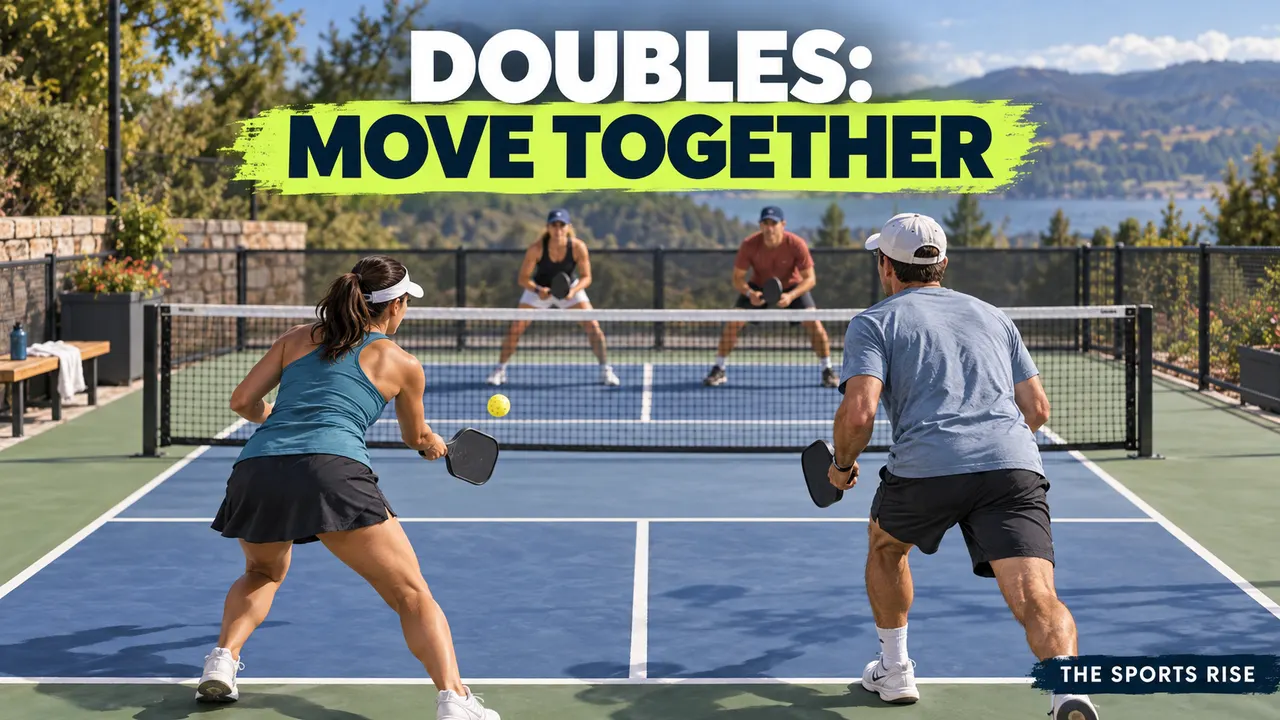
Where to stand in pickleball doubles, shot by shot
Here's where to stand in pickleball doubles in one line: the serving team starts at the baseline, the returning team puts one player up at the kitchen and one back, and everybody's job after that is to get both partners to the non-volley-zone line together. That last part is the whole game. Win the race to the line and you win most of your points.
And it trips up almost every beginner. You serve, you stand there admiring it, and suddenly two opponents are at the net dinking while you're stuck at the baseline. So let's fix your feet. We'll walk the first three shots one at a time, then get you up to the line and keep you there.
Key takeaways
• Serve from the baseline: in pickleball doubles, the server and their partner both start behind the baseline, because the two-bounce rule means nobody can volley the first two shots anyway.
• The return team splits: the receiver stands back to let the serve bounce, while their partner already owns the kitchen line.
• The up-and-up: the goal of every rally is getting both you and your partner up at the non-volley-zone line, side by side.
• The transition zone is a trap: the mid-court between baseline and kitchen is where points go to die, so pass through it; don't park in it.
• Move as one: if your partner slides, you slide; a doubles team is one unit, never two solo players.
Why the two-bounce rule decides your starting spot
Before you can place your feet, you have to understand the rule that places them for you. USA Pickleball's two-bounce rule (Rule 10.A) says the serve must bounce once, and the return of serve must also bounce once, before anyone is allowed to volley. Two bounces. No exceptions for the first exchange.
That single rule explains every starting position on the court. The serving side can't volley the return, so there's no reason for either of them to crowd the net early; they'd just have to back up. And the receiver has to stay deep to let the serve bounce. But the receiver's partner? That player never has to touch the first two shots, so they march straight to the kitchen line and claim it. Asymmetry by design.
Two-bounce rule: the serve and the return of serve must each bounce once before either side may hit the ball out of the air. After those two bounces, volleys are legal. It's the reason the serving team starts deep and the receiving team starts split.
How to position yourself: a step-by-step walkthrough
Picture the court in your head as we go. Baseline at the back, the 7-foot non-volley zone hugging the net, and the no-man's-land in between. Now follow the feet.
1. Step 1, the serve (you're serving): stand behind the baseline, roughly midway between the centerline and your sideline, on the correct side for the score. Your partner stands behind the baseline too, on the other half. Both of you are deep. If you're fuzzy on which side serves first, our guide on what 0-0-2 means at the start clears it up.
2. Step 2, the return (you're receiving): the receiver stands a step or two behind the baseline so the serve can bounce in front of them. Their partner stands up at the kitchen line, paddle ready. This is the split formation: one back, one up.
3. Step 3, the third shot: the serving team hits its third shot (usually a soft drop into the kitchen) and immediately starts moving forward. This is your window. Hit, then go.
4. Step 4, the transition: move up through the mid-court toward the kitchen line, splitting the distance with each ball. Don't sprint blindly. Take a split-step as your opponent strikes, then keep advancing when it's safe.
5. Step 5, the line: arrive at the non-volley-zone line, plant both feet, paddle up around chest height. You and your partner are now side by side, each covering your half. That's the finished picture.
Notice the pattern. Every shot moves you forward unless the ball forces you back. That forward creep is the engine of doubles.
A quick map of every position
Here's the whole thing in one glance, showing where each player stands on the serve and where they're trying to get to.
| Player | Start position (the serve) | Goal position | Why |
|---|---|---|---|
| Server | Behind baseline, on the correct service side | Kitchen line | Can't volley the return, so starts deep, then advances |
| Server's partner | Behind baseline, other half | Kitchen line | Moves up with the server as a pair |
| Receiver | A step behind the baseline | Kitchen line | Stays deep so the serve can bounce, then charges in |
| Receiver's partner | At the kitchen line | Stays at the kitchen line | Never touches the first two shots, so claims the net early |
Common beginner positioning mistakes
Three errors cost newcomers more points than anything else, and all three are about feet, not paddles.
First: parking in no-man's-land. You return serve, then stop halfway up the court because it feels safe. It isn't. Balls land at your feet there and you're an easy target. Pass through that zone, don't picnic in it.
Second: leaving your partner behind. One of you charges the net while the other lingers at the baseline. Now there's a diagonal gap a mile wide, and good opponents will hit straight into it. If your partner can't get up, you come back to them and stay level.
Third: standing still when you're not hitting. The off-ball player isn't a spectator. When your partner slides to cover a wide shot, you slide too, keeping the team tight across the middle.
"Your player position is incredibly important to the game of pickleball." Jaclyn Brandt, PlayPickleball
Brandt's point lands hard for beginners: in a sport where the net battle decides most rallies, the player who reaches the right spot first usually doesn't have to hit a great shot. They just have to hit a steady one from a winning position.
A starter on stacking and switching
Once the basics feel natural, you'll hear two words: switching and stacking. Switching is simple. Partners trade sides during a rally, usually after one of you is pulled wide and it's faster to swap than to scramble back. Call it out loud ("switch!") so nobody collides.
Stacking is the planned version. Both players line up on the same side before the serve, then slide to their preferred halves once the ball's in play, which is handy if one of you has a stronger forehand you want guarding the middle. You don't need it on day one. But knowing it exists means you won't panic when a more experienced pair does it to you. Good court coverage often matters more than a fancy paddle, though a forgiving one helps. See our pick of the best beginner paddles for 2026, and if you're sliding around, our take on whether you need court-specific shoes.
The verdict: live on the up-and-up
If you remember one thing, make it this: the team that gets both players up at the kitchen line, together, wins the rally far more often than not. That's the up-and-up, and it's the entire strategy compressed into a phrase. Serve deep, return deep, then move your feet on every single ball until you're both planted at the line. Get both of you planted at that line and your dinks, drops and resets suddenly have somewhere to live. Want to wire the rest of the game together next? Start with how to keep score in pickleball, then browse the full pickleball hub for more beginner guides.
Written by Miguel Torres, Managing Editor. Every rule and position here was checked against USA Pickleball's official how-to-play guidance and the 2026 Official Rulebook (two-bounce rule 10.A), plus PlayPickleball's player-positions guide. Reviewed by Rahul Gaur. Published June 30, 2026. See our editorial policy and corrections policy. Questions or corrections: editorial@thesportsrise.com.
Frequently asked questions
Where does the server's partner stand in pickleball doubles?
The server's partner stands behind the baseline on the opposite half from the server. Because the two-bounce rule stops the serving team from volleying the return, there's no benefit to rushing the net early. Both players start deep, then move up to the kitchen line together once the third shot is away.
Why does the receiving team start with one player at the net?
The receiver's partner never has to play the first two shots, so they claim the kitchen line immediately. Only the receiver must stay back to let the serve bounce. That split, one up and one back, gives the returning team a built-in head start in the race to the non-volley-zone line.
What is the transition zone in pickleball?
The transition zone is the mid-court area between the baseline and the kitchen line, sometimes called no-man's-land. Balls tend to land at your feet there, making it the worst place to stand still. Move through it toward the net rather than stopping in it.
When should I switch sides with my partner?
Switch when one of you gets pulled wide and it's faster to swap halves than to scramble back into position. Always call it out loud so you don't both chase the same ball. Switching mid-rally is reactive; stacking is the same idea planned before the serve.
How do I get to the kitchen line faster?
Hit your shot, then move forward immediately, taking a split-step each time your opponent strikes the ball. Advance in stages rather than one mad dash. After returning serve, the returning team should be especially quick, since they only have to bring one player up to join their partner.