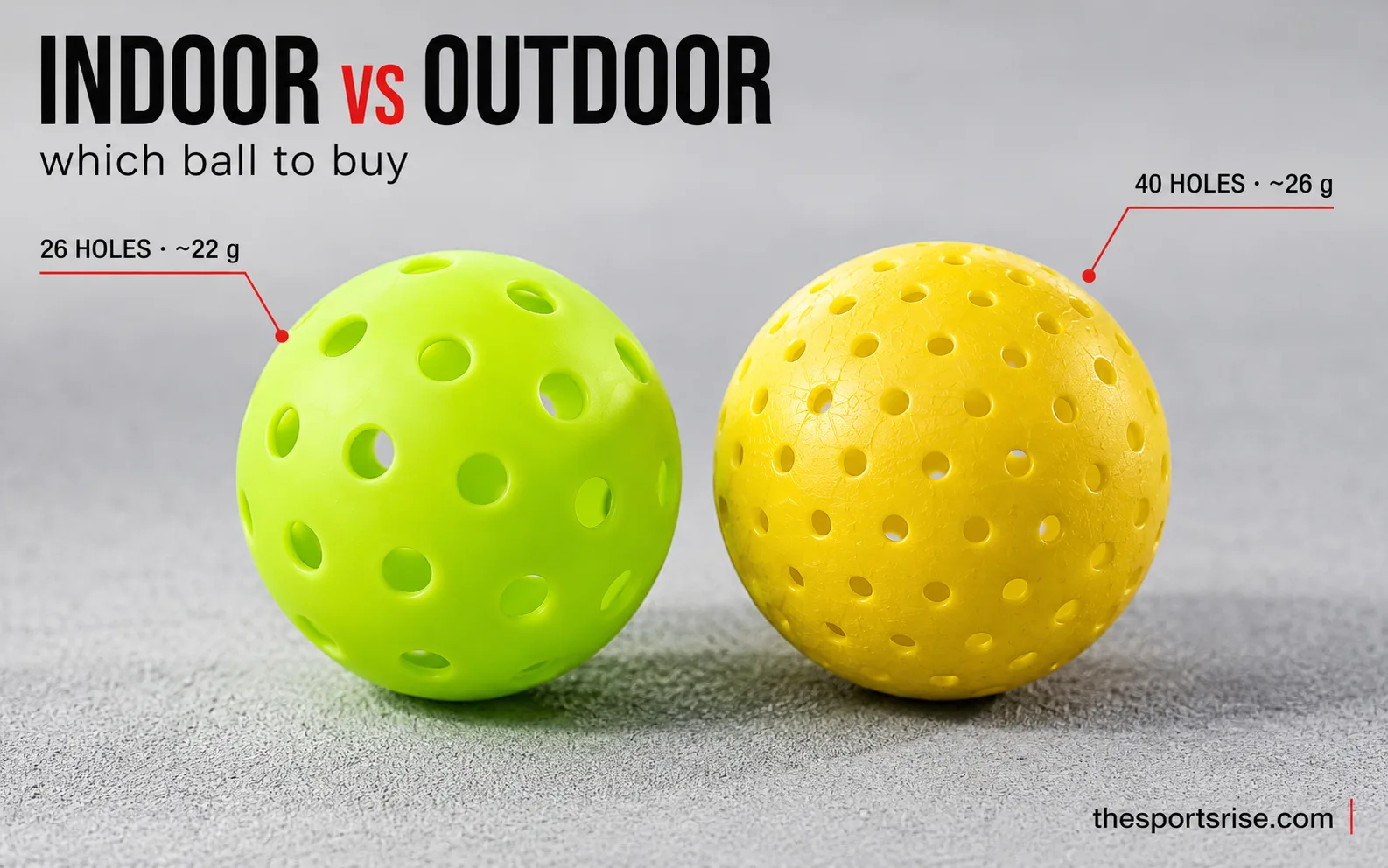
The whole decision comes down to one number, so start there. If you play on a wood gym floor, buy a true indoor ball. If you play anywhere with wind or concrete, buy an outdoor ball. And if you bounce between both on hard courts, an outdoor ball is the safer single purchase. That last point is the one most buying guides skip.
Key takeaways
- Hole count: Indoor pickleball balls carry roughly 26 larger holes; outdoor balls have 40 smaller ones to cut through wind.
- Weight: A USAPA-aligned indoor ball runs about 22.1g; an outdoor ball about 25.5g, so outdoor balls hit harder and drop faster.
- The hard-court default: On most hard surfaces, an outdoor (40-hole) ball is the smarter single buy, even when you sometimes play inside.
- Durability: Soft indoor balls go mushy; hard outdoor balls crack, and cold weather makes both worse.
- Legality: Every USA Pickleball approved ball, indoor or outdoor, meets the same firmness and bounce rule.
Indoor vs outdoor pickleball balls: what 26 vs 40 holes changes
The hole count isn't a gimmick. It's the whole design. An indoor pickleball ball has fewer, bigger holes, so air passes through with less drag and the ball stays light and slow. An outdoor pickleball ball has more, smaller holes, which adds weight and helps the ball hold a straighter line when the wind picks up.
Selkirk puts the trajectory point plainly. As their education team writes, "The additional holes help outdoor pickleballs maintain a straighter trajectory, reducing the impact of gusts and crosswinds on your game." That's the real reason an outdoor ball has 40 holes and not 26. It's weather armor.
That single sentence explains the feel difference better than any spec sheet. Lighter and softer reads as control. Heavier and harder reads as speed and durability. You're choosing one or the other every time you buy a sleeve.
The full spec comparison
These numbers come from Pickleball Warehouse's USAPA-aligned reference, with the design logic cross-checked against Selkirk. No single retailer page lines them all up, so here's the assembled table. Treat the weights and hole counts as typical, not exact for every brand.
| Spec | Indoor ball | Outdoor ball | USA Pickleball rule |
|---|---|---|---|
| Holes | ~26 (larger, beveled) | ~40 (smaller) | 26 to 40 holes |
| Ball diameter | ~2.87-2.90 in | ~2.90-2.97 in | 2.874 to 2.972 in |
| Weight | ~22.1 g (0.78 oz) | ~25.5 g (0.90 oz) | 0.78 to 0.935 oz |
| Plastic feel | Softer compound | Firmer, smoother | 40 to 50 Durometer D at 75-80°F |
| Bounce | Lower, controlled | Livelier, faster | 30 to 34 in from a 78-in drop |
| Wind behavior | Floats, drifts | Cuts through gusts | Single uniform color |
| Wears out by | Going soft, out of round | Cracking, warping | Replace when out of spec |
Notice the weight gap. About 3.4 grams sounds tiny. On court it's the difference between a ball that floats on you and one that punches off the paddle. That same firmness is why outdoor balls outlast indoor balls on rough ground but crack when it gets cold.
Which to buy: the hard-court default
Now the decision. Match the ball to the surface first, then to your weather, and skill level barely matters at all.
Play on a wood gym floor? Buy a true indoor ball. The softer plastic and 26 big holes give you the slower, quieter, more controllable game that suits a sprung floor. A bouncy outdoor ball on wood skids and rattles. The Selkirk guide backs this: indoor balls are built for controlled indoor play, not the elements.
Play outside, or on any open-air concrete court? Buy an outdoor ball, full stop. You need the 40 holes and the extra weight the moment a breeze shows up, and the harder shell survives concrete that would chew a soft ball to bits.
But here's the part that actually decides most purchases. A huge share of "indoor" play now happens on hard gym floors and converted hard courts, not sprung wood. On those harder surfaces a lot of clubs and rec players just default to an outdoor ball indoors, because it survives the floor and behaves like the ball they use everywhere else. That's the hard-court default, and it's why most coaches steer newcomers the same way: if you're not sure, buy outdoor. One ball covers nearly every court you'll meet. Save the soft indoor ball for actual wood.
Can you use indoor balls outdoors? Technically yes, badly. The light ball wanders in any wind and you'll fight it all game. The reverse, an outdoor ball indoors, only feels off on real wood floors where it bounces too hot. So that one-ball-fits-most logic holds in one direction more than the other.
My picks and what they cost
Affiliate disclosure: some links below are affiliate links. If you buy through them, thesportsrise.com may earn a small commission at no extra cost to you. It never changes our pick. All prices are estimates as of June 2026 and shift with pack size and retailer.
Outdoor: The Franklin X-40 is the easy answer. It's the official ball of USA Pickleball and the US Open, weighs in at the regulation ~26.6 grams (0.93 oz), and runs about $1.80 per ball in a 100-count box. For a livelier flight that pros love, the Dura Fast 40 is the classic, roughly $24 to $40 a dozen, though it cracks sooner. The Onix Pure 2 splits the difference at around $17 for a 4-pack.
Indoor: The Onix Fuse Indoor, about $11 for a 3-pack, has welded seams that resist splitting on wood. The GAMMA Photon Indoor runs around $15 for a 6-pack with strong visibility. The Franklin X-26 gives you those 26 beveled holes for even rotation on a budget.
The verdict
- Pros of going outdoor: survives concrete, holds a line in wind, and one ball fits nearly every hard court.
- Cons of going outdoor: the harder plastic cracks and warps, and it bounces too hot on real wood.
- Pros of going indoor: slower, quieter, more controllable on a sprung wood floor.
- Cons of going indoor: it floats and drifts in any breeze, so it plays badly outside.
- Bottom line: not sure? Buy the Franklin X-40 outdoor. Only the real-wood gym crowd needs a true indoor ball.
Pair whatever ball you pick with the right beginner paddle, and if your elbow flares up, a softer arm-friendly setup helps more than ball choice does. New to the game? Get the scoring basics and the non-volley-zone rules down first, make sure you've got court-appropriate shoes, and if you're weighing the sport itself, see how it stacks up in our padel vs pickleball breakdown.
Frequently asked questions
How many holes does an indoor pickleball have versus an outdoor one?
An indoor pickleball has about 26 larger holes, while an outdoor pickleball has 40 smaller ones. USA Pickleball allows any approved ball to fall anywhere in the 26-to-40 range, so the count itself is legal at either end; the design just tunes the ball for its setting.
Can you use indoor pickleball balls outdoors?
You can, but it plays badly. Indoor balls weigh around 22 grams and float in even a light breeze, so they drift off line. Outdoor balls weigh about 25.5 grams with 40 holes specifically to hold a straight path in wind. Outside, always reach for the outdoor ball.
Which pickleball ball should a beginner buy?
Skill level barely matters; surface does. Beginners on outdoor or concrete courts should buy an outdoor ball like the Franklin X-40. Beginners on a wood gym floor should buy an indoor ball such as the Onix Fuse. When unsure, the outdoor ball is the safer single purchase.
Why do outdoor pickleball balls crack so easily?
Outdoor balls use a firmer, smoother plastic to survive concrete and wind, and that same hardness makes them brittle. They crack and warp from drill holes after repeated hard hits, and cold weather makes it worse. Indoor balls instead go soft and lose their round shape over time.
Are indoor and outdoor pickleballs both tournament legal?
Yes, if they appear on the USA Pickleball approved list. Every approved ball, indoor or outdoor, must register 40 to 50 on the Durometer D scale at 75-80°F and bounce 30 to 34 inches when dropped from 78 inches. You match the ball to the court, not to a separate rulebook.
]]>
Conversation
Be the first to comment.
Leave a comment
Comments are reviewed before appearing. Your email stays private.