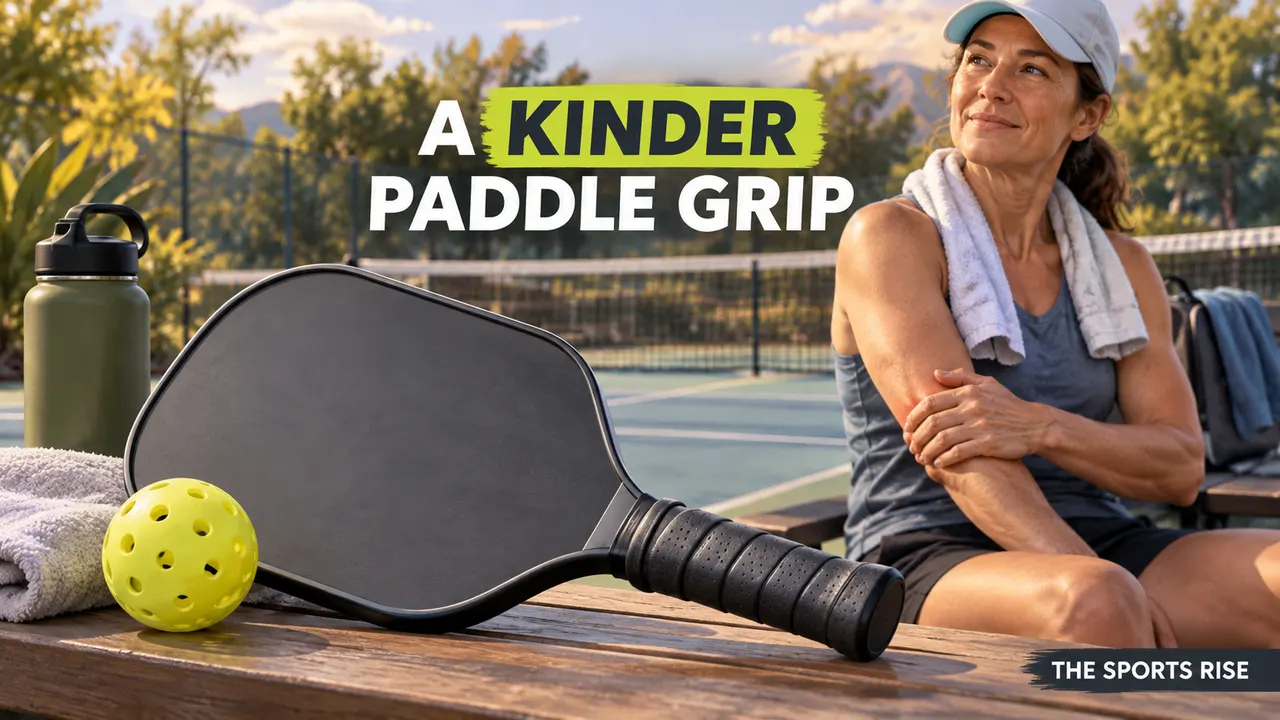
The best pickleball paddle for tennis elbow is a 16mm-core model with a low swing weight (roughly 100-115) and built-in vibration dampening, because that combination absorbs impact shock before it travels up your forearm to the already-irritated ECRB tendon. If your elbow throbs after every session, the paddle in your hand is part of the problem, and a fixable part.
You finish a few games, peel off your grip, and there it is again: that hot, nagging ache on the outside of your elbow that lingers into the next morning when you reach for a coffee mug. You're not imagining it, and you almost certainly don't have to quit. A heavier, stiffer paddle drives more vibration into a tendon that's already inflamed, and swapping to an arm-friendly build is one of the few changes you control today.
Key takeaways
• The lowest-load pickleball paddles pair a 16mm-plus core with a swing weight near 100-115, what we call a low Vibration Tax on your elbow.
• It's swing weight, not static weight, that punishes the ECRB tendon; a paddle can feel heavy on the scale yet light through the swing and still spare your arm.
• ProKennex Kinetic paddles use tungsten-filled perimeter chambers that the brand says cut vibration 43% and shock 20% (a manufacturer claim via MIT Labs).
• A slightly thicker grip lowers how hard you squeeze, which directly reduces forearm load on every dink and drive.
• No paddle cures tennis elbow; technique and workload are the root cause, so pair the right gear with rest and an eccentric-loading routine, and see a physio if pain persists.
How to pick the best pickleball paddle for tennis elbow
For most players in pain, the safest starting point is a thick-core control paddle that keeps swing weight low. Here's the at-a-glance shortlist, then the criteria behind it.
Best overall: a ProKennex Kinetic paddle (Pro Speed line) with tungsten-chamber dampening built for shock absorption, around 8.0 oz. Best budget: a 16mm thermoformed foam-core control paddle in the sub-$120 range. Best for power without the punishment: the JOOLA Graf Pro 16mm, an 8.1 oz, 5.5in-handle paddle tuned for forgiveness. What ties them together: a thick core, a swing weight near the low end, and a grip you don't have to strangle.
Disclosure: thesportsrise.com may earn a commission when you buy through links on this page. It never changes which paddles we recommend or the prices you pay.
What makes a paddle arm-friendly comes down to four levers:
• Low swing weight (target ~100-115) so the paddle isn't fighting your forearm through contact.
• Vibration and shock dampening from perimeter mass, foam edges, or Kinetic chambers that eat impact energy.
• Balanced weighting so mass sits where it absorbs shock, not where it loads your wrist.
• A correctly sized grip that lets you hold, not clench.
Tennis elbow, clinically lateral epicondylitis, is an overuse injury where the forearm tendon that anchors to the outside of your elbow gets damaged from repeating the same motion again and again. In pickleball it shows up from mishits, wristy strokes, and high-vibration paddles loading that tendon shot after shot. The AAOS OrthoInfo guide to lateral epicondylitis lists racquet-sport overload and poorly fitted equipment among the recognized triggers.
The arm-friendly spec matrix: why each feature lowers elbow load
Most buying guides hand you a list of paddles and a price. None of them map the actual specs to why each one spares your arm. So we built the view we wished existed: every arm-relief lever, what to aim for, and the mechanism behind it.
| Spec lever | Arm-friendly target | Why it lowers elbow load |
|---|---|---|
| Core thickness | 16mm or thicker | A thicker core flexes on contact for a plush feel, absorbing vibration that a thin 13mm power core sends straight up the arm. |
| Swing weight | ~100-115 | Lower swing weight means less rotational force resisting your stroke, the main driver of tendon strain. |
| Static weight | ~7.6-8.2 oz | Counterintuitively, a touch more mass helps absorb shock, as long as swing weight stays low, so the paddle does the work, not your elbow. |
| Dampening tech | Kinetic / foam edge | Perimeter chambers or foam walls convert impact energy to heat before it reaches the ECRB tendon. |
| Grip size | Slightly larger | A thicker grip means you squeeze less; less squeeze means less forearm-extensor load on every contact. |
| Face material | Textured carbon fiber | Spin and control from the face let you use the soft game instead of muscling shots, reducing repetitive strain. |
Read that matrix once and the buying logic clicks. You're not chasing the lightest paddle on the rack. You're chasing the lowest Vibration Tax: the hidden shock load every mishit charges your elbow. A paddle that quietly pays that tax for you is worth more than any spin number.
Does a heavier or lighter paddle help tennis elbow?
This is where most shoppers get it backwards. The instinct is to grab the lightest paddle you can find, and it's the wrong instinct.
The number that injures your elbow is swing weight, not static weight. A paddle with slightly more mass in the head can actually absorb more shock at contact, as long as it feels light through the swing. As Drew Pierce of PickleballRookie.com frames it, you want something that swings light but carries enough core to do the heavy lifting for you.
"While a heavier 'static weight' helps absorb shock, a high 'swing weight' causes the injury. Aim for a paddle that feels light to swing but has enough core thickness (16mm+) to do the heavy lifting for you."- Drew Pierce, PickleballRookie.com
That's why a featherweight 7.3 oz power paddle can wreck your arm while an 8.0 oz control paddle soothes it. The lighter stick often has a thin, stiff core and a high swing weight, transmitting every vibration. The heavier one spreads its mass to absorb the hit. Pierce's own guide pins the protective sweet spot at a swing weight of 100 to 115, so check that spec, not just the number on the scale, and treat a missing swing-weight figure as a quiet red flag.
Do thicker 16mm cores really reduce vibration?
Yes, and it's the single clearest spec signal you can shop on. A 16mm core gives a noticeably plusher feel on contact than a thin 13mm power core, which is exactly why gear specialists steer arm-pain players toward the thicker version of almost any paddle.
The mechanism is simple. A thicker polymer core deforms slightly more at impact, spreading the energy over more milliseconds instead of spiking it into a hard, jarring shock. Some control paddles now push to 19mm for an even softer touch, so treat 16mm as the practical floor, not the ceiling. When you settle into the soft game and trade dinks at the kitchen line, that plush core is the difference between a clean, quiet contact and a sting that rides up your forearm.
Pair that core with real dampening and the effect compounds. ProKennex builds Kinetic paddles around micro-tungsten beads embedded in the frame perimeter, designed to soak up vibration before it leaves the paddle. The brand cites an independent MIT Labs study claiming a 43% drop in vibration and a 20% drop in shock, a manufacturer figure rather than an independent verdict, but the engineering direction is sound. If you've already got pain, that's the kind of build worth auditioning, and our wider pickleball gear reviews walk through how these technologies compare in the hand.
Comparison: arm-friendly paddle picks at a glance
Here's how the headline 2026 picks line up on the three specs that decide elbow load. Prices are approximate US retail as of June 2026 and shift with sales, so confirm at the retailer before you buy.
| Paddle | Best for | Static weight | Core | Swing weight | Price (USD) |
|---|---|---|---|---|---|
| ProKennex Kinetic Pro Speed | Best overall (max dampening) | ~8.0 oz | Kinetic core | Low-mid | ~$180-$200 |
| JOOLA Graf Pro 16mm | Best for power without punishment | 8.1 oz | 16mm | Mid | ~$200 |
| Engage Pursuit Pro1 Hybrid | Best overall control pick | ~8.0 oz | 16mm | ~101 | ~$200-$230 |
| Vatic Pro PRISM Flash | Best budget | ~7.9 oz | 16mm | ~114 (top of range) | $99-$120 |
| JOOLA Agassi Pro | Best for power players | ~8.0 oz | 16mm | Mid-high | ~$220-$250 |
If you're brand new and pain-free but want to stay that way, the same logic scales down. Our guide to the best pickleball paddles for beginners leans toward forgiving control builds for exactly this reason.
The "Soft on the Arm" protocol: gear plus the rehab science
No competitor pairs the paddle specs with the actual rehab evidence, so here's the part the buying guides leave out. The right paddle lowers the load; an eccentric forearm routine helps the tendon heal. You want both.
Start with sizing your grip. Hold the paddle and slide your other index finger into the gap between your fingertips and palm. If it slots in snugly, the grip's about right; if your fingers dig into your palm, the grip is too small and you're over-squeezing the ECRB tendon on every shot. A slightly larger grip is the cheapest arm-relief upgrade you'll ever make.
The Vibration Tax, defined: the cumulative shock load your elbow absorbs across thousands of contacts in a session. A thin, stiff, high-swing-weight paddle charges a high tax; a 16mm core with dampening and a right-sized grip charges far less. Lower the tax and the tendon gets a chance to recover.
Then add the rehab side. A systematic review found that eccentric exercise, meaning slow, controlled lowering of the wrist against light resistance, improves pain, function, and grip strength in lateral epicondylitis. The honest caveat: it works best inside a multimodal physio program, not as a solo fix. The orthopedic data is encouraging on the whole, with roughly 80 to 95% of tennis-elbow cases resolving without surgery and forearm strengthening doing real work.
Two or three eccentric moves, a properly sized grip, a 16mm dampened paddle, and managed court time: that's the full Vibration Tax reduction. Padel players fight the same tendon, and the prevention principles carry across, as our breakdown of padel elbow and knee pain lays out.
Pros and cons of switching to an arm-friendly paddle
Changing paddles isn't free, in money or in feel, so weigh it honestly.
| Pros | Cons |
|---|---|
| Cuts vibration to the ECRB tendon on every contact | Thick-core control paddles sacrifice some raw power |
| Lower swing weight reduces forearm strain through the stroke | Premium Kinetic and 16mm models run $180-$250 |
| A right-sized grip lowers squeeze load instantly | Won't fix the underlying technique or workload issue alone |
| Lets you keep playing while the tendon recovers | Heavier static weight takes a few sessions to adjust to |
The honest summary: a better paddle buys you comfort and time, not a cure. Spend the money where it counts, on the dampening and the core, and put the saved effort into your stroke. If you're rusty on the soft game that keeps you off the baseline and out of trouble, brush up on the non-volley zone rules and lean into dinking over banging.
The bottom line: our pick, and a responsible note
If your elbow hurts and you want one paddle to start with, go for a ProKennex Kinetic Pro Speed or an Engage Pursuit Pro1 Hybrid. Both keep the Vibration Tax low with a 16mm core, controlled swing weight, and real dampening. On a budget, the Vatic Pro PRISM Flash gets you most of the way for around $100. Add a slightly larger grip and you've covered the gear side completely.
One firm word of care. A paddle is a load-reducer, not a treatment. The root cause sits in your technique and your workload, and the wrong stick or the wrong stroke can keep the pain alive no matter what you spend. If the ache lingers past a couple of weeks of rest and gear changes, stop self-managing and see a physiotherapist. You came here worried you'd have to give up the game. You almost certainly don't. You just need the paddle to start carrying its share of the work, and your elbow to get a little help. Once you're back at the kitchen pain-free, keeping score the right way is the easy part.
Written by Miguel Torres, Managing Editor. Every figure here was checked against the AAOS OrthoInfo lateral-epicondylitis page, Cleveland Clinic, a SAGE systematic review on eccentric exercise, ProKennex and JOOLA official specs, USA Pickleball, and Pickleheads. Published June 28, 2026. Questions or corrections: editorial@thesportsrise.com.
Frequently asked questions
Is it okay to play pickleball if you have tennis elbow?
Playing pickleball with mild tennis elbow can be okay if you reduce load: switch to a 16mm dampened paddle, lighten your grip, and cut session length. Racquet sports and improper equipment are recognized risk factors, so if pain sharpens during or after play, rest the elbow and see a physiotherapist before continuing.
What's the difference between tennis elbow and pickleball elbow?
There's no medical difference. "Pickleball elbow" is just tennis elbow (lateral epicondylitis) earned on a pickleball court. Both describe overuse damage to the same ECRB tendon on the outside of the elbow. The cause is identical: repetitive strain from the same stroke pattern repeated thousands of times.
Can the right paddle cure tennis elbow?
No paddle cures tennis elbow. The root cause is technique and workload, not gear, so equipment can only lower the load while the tendon heals. The encouraging part: roughly 80 to 95% of tennis-elbow cases resolve without surgery when you combine rest, an arm-friendly paddle, and forearm strengthening exercises.
Does a thicker grip really help tennis elbow?
Yes. A slightly thicker grip means you don't have to squeeze the handle as tightly, and grip squeeze directly loads the forearm extensor muscles that feed the ECRB tendon. Sizing up by even one increment, or adding an overgrip, is one of the cheapest and fastest ways to reduce elbow strain on court.
What is the most common injury in pickleball?
Soft-tissue overuse injuries lead the list, with lateral epicondylitis (tennis elbow) among the most common upper-body complaints, alongside ankle and wrist injuries from falls. Tennis elbow stands out because it builds gradually from repetitive strokes rather than a single moment, which is why paddle choice and technique matter so much.
Legacy product comparison data
These are historical source claims, prices and ratings. They have not been presented as new product tests or current offers.
ProKennex Kinetic Pro Speed
Kinetic-core paddle with micro-tungsten perimeter chambers that the brand says cut vibration 43% and shock 20% (MIT Labs claim). Around 8.0 oz, with the paddle's mass doing the impact work instead of your arm. Best overall for maximum dampening. Price approximate as of June 2026.
| Brand | Currency | Source low price | Source high price | Source rating | Source rating count |
|---|---|---|---|---|---|
| ProKennex | USD | 180.0 | 200.0 | None | None |
JOOLA Graf Pro 16mm
16mm-core, 8.1 oz paddle with a 5.5in handle, textured carbon-fiber face, and TechFlex Power weight distribution for smooth, forgiving handling. Best for players who want power without the elbow punishment. Price approximate (~$200) as of June 2026.
| Brand | Currency | Source low price | Source high price | Source rating | Source rating count |
|---|---|---|---|---|---|
| JOOLA | USD | 190.0 | 210.0 | None | None |
Engage Pursuit Pro1 Hybrid
16mm control paddle with a low swing weight around 101, ranked best overall on the top tennis-elbow guides for its plush, arm-sparing contact feel.
| Brand | Currency | Source low price | Source high price | Source rating | Source rating count |
|---|---|---|---|---|---|
| Engage | USD | 200.0 | 230.0 | None | None |
Vatic Pro PRISM Flash
Budget 16mm thermoformed paddle. Independent testers measure swing weight around 114, the top of the arm-friendly 100-115 band, so it swings a touch heavier than ultralights but still inside the protective range, with a soft contact feel for around $100. Best budget arm-friendly pick.
| Brand | Currency | Source low price | Source high price | Source rating | Source rating count |
|---|---|---|---|---|---|
| Vatic Pro | USD | 99.0 | 120.0 | None | None |
Legacy comparison notes
Pro: Cuts vibration to the ECRB tendon on every contact
Pro: Lower swing weight reduces forearm strain through the stroke
Pro: A right-sized grip lowers squeeze load instantly
Pro: Lets you keep playing while the tendon recovers
Con: Thick-core control paddles sacrifice some raw power
Con: Premium Kinetic and 16mm models run $180-$250
Con: Won't fix the underlying technique or workload issue alone
Con: Heavier static weight takes a few sessions to adjust to